
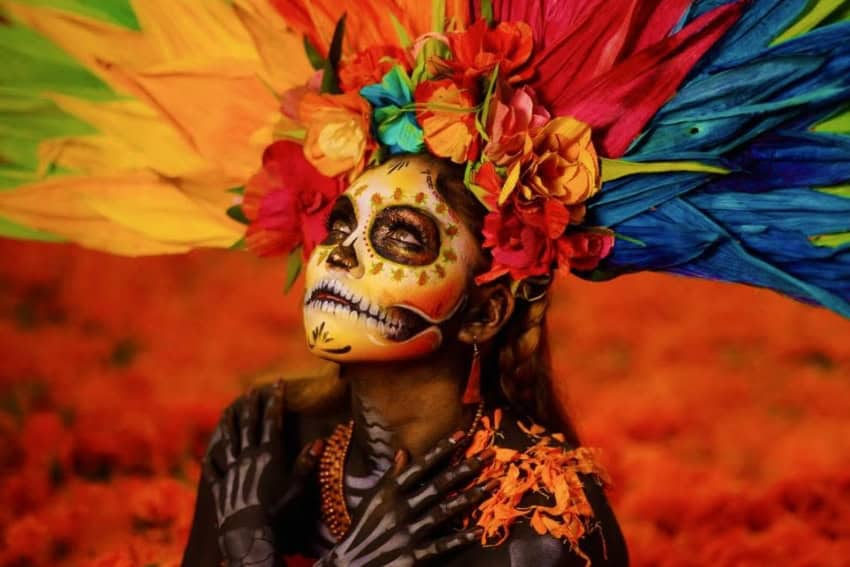
When we started working around Día de Muertos in 2019, none of us imagined where it would lead. At the beginning, we were simply a group of friends traveling through different parts of Mexico, creating Catrina makeup, putting together wardrobe and photographing the results against landscapes we loved. There was no elaborate business model behind it. We enjoyed creating characters, traveling and showing a little of Mexico through photography. Eventually, people began asking if they could take part in what they were seeing. A photo session slowly became an experience. Visitors wanted makeup, but they also wanted to understand where the tradition came from. They wanted to visit the places we photographed, try the food, meet local people and experience Día de Muertos beyond the image they had seen online. That changed our work considerably. Over the following years, we began incorporating photography, transportation, lodging, traditional food and tours with certified guides. The makeup was still important, but it became one part of something larger. By 2024, the Catrina market had also changed. There were many more artists offering Día de Muertos makeup and photography, and for a while I wondered whether it was time for me to stop doing it altogether. Instead, I decided that we needed to evolve. I became less interested in making another Catrina portrait and more interested in building complete worlds around the people we photographed. Building El Viaje de las Ánimas One of the projects that pushed that idea further was El Viaje de las Ánimas. Day of the Dead in photos: Color and light fill streets and homes as Mexico remembers loved ones lost The project had been in my head for years. It actually came from a dream, and I kept the idea almost entirely to myself while I tried to save enough money to produce it properly. For around four years, I thought about how to turn that image into something physical. When we finally made it, almost everything had to be real. The Catrinas were real models. The cempasúchil was natural. We needed costumes, makeup, transportation, lodging and a large amount of coordination. The production took place in Xochimilco. We rented three trajineras for more than 11 hours and moved large quantities of cempasúchil into the location. More than 12 people were involved. Seeing something that had existed in my imagination for years finally become real was incredibly satisfying. It was also expensive and logistically difficult. That experience made me much more aware of the relationship between an idea and the resources needed to execute it. Sometimes the image you want to create only exists for a few hours, yet reaching that moment can require years of savings, weeks of preparation and a large team. I began thinking about what else we could create if those physical limitations were different. Learning AI instead of expecting instant results I became seriously interested in artificial intelligence at the beginning of 2026. Like many people, I started by experimenting, and, honestly, my first results were not very good. The images could be interesting, but they did not have the consistency, quality or level of control I expected. Characters changed between shots. Locations changed. Cameras behaved unpredictably. A scene that looked good on its own often did not work when placed next to another scene. That was when I realized how different generating an image is from telling a story. I decided to slow down some of our regular Catrina productions and travel projects and dedicate more time to studying these tools. There was a lot to learn. If a character walks into a room, where is the door? If the camera cuts to the opposite side, is the geography still correct? If the same person appears five minutes later, do they still look like the same person? If a dog follows someone through several scenes, does its behavior make sense? These may sound like very basic filmmaking questions, but generative models do not necessarily solve them for you. One idea I began exploring during this period was something I call “Sacred Nature.” The concept came from looking at things we see every day — flowers, landscapes, plants — and asking what would happen if we treated them as something monumental. An example of “Sacred Nature” as it applies to Día de Muertos celebrations. (Ale Su Art) Instead of using nature as background decoration, I wanted it to dominate the frame: giant flowers, exaggerated natural environments and landscapes that made familiar elements feel extraordinary. AI gave me a way to experiment with that scale without physically building everything. Adding AI to the work we already had We now use AI in several parts of our workflow, although we are still learning constantly. Sometimes it is very practical. We can recover an image that was slightly blurred, refine details, assist with video editing or reconstruct a shot that did not work as expected. During high season, it can also help us deliver photography more quickly while maintaining the visual identity we have developed with our photographers over the years. Other times, AI allows us to take an existing production somewhere completely new. A real portrait can inspire an environment that would have been impossible for us to build physically. An idea that would once have required a huge set can now be tested before we invest in making it real. I do not see that as replacing our previous work. We still work with real makeup, real flowers, photography, travel, models and cultural experiences. Those things remain central to what we do. AI simply gave us another tool. The author’s new Día de Muertos-themed film is titled “Cada Noviembre.” (Ale Su Art) The most important result of that evolution so far has been “Cada Noviembre.” The real stories behind ‘Cada Noviembre’ “Cada Noviembre” was inspired by three different experiences. The first happened in Oaxaca. One of the things I love about traveling during Día de Muertos is how easily people begin talking to you. There is often a warmth and openness that leads to conversations you would never expect. During one of those trips, we met a man who told us he was the last living member of his family. Every year he visited the cemetery and went from grave to grave, remembering the relatives who were no longer there. He had even purchased his own grave. He wanted to prepare it himself and know what it would look like before the day came when he would occupy it. I never forgot that conversation. Years later, it became the foundation for Juan, the main character in “Cada Noviembre.” The second part of the story came from my own life. Juan suffers from a progressive pulmonary illness. I chose that because of my own experiences with pulmonary hospitals and because of the people I have met there. What happens when a dog loses someone it considers part of its family? That question and the relationship that ensues is central to “Cada Noviembre.” (Ale Su Art) When you spend time in hospitals, you hear stories. You see other families. You begin to understand how differently illness changes everyday life. Film frequently uses cancer to represent serious illness. I wanted to talk about something I knew more personally. The third element was the dog. I kept thinking about a simple question: What happens when a dog loses the person it considers its family? In the film, Juan initially does not want the stray xoloitzcuintle following him. Over time, however, the animal becomes part of his routine. They walk together. The dog waits for him. Their relationship develops quietly until companionship becomes family. I wanted that relationship to feel ordinary rather than magical. The xolo does not understand death like a person. It simply remembers routines. For me, that made the ending much stronger. Making the film We made “Cada Noviembre” in approximately three weeks with a team of five people. Three people worked on sound, one person supported editing and post-production, and I handled the generative visual production. I wrote the screenplay, directed the project, developed the characters and created the AI-generated video sequences. Opinion: Mexico is AI’s secret weapon It was a very intense three weeks. The biggest challenge was continuity. Juan could not suddenly become another person between scenes. The cemetery needed to remain geographically consistent. The xolo had to look and behave like the same animal. Juan’s house, his cane, the photographs, flowers and lighting all had to remain recognizable. Even Juan’s walking pace mattered because his illness progresses throughout the film. Sometimes we generated a shot where the performance worked perfectly but the camera angle was wrong. Other times the picture worked and the audio did not. We learned to reconstruct certain shots instead of throwing everything away and starting again. The process became much closer to filmmaking than I initially expected. There were scripts, revisions, continuity problems, sound problems, editing decisions and many failed takes — except our “takes” were generations. A Mexican story traveling internationally Today, “Cada Noviembre” is participating in an international AI film festival. What makes me proud is not simply that it was made with artificial intelligence. What matters to me is that Día de Muertos is at the center of it. This is the same culture we began working with when we were painting Catrinas with friends in 2019. The author’s focus remains rooted in Día de Muertos and its unique place in Mexican culture. (Ale Su Art) Then we traveled through Mexico. Then we created cultural experiences. Then came El Viaje de las Ánimas, which we built almost entirely in the physical world. Now we are telling a complete cinematic story using another set of tools. The film has received responses from people in Mexico, the United States and other countries. Some identify with Juan’s illness. Others have lost parents or grandparents. Others simply recognize the loyalty of a dog waiting for someone it loves. That response has convinced me that technology is not the part people ultimately remember. They remember the story. What AI changes, and what it does not Artificial intelligence has made things possible for us that would have been financially unrealistic only a few years ago. A small independent team can now attempt visual ideas that once might have required a much larger production budget. That is exciting. But I also think people underestimate how much human work remains. AI does not know why Juan matters. It does not know what Día de Muertos means to my family or to the people we have met throughout Mexico. It does not automatically understand when a cultural detail feels authentic and when it feels like a stereotype. Those decisions still belong to us. For our team, AI is not a replacement for the work we have done since 2019. It is part of its evolution. We still want to travel. We still want to work with flowers, makeup, photography and real people. We still want to create physical experiences. Now we can also take the stories we discover along the way and imagine them at a scale that previously felt impossible. We started with Catrina makeup. Today, we are making films. The tools have changed considerably, but the reason we create has stayed surprisingly simple. We want to tell stories about Mexico and find new ways to share them with the world. Alejandro Su is a contributor to Mexico News Daily.
From real-world Catrinas to AI cinema: An artist’s next Día de Muertos chapter
Full Article
Original Source
Read the full article at Mexiconewsdaily →KhanList aggregates and links to publicly available news content. We do not host full articles from third-party sources. Always verify important information with original sources.