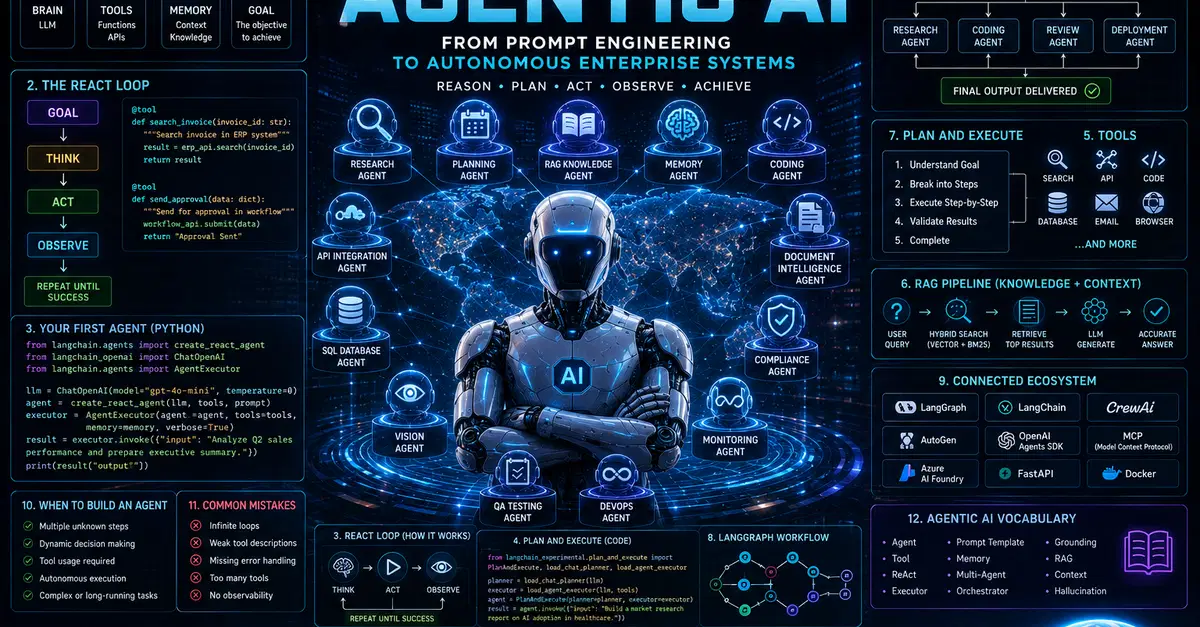
Over the last few months, I've been diving deep into Agentic AI, building production-ready AI systems that don't just answer questions—they think, plan, reason, use tools, collaborate, and complete goals autonomously. While exploring an excellent Agentic AI cheat sheet, I reflected on how these concepts map to real-world enterprise applications. Here's my engineering perspective. 1️⃣ What is Agentic AI? Traditional LLMs generate responses. Agentic AI goes beyond that. It understands an objective, creates a plan, selects tools, executes tasks, observes results, retries when needed, and stops only after achieving the goal. Example: ❌ "Summarize this invoice." vs ✅ Read invoices → Extract data → Validate against ERP → Detect duplicates → Send for approval → Post into SAP → Notify Teams. That's an AI Worker. 2️⃣ Every Agent Needs Four Building Blocks Every production AI agent consists of: 🧠 Brain (LLM) 🛠 Tools 🧠 Memory 🎯 Goal Without any one of these, your agent becomes unreliable. 3️⃣ The Think → Act → Observe Loop This is the heart of Agentic AI. Goal │ Think │ Act │ Observe │ Need more work? │ Yes ───────► Think again │ No ▼ Finish Enter fullscreen mode Exit fullscreen mode This ReAct pattern enables autonomous reasoning and iterative problem solving. 4️⃣ Your First AI Agent A simple ReAct agent can be created in just a few lines. from langchain.agents import create_react_agent from langchain_openai import ChatOpenAI llm = ChatOpenAI(model="gpt-4o-mini") agent = create_react_agent( llm=llm, tools=tools, prompt=prompt ) Enter fullscreen mode Exit fullscreen mode Behind these few lines is an execution loop that reasons, chooses tools, and iterates until the objective is met. 5️⃣ Tools Give Agents Superpowers Without tools... An LLM only generates text. With tools... ✅ Search APIs ✅ Databases ✅ SQL ✅ Python ✅ SAP ✅ Jira ✅ Email ✅ Browser Automation Example: @tool def search_invoice(invoice_id: str): ... Enter fullscreen mode Exit fullscreen mode A well-written tool description helps the agent know when to invoke it. 6️⃣ Memory Makes Agents Smarter Real enterprise agents require memory. • Short-term memory • Long-term memory • Entity memory Memory enables context retention across interactions and workflows. 7️⃣ Planning Before Execution Complex objectives should be decomposed before execution. Instead of: Do everything Enter fullscreen mode Exit fullscreen mode Use: Plan ↓ Execute Step 1 ↓ Execute Step 2 ↓ Execute Step 3 Enter fullscreen mode Exit fullscreen mode Plan-and-Execute improves reliability for long-running tasks. 8️⃣ Multi-Agent Systems One giant AI agent isn't always the answer. A better approach is specialization. Manager Agent │ ┌────┼────┐ │ │ │ Research Coding Review Agent Agent Agent │ Final Output Enter fullscreen mode Exit fullscreen mode Each agent owns a specific responsibility, improving scalability and maintainability. 9️⃣ Choosing the Right Framework Different frameworks excel at different problems: ✔ LangGraph → Complex orchestration ✔ LangChain → Flexible pipelines ✔ CrewAI → Role-based collaboration ✔ AutoGen → Conversational agent teams ✔ OpenAI Agents SDK → Rapid prototyping Choose based on architecture, not popularity. 🔟 When Should You Build an Agent? Don't force an agent into every use case. Use an agent when: ✔ Multiple unknown steps ✔ Dynamic decision making ✔ Tool usage ✔ Autonomous execution Otherwise, a prompt or workflow chain may be sufficient. 1️⃣1️⃣ Common Mistakes Avoid: ❌ Infinite loops ❌ Weak tool descriptions ❌ Missing error handling ❌ Too many tools ❌ No observability In production, also invest in: • Logging • Tracing • Cost monitoring • Human approvals • Guardrails • Evaluation metrics 1️⃣2️⃣ Learn the Vocabulary A few foundational concepts: • Agent • Tool • ReAct • Executor • Prompt Template • Memory • Multi-Agent • Orchestrator • Grounding Mastering these terms makes it easier to design, communicate, and debug agentic systems. 💡 My Engineering Stack 🚀 LangGraph 🚀 LangChain 🚀 Azure AI Foundry 🚀 Azure OpenAI 🚀 OpenAI Agents SDK 🚀 MCP (Model Context Protocol) 🚀 RAG 🚀 Hybrid Search 🚀 FAISS / Chroma / Milvus 🚀 PostgreSQL 🚀 FastAPI 🚀 Docker 🚀 Langfuse 🚀 CrewAI 🚀 AutoGen Final Thought The next generation of software won't just expose APIs—it will reason, collaborate, and execute. The future belongs to engineers who can architect autonomous AI systems, not just prompt LLMs. Keep building. Keep experimenting. The Agentic AI era has only just begun. 🔥 Hashtags AgenticAI #SeniorAIEngineer #GenerativeAI #ArtificialIntelligence #LangGraph #LangChain #MultiAgentSystems #OpenAI #AzureAI #AIFoundry #RAG #HybridSearch #MCP #CrewAI #AutoGen #Python #MachineLearning #LLM #SoftwareEngineering #Innovation
# 🚀 From Prompt Engineering to Autonomous AI Systems
Full Article
Original Source
Read the full article at Dev →KhanList aggregates and links to publicly available news content. We do not host full articles from third-party sources. Always verify important information with original sources.