
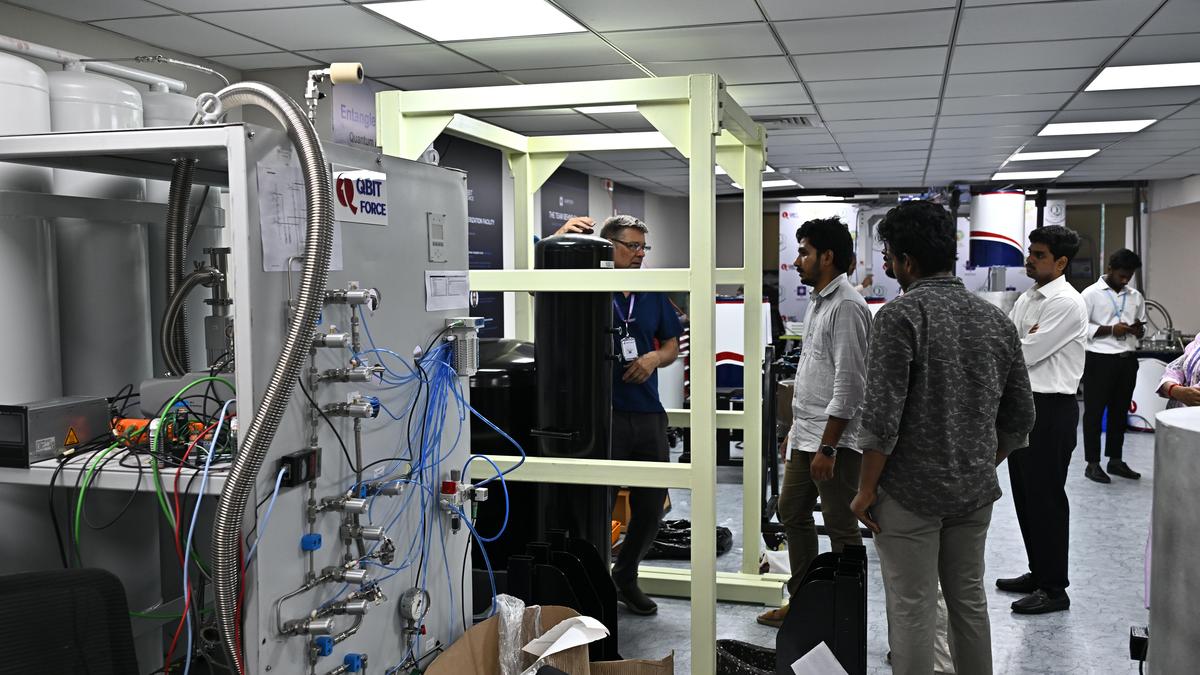
A quantum processor cooled to near absolute zero draws headlines, yet hardware alone does not build an industry. Its real value depends on the researchers, institutions, and policies surrounding it.When Chief Minister Nara Chandrababu Naidu outlined his vision for the Amaravati Quantum Valley (AQV), a project backed by Prime Minister Narendra Modi, the goal extended well past installing isolated machines. C.V. Sridhar, Mission Director of Andhra Pradesh State Quantum Mission, highlighted that buying a quantum computer will not trigger an innovation wave on its own. Long-term leadership requires linking basic research, commercial applications, policy incentives, and specialised talent under one roof.To put Amaravati among the top five global quantum hubs by 2030, competing alongside established centres in Chicago, Munich, Singapore, and Australia, Andhra Pradesh started with regulation.First Indian State to unveil quantum policyIt became the first Indian State to introduce a dedicated Quantum Policy, reinforced by the cabinet-ratified Amaravati Quantum Valley Declaration. Instead of falling back on traditional IT service delivery models, the policy pushes for original R&D and homegrown intellectual property.Last year, the mission brought together nearly 95% of India’s leading quantum researchers, including more than 300 senior scientists, and national mission leaders to draft its roadmap.While National Quantum Mission hubs at IIT Madras, IISc Bengaluru, IIT Bombay, and IIT Delhi focus on foundational science, Amaravati is designed to act as the commercial engine that turns lab discoveries into deployable products.That blueprint is already drawing major institutions to the region. National research agencies, including DRDO, C DAC, C DOT, and CSIR (which has mapped out 15 specialised quantum laboratories), are establishing local operations. Global corporations, international organisations, and Indian startups have also signed on. The roster includes IBM, TCS, L&T, AstraZeneca, Pasqal, the UN International Computing Centre, and the Frugal AI Hub, alongside emerging quantum firms such as Qbit Force, QuBeats, Qlairvoyance, CybraneX, and Qubitech. Startups like QKrishi, Qute, Electronics, Quantum AI Global, TriQuanta Labs, Atomionics and many more joined.Financial institutions are already testing practical use cases nearby. In Vijayawada, HDFC Bank runs a 200-person Centre of Excellence dedicated to quantum AI applications, while Punjab National Bank has opened its own quantum facility. Supporting these centres, the active Quantum and AI Centre (QAIC Hub) and a proposed unified State Data Lake will provide the large datasets needed to run AI and quantum workloads side by side.Alliances and infrastructure still rely on a steady supply of engineers. Because quantum technology demands rare interdisciplinary training, the State launched an aggressive skilling program that has reached more than 1,04,000 professionals so far.Local universities are reinforcing that pipeline. NIELIT is rolling out joint AI and quantum programs with Acharya Nagarjuna University, and SRM University AP provides open access lab facilities and practical training. Meanwhile, transit incubation centres are steadily filling up as early-stage startups prepare to scale.With early policy backing, large-scale workforce training, national labs, and private sector partners now aligned, Amaravati is positioning itself as a practical testbed where Indian researchers can move quantum computing from theory into everyday commercial use.
From policy to talent: Amaravati Quantum Valley’s innovation blueprint
Full Article
Original Source
Read the full article at Thehindu →KhanList aggregates and links to publicly available news content. We do not host full articles from third-party sources. Always verify important information with original sources.