
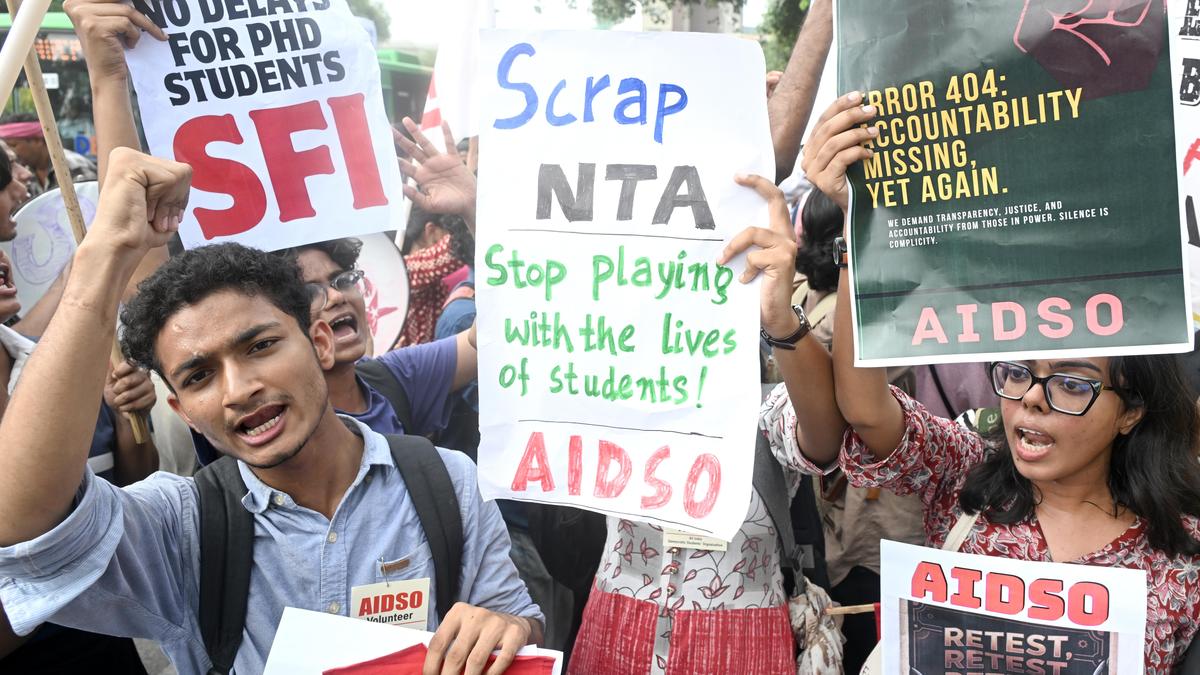
NTA has increasingly relied on biometrics, CCTV, encrypted communication, GPS tracking, digital authentication, and AI-enabled surveillance to secure examinations. | Photo Credit: SHASHI SHEKHAR KASHYAP Despite successive committees, reforms, tougher laws, security measures, and increasing use of technology, breaches and irregularities continue to haunt India’s high-stakes examinations. The recurring failures suggest that the problem lies deeper than security or technology: does the examination system have the academic competence, process integrity, and institutional accountability needed to protect the examination from question setting to results? The issue is not merely how to secure an examination, but how to make the entire examination ecosystem trustworthy.(Sign up for THEdge, The Hindu’s weekly education newsletter.)The National Testing Agency (NTA) has an unusual institutional character: it combines traditional bureaucracy with academic expertise, with both playing major roles in the examination process. Its administrative machinery comprises its own officers, officers on deputation, and personnel engaged on tenure or contractual terms. Much of its academic work — including question setting and related functions — is entrusted to external academics, largely on a per-project or per-assignment basis, rather than through a permanent salaried academic structure.Bureaucracy provides continuity, scale, hierarchy, and procedural control. Its natural emphasis is on compliance with prescribed SOPs and rules. Academia, in contrast, rests on professional competence, autonomy, and individual integrity, with relatively less emphasis on hierarchy. Genuine academics are expected to exercise independent judgment and not compromise professional standards merely to satisfy a procedure.The distinction is fundamental: bureaucracy derives authority largely from office, hierarchy, and procedure; academia derives it from individual competence, professional standing, and intellectual judgment. Both are necessary. But applying one’s own norms to the other’s functions can produce serious anomalies. A bureaucratically compliant system can still be academically deficient; an academically autonomous system can still lack institutional controls. Published - September 10, 2026 08:30 am IST
From paper leaks to policy failures: the academic cost of NTA’s bureaucracy
Full Article
Original Source
Read the full article at Thehindu →KhanList aggregates and links to publicly available news content. We do not host full articles from third-party sources. Always verify important information with original sources.