
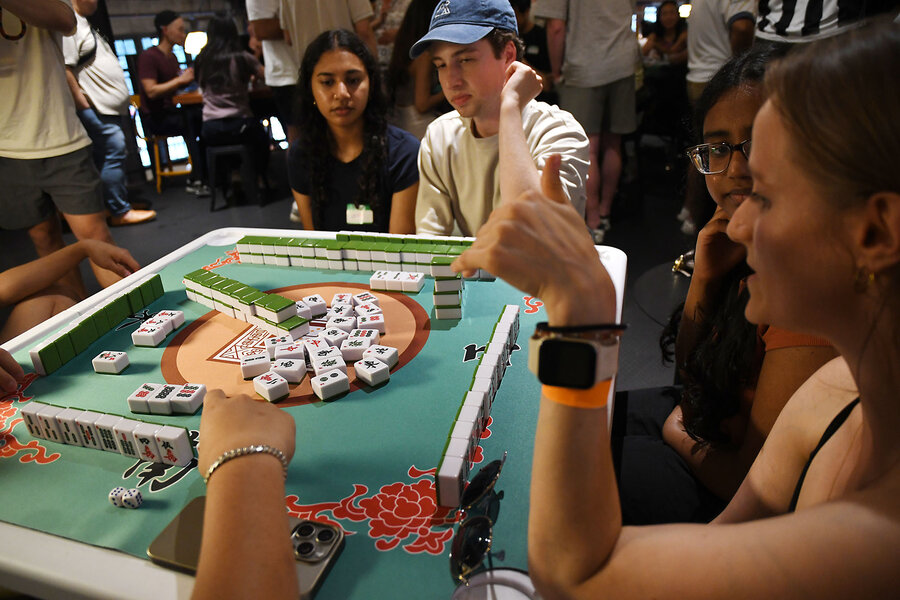
It’s a warm weeknight in Seattle’s trendy Capitol Hill neighborhood, and hundreds of 20-somethings cluster around green felt table tops, talking and laughing as they clack the white tiles of a 19th-century Chinese game. The Emerald City Tile Club began last year with just a handful of mahjong players, and quickly “blew up,” says founder Sean Herrera. These days, it meets twice a month, and table reservations are snapped up within minutes.Chinese culture suddenly seems everywhere, from the mahjong groups springing up nationwide to the surging interest in Chinese trinkets and video games. On social media, Westerners extol the benefits of “Chinamaxxing” by embracing traditional Chinese wellness habits, such as wearing house slippers, and influencers beam gee-whiz China tours to millions of viewers – helping amplify an idealistic, state-sanctioned image of the Asian superpower. Why We Wrote This Americans are embracing Chinese culture with an enthusiasm not seen since before the pandemic. The shift, welcomed and promoted by Beijing, comes as China works to raise its global standing and displace the U.S. as the world’s preeminent superpower. In sharp contrast to the pandemic years, when the country’s popularity hit rock bottom, China and many things Chinese are now regaining favor in the American mainstream. Polls show that the percentage of Americans with positive views of China, while still a minority, has nearly doubled since 2023, with young people’s attitudes the most favorable. Beijing is taking note, as are ordinary folks in China. “It’s good that Chinese culture is being absorbed and inherited – before it was suppressed and ignored,” says Wang Feifei, a teacher from China’s southern Anhui province, posing for photos with her sister in traditional Chinese garb at the Temple of Heaven in Beijing.“Foreigners come to learn some of our Chinese culture, understand some of our customs and lifestyles, and then start imitating us,” she adds. “We’re very proud.” Ann Scott Tyson/The Christian Science Monitor Wang Feifei (left), a teacher from China’s southern Anhui Province, and her sister pose in traditional Chinese garb at the Temple of Heaven in Beijing, May 18, 2026. China maximizes its soft-power boomSuch U.S. enthusiasm for Chinese culture, however superficial, would have been hard to imagine a few years ago. When the pandemic hit in early 2020, China closed its doors to most foreigners, limited internal travel, and imposed draconian lockdowns. U.S. President Donald Trump often attacked Beijing for what he called the “Wuhan virus,” fueling anti-Chinese sentiment, fear, and a spike in hate crimes against Asians.It was a low point for many Chinese Americans, including Sherry Zhu, a social media influencer raised in New Jersey, who has recalled in media interviews being teased as a child for her cultural heritage. But in 2025, she saw the pendulum swinging the other way. On social media, Americans were embracing Chinese culture and lifestyle habits, praising Chinese technology, and even joining the Chinese social media app Rednote. Ms. Zhu, a self-described “Chinese baddie” whose parents were both born and raised in China, joined in. “I’m gonna let you in on a little secret, OK?” she jokingly told her TikTok followers early this year. “Tomorrow, you are turning Chinese.”Ms. Zhu proceeded to post rules for “becoming” Chinese: drinking warm water, eating congee and hot pot, and celebrating Chinese holidays. In recent weeks, she’s posted about traveling in China and popular Cantonese TV dramas. Her posts went viral, racking up millions of views and adding fuel to an emerging “Chinamaxxing” trend.From welcoming a record number of foreign tourists – including growing numbers of U.S. citizens – to selling more hot-water thermoses, China is already reaping gains from its growing soft-power influence. State-run media and officials are eager to promote the trend, seeing it as complementary to the country’s growing hard power – showcased by breakthroughs in artificial intelligence, green energy, and e-commerce. In May, China’s ambassador to the United States, Xie Feng, described Chinamaxxing as part of an “unstoppable” force bringing the U.S. and China closer together. A one-sided view of ChinaStill, researchers warn that Americans are not gaining a full picture of China.A series of studies published last year found that TikTok and other made-in-China social media platforms featured more pro-Chinese Communist Party content than American apps, and suppressed posts on sensitive topics such as the Chinese government’s human rights abuses. U.S. influencers who travel to China – sometimes on Beijing's dime – tend to highlight China’s skyscrapers and high-speed rail, while glossing over signs of its stagnant economy. They often present their experience as the “real China.” TikTok users gather outside the Capitol as the House was considering a bill requiring the platform's China-based parent company to sell the popular social media app or face a nationwide ban, in Washington, March 13, 2024. During a trip to China in April, Ms. Zhu echoed that position in a Chinese-language interview for Xinhua. “Not many people get to travel to China, so I want to make propaganda about what China is really like,” she said.Tianyu Fang, a Harvard University researcher focused on Chinese technology trends, says “there’s this fascination with Chinese futurism” that ignores how the country is built by a low-paid, less-educated labor force that lacks protections or upward mobility. “There is always this Western expat who goes to China, and everything is cheap and convenient,” he says. Yet the Chinamaxxing trend is “blind to a lot of the real problems in China,” including human rights abuses and the challenges of living in an authoritarian surveillance state.Ultimately, he says, these trends might say more about Americans’ needs than China’s inherent cultural appeal. For instance, the explosion in mahjong get-togethers across the U.S. – up 235% during the first half of this year – reflects a broader Gen Z shift away from digital life to in-person gatherings such as trivia nights and bird-watching, according to data from the ticketing platform Eventbrite. Several of the young tech workers at Seattle’s Emerald City Tile Club said it was a cool place to socialize.“It keeps growing, friend to friend,” says organizer Thomas Loftus. “It’s very much a social club.”On a deeper level, young Americans might be feeling pessimistic about their own prospects and could be looking elsewhere for answers, says Mr. Fang. “I observed this wave of [young people] seeming more positive about China as the U.S. was scaling down its globalist aspirations,” he says, leading some to conclude that “we need to be more like China.”Donald Keough contributed reporting to this story from Boston.
From mahjong clubs to ‘Chinamaxxing,’ why Chinese culture seems to be everywhere
Full Article
Original Source
Read the full article at Csmonitor →KhanList aggregates and links to publicly available news content. We do not host full articles from third-party sources. Always verify important information with original sources.