
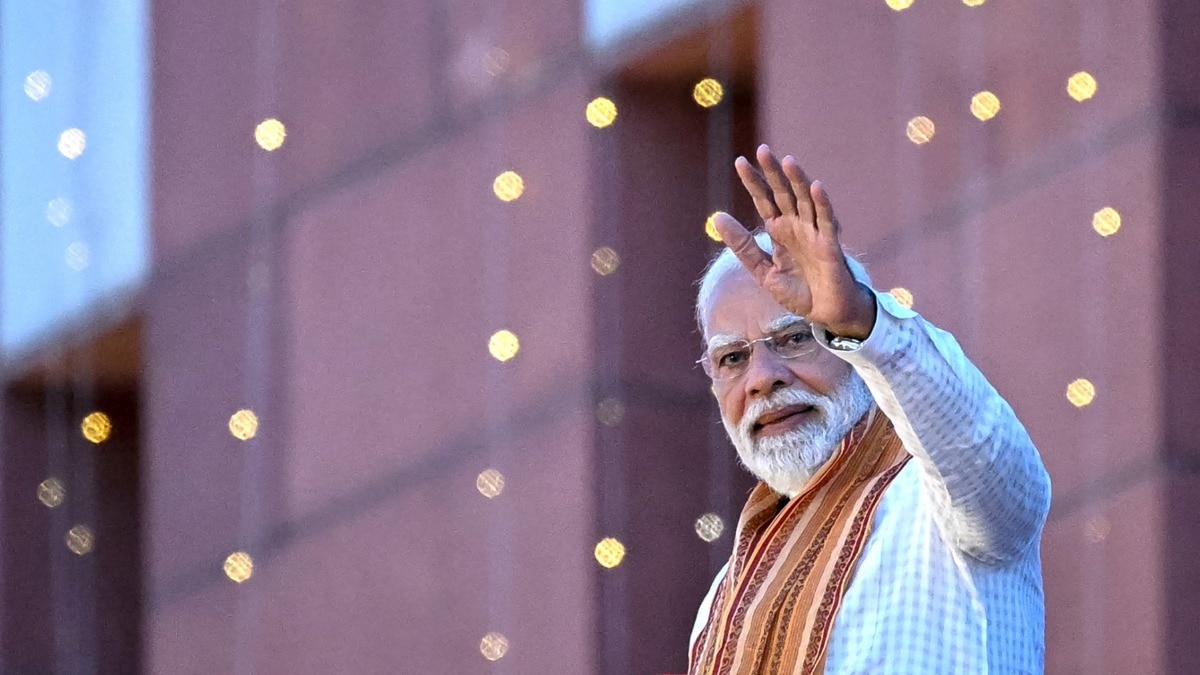
As Prime Minister Narendra Modi marks 25 years as the head of governments in Gujarat and at the Centre, it's worth revisiting 10 major decisions from his political journey. Together, they offer a glimpse into how his governments sought to reshape governance, the economy, constitutional politics and the country's security response.Prime Minister Narendra Modi is India's longest-serving head of an elected government, with 25 years of combined service as Gujarat Chief Minister and Prime Minister. (Image: AFP)From Gujarat's power and water reforms to GST, Article 370 to Operation Sindoor, Prime Minister Narendra Modi's 25 years at the helm of governments have been defined by decisions that sought to change systems, reshape delivery models, and, at various times, alter the political grammar itself.On October 7, 2001, Narendra Modi took oath as Gujarat's Chief Minister. Now, 25 years later, he is the head of the Government of India. He spent nearly 13 years as Prime Minister after his 13-year tenure in Gujarat. Today, Modi marked the milestone of 25 years of serving as the head of governments in his home-state and on the national level.In a quarter of a century, Modi introduced a long list of schemes, reforms and political decisions. But some stand out because they went beyond a single programme. They changed how the state delivered power, water and welfare, how businesses paid taxes, how cash moved through the economy and how India responded to security threats.At this historic juncture, the 10 most defining decisions and policies of the Modi era deserve a revisit. 1. THE VILLAGES OF GUJARAT STOPPED WAITING FOR POWER: JYOTIGRAMIn Gujarat, one of Modi's early tests as the chief minister was providing villages with electricity without bankrupting the power system.The Jyotigram Yojana, rolled out in 2006 under his leadership, made a clear distinction between electricity meant for agriculture and that meant to be supplied to rural homes and businesses. The idea was to provide reliable three-phase electricity to villages while regulating the supply for agricultural use. It meant separating what had earlier been a tangled system of farm and household demand. The project required a huge physical infrastructure overhaul, including new lines, poles and feeder infrastructure, while Gujarat was preparing for elections and facing resistance over agricultural power subsidies.People credit Jyotigram with improving rural power supply, reducing theft, and creating conditions for small businesses to operate beyond daylight hours. More importantly, it became an early example of CM Modi's model of fixing the delivery architecture first, then selling the result politically.2. MODI'S GUJARAT MODEL: AN INVESTMENT PITCH NAMED VIBRANT GUJARATAs CM of Gujarat, Modi did not just want the state to attract investment. He wanted it to market itself as an investment destination.The first Vibrant Gujarat Global Investors' Summit was held in 2003. The Vibrant Gujarat turned an investment conference into a recurring political and economic showcase by Modi, bringing industrialists, foreign delegates and governments into the same room.After repeated successive editions, Vibrant Gujarat became closely associated with the Gujarat model of Modi. Its main components were infrastructure, industry and ease of doing business.Its impact is debated, particularly over how many investment MoUs eventually became actual projects. But politically, the summit achieved a lot of significance. The Vibrant Gujarat projected Modi as the face of an aspirational development model that could later be taken to every part of India, via New Delhi.3. FROM SCHOOL ENROLMENT TO WATER PROJECTS: MODI BUILT GUJARAT AS A DELIVERY STATEThe Gujarat experiment might have been about factories and highways. It was more about the delivery of education and water resources, which became two other pillars of the administration.Through schemes like Shala Praveshotsav and Kanya Kelavani, the Modi-led government made school enrolment a public campaign, with senior officials participating in enrolment drives. Gunotsav, introduced in 2009, shifted attention towards assessing what children were actually learning rather than merely being enrolled.The problem of water resource delivery was tackled through both large infrastructure and local conservation. Narmada water was pushed towards drought-prone regions, while projects such as SAUNI sought to fill reservoirs in Saurashtra region through pipelines. Check dams, farm ponds and village-level water management were expanded during Modi's tenure.4. AS INDIA'S PM MODI PUSHED FOR FINANCIAL INCLUSION THROUGH JAN DHAN, DIRECT BENEFIT TRANSFERIn 2014, PM Modi's government took financial inclusion out of the policy papers and put it into mass implementation through Pradhan Mantri Jan Dhan Yojana (PMJDY).The idea was to give people bank accounts, connect them to Aadhaar and mobile numbers, and eventually make government benefits reach beneficiaries directly. The JAM trinity of Jan Dhan bank accounts, Aadhaar and mobile phones became a key pillar of the Modi government's welfare-delivery system. By linking beneficiaries to bank accounts and digital identity, it expanded the use of direct benefit transfers, allowing subsidies and welfare payments to be sent directly to recipients.The scale of success was unprecedented. By September 2026, the official PMJDY data showed more than 56 crore accounts nationwide.The model became part of a larger beneficiary-delivery architecture, alongside schemes such as Ujjwala Yojana, which provided LPG connections to women from poor households. The official Ujjwala programme said connections had crossed 10.35 crore by July 2024, with the approved target subsequently raised to 10.6 crore.5. TOILETS AND CLEANLINESS BECAME A NATIONAL ISSUE: SWACHH BHARATOn October 2, 2014, PM Modi launched the Swachh Bharat Mission, turning sanitation into one of the most visible mass campaigns of his government.The programme focused on building household and community toilets and changing sanitation behaviour. The government subsequently declared all villages, gram panchayats, districts, states and Union Territories open-defecation free by October 2, 2019, reporting the construction of more than 100 million rural toilets.Its importance went beyond the toilet itself. Sanitation, women's dignity, household safety and public health entered everyday political conversations in a way they had rarely done before.6. DEMONETISATION, AND THE RISE OF DIGITAL ECONOMYAt 8 pm on November 8, 2016, PM Modi shocked the nation, announcing that existing Rs 500 and Rs 1,000 notes would cease to be legal tender from midnight. The government said the move was aimed at black money, corruption, counterfeit currency and terror financing.While the move attracted criticism over its hasty implementation, demonetisation was hailed a bold economic gamble by Prime Minister Modi. Demonetisation accelerated adoption of digital payments and signalled that the government was willing to take disruptive action against illicit cash.The enormous disruption to a cash-dependent economy became the defining feature of the decision.7. MODI'S ONE TAX, ONE MARKET IDEA AND THE GSTThe Goods and Services Tax (GST) was another reform that attempted to redraw the indirect taxation regime and the entire economic system.The policy was introduced in July 2017, and the GST replaced a maze of central and state indirect taxes with a common framework. Its biggest structural achievement was not simply new tax rates but the creation of a national tax architecture.The GST Council brought the Centre and states into a common constitutional forum to decide rates, exemptions and other issues. Its voting structure and consensus-oriented functioning have made GST an important example of cooperative federalism.The transition was far from smooth. Businesses faced compliance problems, multiple rate changes and technological difficulties. But over time, the system stabilised and became a central pillar of India's formalisation story.8. ACT OF TERROR EQUALS TO ACT OF WAR: INDIA'S NEW SECURITY DOCTRINEIf economic reforms changed financial systems, the security decisions taken by his governments changed the language of India's response to terrorism.After the Uri terror attack in 2016, India announced surgical strikes across the Line of Control (LoC). Following the Pulwama terror attack in 2019, India carried out the Balakot air strikes. Operation Sindoor in May 2025 extended that pattern with strikes against terrorist infrastructure in Pakistan and Pakistan-occupied Jammu and Kashmir (POJK).The doctrine is the sequence of a departure from strategic restraint towards visible and proportionate retaliation.Cross-border terrorism became an issue on which the government sought to demonstrate that terror attacks would carry an immediate cost beyond the battlefield.9. BIGGEST CONSTITUTIONAL BET: ABROGATION OF ARTICLE 370On August 5, 2019, the BJP government led by PM Modi moved to end Jammu and Kashmir's special Constitutional status under Article 370. Parliament passed the Jammu and Kashmir Reorganisation Act, 2019, which reorganised the former state into two Union Territories.For the BJP, this was the fulfilment of one of its longest-standing ideological commitments and a political promise.The government said that the move would integrate Jammu and Kashmir more fully with the Union, extend central laws and create conditions for investment and development.But politically, there were a few decisions that better capture the Modi government's willingness to pursue long-standing ideological promises rather than incremental compromise.10. WHEN PANDEMIC ENGULFED THE WORLD: INDIA EMERGED AS VISHWABANDHUWhen Covid-19 brought the world to a standstill, the Modi government faced one of its biggest tests of containing the pandemic while protecting millions whose livelihoods had suddenly vanished.The nationwide lockdown in March 2020 helped buy time to expand health infrastructure but also caused severe economic disruption and triggered a massive migrant crisis.The government built a vast welfare safety net, with the Pradhan Mantri Garib Kalyan Anna Yojana providing free foodgrains to around 80 crore beneficiaries during the pandemic.India's vaccination drive, launched in January 2021, became another exercise in delivery at scale, with free vaccines eventually provided to adults through the government system.The pandemic response remains contested over the lockdown's economic and humanitarian costs, but it also became a moment for Modi to project India as a Vishwabandhu (a friend to the world) through vaccine diplomacy, medicines and humanitarian assistance.Some decisions by PM Modi's government produced visible gains. Some remain contested. Some transformed institutions, while others transformed political expectations. But the enduring feature of the Modi era might be the belief that government decisions must be large enough to be felt, simple enough to be communicated, and visible enough to become part of everyday politics.- Ends(Written by Avinash Kateel)
From Jyotigram to JAM and Sindoor. Modi's 10 big decisions in 25 years of sewa
Full Article
Original Source
Read the full article at Indiatoday →KhanList aggregates and links to publicly available news content. We do not host full articles from third-party sources. Always verify important information with original sources.