
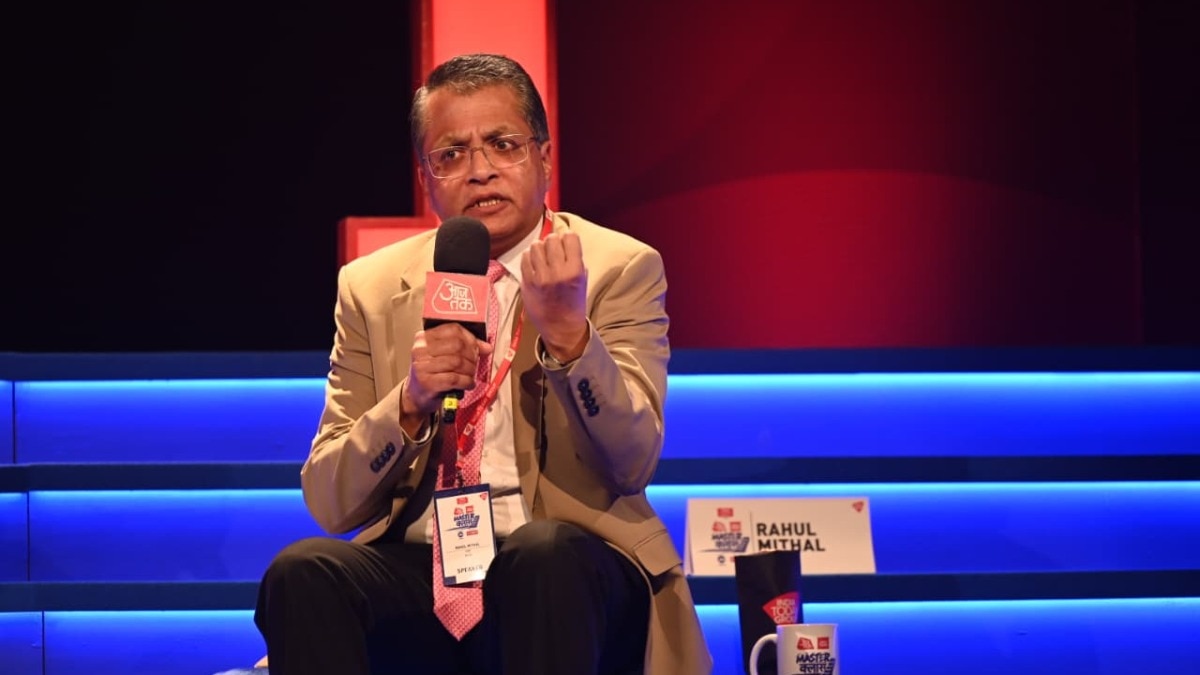
For many young engineers, securing a government job remains a major career aspiration. But what does it take to build a career in Indian Railways, and what opportunities do the sector offer beyond traditional railway operations?Speaking at the Aaj Tak Masterclass 2026, Rahul Mithal, Chairman and Managing Director (CMD) of RITES, shared his journey, discussing his decision to choose Indian Railways over opportunities abroad, experiences as a young railway officer, government job salaries and emerging career opportunities.In a conversation with Siddharth Zarabi, Group Editor, Business Today, he also addressed questions on railway recruitment, train delays, derailments and the future of driverless trains.WHY DID RAHUL MITHAL CHOOSE INDIAN RAILWAYS OVER OPPORTUNITIES ABROAD?Mithal's journey began in 1985 when he was pursuing engineering at IIT Kanpur. He later appeared for the Special Class Railway Apprentices (SCRA) examination, a highly competitive examination that offered candidates an opportunity to pursue mechanical engineering and join the Railways. Despite having an opportunity to continue his education abroad, Mithal decided to stay in India."I wanted to stay on and do something here," he said, recalling how some of his relatives who had studied at IIT Kanpur and were working in the US encouraged him to pursue opportunities overseas. He said that the decision to stay in India eventually shaped his professional journey, which has now spanned several decades.WHAT MAKES INDIAN RAILWAYS AN ATTRACTIVE CAREER OPTION FOR ENGINEERS?Explaining why he chose the Railways, Mithal said the organisation offers engineers exposure to different kinds of work and responsibilities.According to him, Indian Railways provides opportunities across operations, maintenance, design and management, allowing professionals to apply their technical knowledge in real-world situations."Railways is such a huge organisation in terms of giving you a varied experience," he said.He also highlighted the scale of the organisation, which has a workforce of around 14 lakh people, making it a large platform for professional growth.For young engineers, this exposure can help develop both technical and managerial skills while offering opportunities to work on projects that have a direct impact on public infrastructure.ARE GOVERNMENT JOBS STILL FINANCIALLY ATTRACTIVE COMPARED TO PRIVATE SECTOR JOBS?Addressing the perception that government jobs offer lower salaries than private-sector roles, Mithal said the gap has narrowed, particularly during the initial years of a professional's career.He explained that when the overall cost-to-company (CTC), including employee benefits, is considered, government organisations and public sector undertakings (PSUs) can offer competitive compensation packages.According to Mithal, employees in government organisations and PSUs can remain financially competitive with their private-sector counterparts for approximately the first 10 to 12 years of their careers.He added that the difference becomes more noticeable at senior management levels, where private-sector salaries can grow substantially.The discussion highlighted how career decisions should not be based on salary alone, but also on job security, professional exposure, learning opportunities and long-term growth.WHAT IS RITES AND WHAT CAREER OPPORTUNITIES DOES IT OFFER?Speaking about RITES, Mithal described it as a 52-year-old infrastructure consultancy company with operations across several sectors.He explained that the organisation has 13 verticals, including railways, ports, metros, highways, buildings and urban engineering.At the time of the discussion, RITES was executing more than 700 consultancy orders across India and overseas.Mithal also highlighted the company's international presence, saying it had worked in more than 55 countries over the past five decades.Its projects include work associated with IIT Delhi, Delhi Metro, Gwalior Airport and the Mauritius Metro, among others.The organisation, he said, offers opportunities for professionals across different infrastructure disciplines, making it a potential career destination for engineers interested in working on large-scale projects.ARE RAILWAY JOB OPPORTUNITIES INCREASING AS INFRASTRUCTURE EXPANSION GATHERS PACE?With increasing competition for government jobs and concerns about fewer vacancies, the discussion also turned to recruitment opportunities in the railway sector.Mithal acknowledged that competition remains high but said recruitment activity has received a push in recent years.He pointed to the rising capital expenditure in Indian Railways, the expansion of new corridors and the introduction of new rolling stock as factors creating greater opportunities.He also highlighted recruitment across railway public sector undertakings, noting that several PSUs associated with the Railways have been hiring professionals.The expansion of railway infrastructure, including high-speed and semi-high-speed corridors, is expected to create demand for professionals with specialised engineering and technical expertise.WHY DO TRAINS GET DELAYED AND WHAT CAUSES RAILWAY ACCIDENTS?Responding to questions from the audience about train delays, derailments and railway operations, Mithal explained that the pressure on existing railway infrastructure remains significant because of the high demand for train services.He said that although the number of trains is increasing, demand continues to exceed available capacity on several routes.Explaining the operational challenges, he pointed to the complexity of managing different categories of trains on shared tracks.Using Mumbai's suburban railway network as an example, he highlighted how local, fast, slow, passenger and goods trains operate on the same railway network.This creates considerable operational pressure and can sometimes affect punctuality.He also explained that derailments and accidents can occur because of multiple factors, including track-related problems. Recalling an incident involving a coal-loaded goods train, he described how a track problem led to a derailment, followed by a collision with another train.The example highlighted how railway accidents can sometimes have consequences beyond the initial incident.CAN DRIVERLESS TRAINS BECOME THE FUTURE OF RAILWAY TRANSPORT?The discussion also touched upon the growing use of driverless trains, particularly in metro networks.Addressing concerns about how trains can operate without someone sitting in the driver's cabin, Mithal explained that these systems rely on advanced technology, control mechanisms and simulation.He said driverless operations have gradually gained acceptance as confidence in the technology and systems has increased.Rather than having a driver physically operating the train from the cabin, the system can be monitored and controlled remotely.This shift reflects the growing role of automation in modern railway transportation.WHAT CAN YOUNG PROFESSIONALS LEARN FROM A FOUR-DECADE-LONG CAREER?Reflecting on his early years, Mithal recalled his first posting in Katni, near Jabalpur, after completing his training.As a young engineer, he was given independent responsibility for a workforce of around 1,500 people.He said the experience was a reality check, as the responsibilities were very different from what he had learnt in engineering classrooms.He also recalled an incident during his early years in Mumbai when he was sent to a railway station late at night following a disruption involving a train carrying personnel for election duty.The situation turned tense, and he was injured during the incident.However, what stayed with him was the support he received from the organisation.He recalled how the Railways and the concerned defence authorities stood by him throughout the incident.For Mithal, the experience marked an important transition from being a young engineer to understanding the responsibilities and realities of working in a large public organisation.- Ends
From IIT Kanpur to RITES CMD: Rahul Mithal on building a career in Indian Railways
Full Article
Original Source
Read the full article at Indiatoday →KhanList aggregates and links to publicly available news content. We do not host full articles from third-party sources. Always verify important information with original sources.