
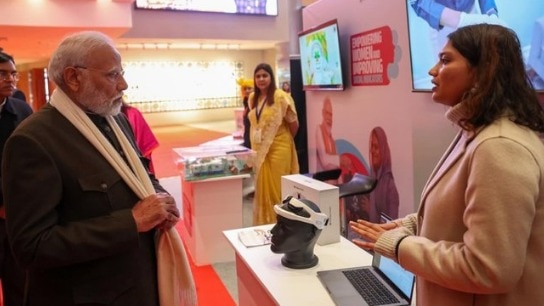
She turned down a full-time offer from Adobe, pursued research in neuroscience and co-founded Marbles Health in 2020. Today, Ramya's work centres on developing medical technology that could offer new approaches to treating certain brain-related conditions.New Delhi,Nov 18, 2026 17:25 ISTA CS student who turns down an offer of employment from one of the world's leading technology companies to build a medical device has taken a course not commonly followed by engineering graduates. For Ramya Yellapragada, however, the decision marked the beginning of a career that would bring together computer science, neuroscience and medicine.Her work eventually took her to Geneva, where she attended the World Health Assembly and met India's then Union Health Minister, Dr Mansukh Mandaviya, to discuss her company's work in mental healthcare.An alumna of the Indraprastha Institute of Information Technology, Delhi (IIIT Delhi), Yellapragada is the co-founder and chief executive officer of Marbles Health, a neurotechnology company established in 2020 with Lakshay Sahni.The company is engaged in the development of a brain-stimulation device intended to assist doctors in the management of certain neurological and mental health conditions. In 2026, Yellapragada was named in Forbes' 30 Under 30 Asia list in the Healthcare and Science category. Her career, however, is best understood through the academic choices and professional decisions that took her from an engineering institution to medical research.FROM IIIT DELHI AND ADOBE TO NEUROSCIENCE RESEARCHShe, in a post on X, shared how her journey looked like "a mistake to someone" while citing what she had done in the past decade from IIIT Delhi to job and how ups and downs have shaped the journey in upcoming years. Yellapragada secured an All India Rank of 190 in JEE Main in 2015 and chose IIIT Delhi over NIT Warangal. During her studies, she developed an interest in computational biology, a discipline that employs computers and mathematical methods to examine biological systems.In 2017, while still in her second year, she secured an internship at Adobe.The following year, she declined a full-time employment offer from the company. Instead of entering the technology industry, she chose to continue her academic and research pursuits.In 2019, she presented a research paper in Greece and joined a fellowship rather than take up a corporate position. It was through her association with Plaksha University and its research programme involving the University of California, Berkeley, that she met Lakshay Sahni.Their common interest in neuroscience eventually led them to establish Marbles Health. Yellapragada has also spoken of her brother's experience with chronic mental illness, which influenced her decision to pursue research in brain science.WHAT IS MARBLES HEALTH DEVELOPING?The company's principal product is EASE, a non-invasive brain-stimulation device that employs a technique known as transcranial direct current stimulation (tDCS).The method involves passing a weak electrical current through electrodes placed on the scalp. The current is intended to influence the activity of particular brain networks. Unlike surgical procedures, it does not require the implantation of electrodes inside the brain.Marbles Health has explored the use of this technology in conditions such as depression, anxiety, attention-deficit/hyperactivity disorder (ADHD) and obsessive-compulsive disorder (OCD), besides stroke rehabilitation.Yellapragada has recalled visiting the All India Institute of Medical Sciences (AIIMS), Delhi, for three months in 2021 to undertake clinical validation work.The exercise brought the research into a hospital setting, where questions of safety, efficacy and the suitability of treatment protocols had to be examined.According to the company, EASE has received medical-device regulatory approval in India and is being used in hospitals and clinics.For students pursuing engineering and the sciences, Yellapragada's career presents an example of how an education in one discipline may provide the foundation for work in another.Computer science, in her case, became a starting point for research into the workings of the human brain and the development of a medical device.Yellapragada's passage from IIIT Delhi to medical entrepreneurship thus brings us to a question of growing importance in higher education: how far can the study of engineering be carried into medicine, and what new fields of work may emerge when the two are brought together?- Ends
From IIIT Delhi to Forbes 30 Under 30: The story of Ramya Yellapragada
Full Article
Original Source
Read the full article at Indiatoday →KhanList aggregates and links to publicly available news content. We do not host full articles from third-party sources. Always verify important information with original sources.