
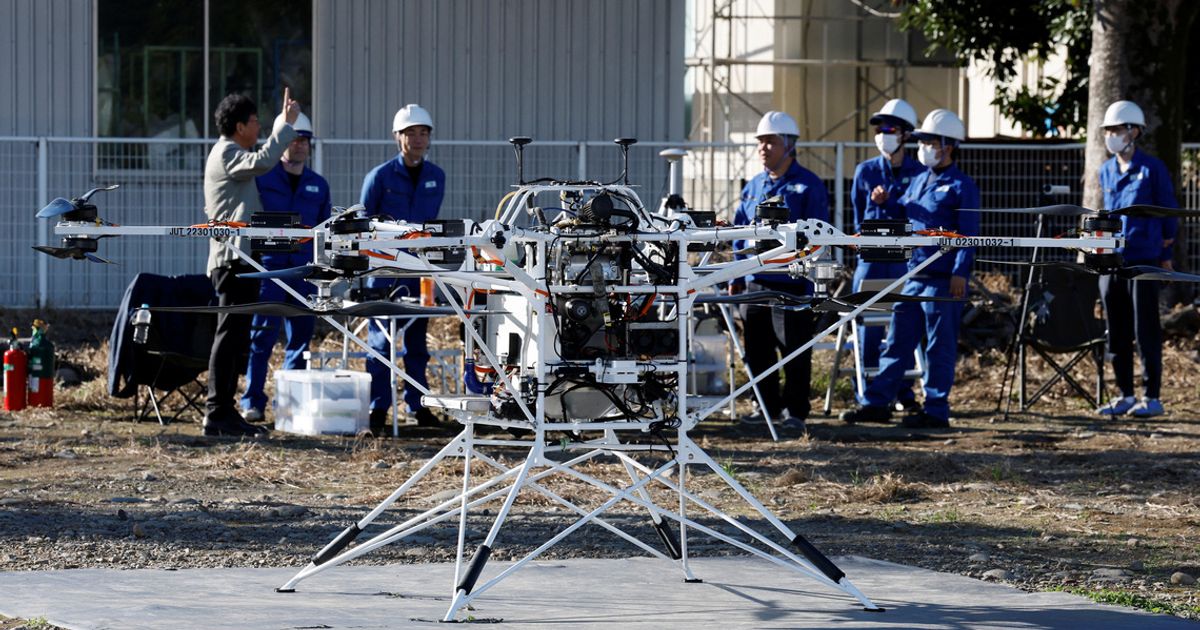
YOKOTE, Japan – For years, Japanese manufacturer Aster made its money supplying parts for Toyota vehicles.But as the country’s auto industry struggles in the face of fierce Chinese competition, Aster has found a new niche in defence technology.Its electric motors power drones built by US military technology company Anduril, and defence work has grown to a tenth of revenue since it entered the sector in 2025.“Drones are a much better business,” chief executive Takenobu Hongo said of Aster’s embrace of defence contracting, which has long been viewed warily by citizens of a country shaped by decades of pacifism. “At the moment, for us, automotive motors aren’t very profitable.”Aster’s pivot is part of a move by Tokyo to encourage Japan’s many auto suppliers to join the country’s biggest military build-up since World War II, according to interviews with nine people, including government officials, company executives and an adviser to Prime Minister Sanae Takaichi’s Cabinet.Takaichi’s government hopes that tapping existing industrial supply chains will speed up Japan’s security transformation as it bolsters its defences against threats from nuclear-armed neighbours China, Russia and North Korea.The rearmament efforts are backed by Tokyo’s chief security partner, the United States, which is pressing allies to increase spending on armed forces.The build-up also offers an important diversification avenue to Japan’s once world-leading auto industry. The country’s factories built nearly 900,000 fewer vehicles in 2025 than a decade earlier, according to the Japan Automobile Manufacturers Association.Reuters is reporting for the first time details of the industry’s nascent push into the defence sector and how it is supported by the Acquisition, Technology & Logistics Agency (ATLA), which oversees defence ministry procurement.The department has been evaluating suppliers like Aster, pairing them with arms firms and offering new funding streams, an agency official and four executives said.An adviser to Takaichi’s Cabinet, Koko Kato, has also played a role in helping steer the industry’s transformation. If there is a synergy between defence and autos, carmakers “should take the opportunity”, she said.Kato told Reuters she oversaw changes in February to a separate trade ministry programme aimed at helping auto suppliers diversify into defence and other industries.ATLA said in response to Reuters questions that it serves as a point of contact to help companies seeking to enter the defence industry and that it will continue to work with other government departments to encourage new entrants.Takaichi’s office did not respond to questions.Manufacturing powerhouseTakaichi’s government has pledged to lay out a new security strategy by year-end, including a road map for bolstering an arms industry that was initially dismantled after Japan’s World War II defeat.The plan builds on Japan’s legacy as a manufacturing powerhouse. Despite its auto industry’s recent decline, Japan is still the world’s third-largest vehicle-producing nation.The industry manufactures more than eight million vehicles a year and supports one in 10 jobs, with some 70,000 companies making an enormous array of components.Skills prized in auto manufacturing, such as precision and electronics manufacturing, as well as quality control, are relevant to arms production, said Pontus Haggstrom, a Japan-based adviser to the auto industry and former chief executive of Stellantis Japan.The industry “also knows how to produce complex products reliably and at scale”, he added.The case for Japan to draw on domestic manufacturing has also grown as American arms makers struggle to replenish arsenals depleted by conflicts in the Middle East and Europe.Tokyo was the destination for about a tenth of US weapon exports in 2021-2025, according to the Stockholm International Peace Research Institute.“Customers tell us their traditional suppliers don’t have the capacity,” said Hiroko Suzuki, the CEO of car-engine component maker Kyowa Industrial, which has received a growing number of orders for prototype drone engines.While Kyowa has long made missile-related components, the defence sideline now comprises 10% of annual sales, up from 3% in spring 2025.Some auto suppliers are also eyeing opportunities to sell to US and European military contractors.ATLA has been holding events in Tokyo to connect Japanese suppliers with potential Western clients. Some 48 Japanese companies from various industries took part in a September event, twice as many as 2025, the procurement agency said.Drone rushATLA, which in October launched a funding programme for the development and testing of new military technology, has encouraged some auto suppliers to produce components for unmanned aerial vehicles (UAVs).The agency has said it is willing to provide millions of dollars in support to projects that advance to prototype development.Ishikawa Energy Research’s gasoline engine-powered drone flies during a demonstration near its factory in Japan on Nov 6. PHOTO: REUTERSThe upcoming national security strategy is expected to outline plans to arm Japan with fleets of attack and interceptor drones of the kind that have reshaped warfare elsewhere.But domestic industrial production is tiny: The country exported just over 1,100 drones in 2025, compared with the roughly 123,000 UAVs sold to overseas clients by neighbouring Taiwan, according to trade figures compiled by Taiwan’s Research Institute for Democracy, Society and Emerging Technology.While fiscal constraints are likely to force Tokyo to rethink some existing orders for missiles and aircraft, such is Japan’s need for UAVs that drone-related spending will likely be ringfenced, according to an official familiar with budget plans.Toru Tokushige, CEO of Japanese dronemaker Terra Drone, said ATLA officials recently introduced him to Kaaz, a maker of racing car parts that has developed a small gasoline-powered aircraft engine. Tapping auto suppliers could significantly increase Japan’s drone-building capacity, he said.A spokesperson for Kaaz said that it has consulted with ATLA and is actively pursuing the development of engines for military drones.Ishikawa Energy Research, a drone start-up that attended ATLA’s September forum, is also seeking military applications for its aircraft.Employees of Ishikawa Energy Research work on an assembly line producing petrol engine-powered drones at the company's factory in Ota on Nov 6. PHOTO: REUTERSThe firm’s UAVs are used mainly for agricultural purposes such as crop spraying, founder Mitsuru Ishikawa told Reuters. But the former Honda engineer said his petrol-powered drones could also transport heavier defence equipment or conduct longer-range military reconnaissance missions than more common battery-powered models.The firm, which is based in the industrial town of Ota, has already tapped into the sprawling local auto supply chain that feeds carmaker Subaru, with more than 50% of the components in its drones coming from auto suppliers.Ishikawa does not think those firms will object to his military ambitions, in part because Subaru, which is better known globally for its sporty cars, already has a major defence arm.The company has built military aircraft, including attack helicopters, for Japan’s Self-Defense Forces for decades.Subaru expects defence-related demand to grow and intends to capture those business opportunities, a spokesperson said, declining to give specific forecasts.Mitsuru Ishikawa, founder of Ishikawa Energy Research, does not think firms will object to his military ambitions, in part because Subaru, which is better known globally for its sporty cars, already has a major defence arm. PHOTO: REUTERSOvercoming a post-war tabooThe auto industry’s shift to defence contracting is for now largely limited to smaller parts makers, according to five officials and analysts.Japan’s big three automakers – Toyota, Honda and Nissan – have shown little appetite for a defence tilt. They still have substantive businesses in China, which has criticised Japan’s arms build-up.They have also long been wary of the reputational risks that come with the defence sector.“The company’s basic position at this point is that we will not do anything related to defence,” senior Toyota executive Hiroyuki Ueda said at a results briefing earlier in November.Nissan declined to comment on potential defence work, while Honda said in response to questions that it has no specific plans to enter the sector.That hesitancy also filters down to their closest suppliers.Mitsubishi Electric chief financial officer Kenichiro Fujimoto told Reuters that some auto parts makers it had approached for a new military drone venture had declined to participate. The suppliers, which Fujimoto did not name, were worried about upsetting their main customers, he said.Aster’s Hongo was also wary that some of his company’s roughly 100 staff might object when he gathered them at his factory in the northern Japanese town of Yokote in November 2025 to announce that Anduril wanted to use their motors.Instead, the 71-year-old executive received a warm reception. “Everyone was more like: ‘Wow, that’s impressive!’” he said of the meeting.The commercial opportunities in defence, as well as growing public concern about Japan’s security challenges, would lure many more companies, Hongo predicted.“In Japan now, there are very few people who think this is somebody else’s problem,” he said. REUTERS
From horsepower to firepower, Japan draws auto suppliers into major arms build-up
Full Article
Original Source
Read the full article at Straitstimes →KhanList aggregates and links to publicly available news content. We do not host full articles from third-party sources. Always verify important information with original sources.