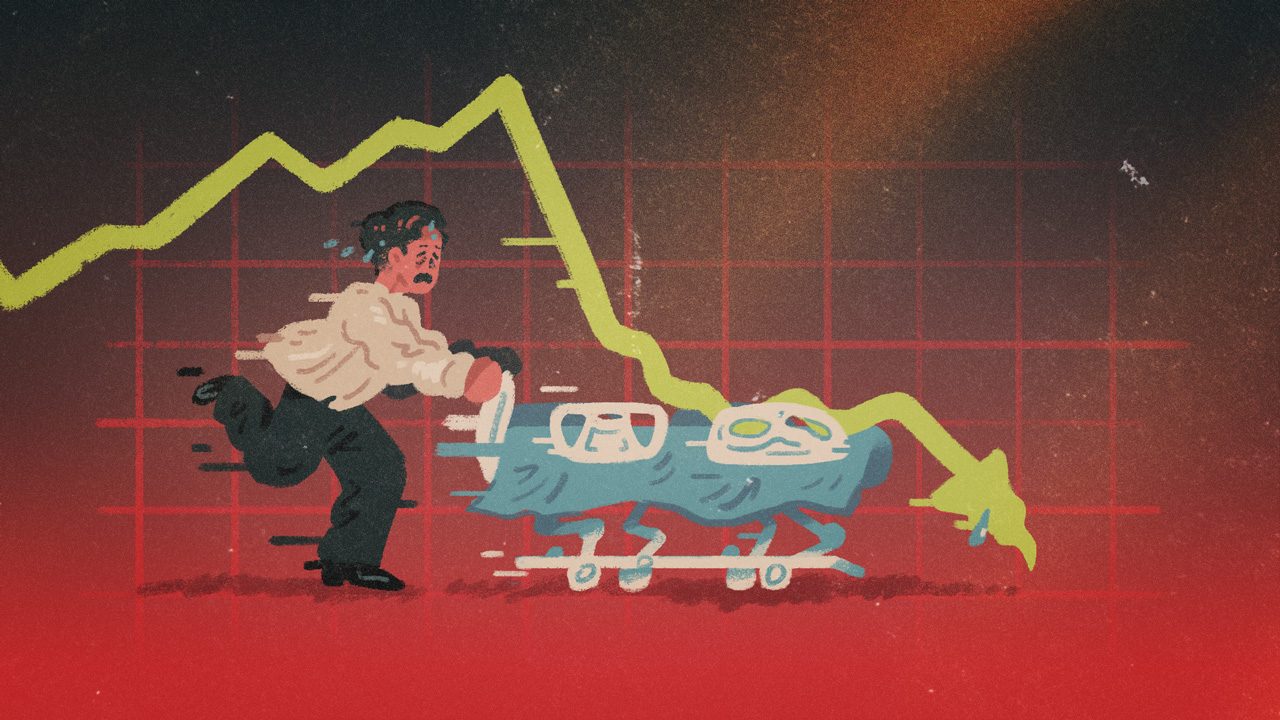
President Ferdinand Marcos Jr. says government must spend faster to revive growth, but after the flood-control mess, even he warns that 'throwing money at the problem simply doesn’t solve it' The Marcos administration is focusing on increasing public spending to revive the Philippine economy, which has been hindered by delays and scrutiny of infrastructure projects. Despite the push for faster spending, there are concerns about the absorptive capacity of government agencies and contractors, as well as the need to avoid past issues with dubious projects. The government is also working to manage its fiscal deficit while increasing revenue through stronger tax collections and privatization efforts. This is AI-generated. Read the article for full context. Report any errors. MANILA, Philippines – After spending months cleaning up the mess left by questionable infrastructure projects, the Marcos administration now finds itself with quite the opposite problem. It needs the government to spend faster. President Ferdinand Marcos Jr. is counting on a rebound in public spending to help pull the Philippine economy out of its slump in the second half of the year. But even as he pushes agencies to catch up, Marcos acknowledged there is only so much money they and their contractors can realistically put to work at once. “The growth rate is heavily dependent on public spending. And that has been delayed,” Marcos said, speaking at a Foreign Correspondents Association of the Philippines forum on Friday, August 14. Part of that delay was self-imposed. After controversies surrounding public works spending, particularly flood-control projects, the government subjected the budget and infrastructure pipeline to closer scrutiny. Contracts that, normally, would have been bid out before the start of the year were instead put out only toward the end of the first quarter, Marcos said. The uncertainty surrounding the infrastructure clean-up also spilled over into investment. The World Bank has said reviews of public infrastructure projects and heightened domestic policy uncertainty spooked investors and contributed to the country’s slower growth. Now Marcos wants the government to make up for lost time. The President expects the government to make up for that spending for the rest of the year, adding that he was “confident” public spending would catch up with and eventually exceed the previous year by the last quarter. But still, he acknowledged that there’s only so much that they can spend on prudently. “What we are running into very much is the absorptive capacity, not only of the government agencies, but also of the contractors. They can only do so much work,” Marcos said. “So throwing money at the problem simply doesn’t solve it, doesn’t make anything better.” Spend faster, but more carefully After the Philippine economy grew by a measly 2.3% in the second quarter, the country’s economic managers are now trying to speed up spending enough to jolt the economy back to life. At the same time, they can’t afford to recreate the same conditions that allowed dubious and alleged nonexistent projects in the first place. At a separate forum of the Economic Journalists Association of the Philippines (EJAP) on Friday, Acting Budget Secretary Kim Robert de Leon said the Department of Budget and Management (DBM) was working with implementing agencies to speed up spending. But DBM is also tightening the way it vets and monitors projects. For flood-control projects returning to the proposed 2027 national budget, De Leon said DBM and the Department of Public Works and Highways agreed to prioritize the completion of ongoing projects and the operation and maintenance of existing infrastructure. “We have the full documentation of it, including the budget forms, the location, the geotagging, and the program of works to make sure that this will not be ghost projects as have earlier been reported in the previous years,” De Leon told economic journalists on Friday. PROPOSED BUDGET. Breakdown of the proposed 2027 national budget, grouped into broad categories. Presentation from the DBM. The budget department is also attempting to rein in unprogrammed appropriations (UA), another controversial part of government spending. The proposed P7.2-trillion national budget for 2027 contains P111.98 billion in unprogrammed appropriations, equivalent to just 1.6% of the expenditure program. De Leon said this was the lowest proposed UA in nominal terms since 2019 and the lowest share of the expenditure program since 1991. Asked whether the government could eventually reduce unprogrammed appropriations even further, De Leon said “the lower the better.” He said the 2027 budget proposal limits UA largely to foreign-assisted projects still undergoing approval processes, as well as a handful of contingent items including risk-management provisions tied to public-private partnership and privatization commitments. Underspending dragged growth Department of Economy, Planning and Development Secretary Arsenio Balisacan was more explicit about how much weak public spending had hurt the economy. Balisacan told the EJAP forum that the economy could have turned in “quite good growth” in recent quarters despite the Middle East conflict had government funds moved as intended. But they did not. Instead, he said public spending contracted by more than 30% for two consecutive quarters. “That’s not likely to be the case in the next two quarters,” Balisacan said. Balisacan argued that the recent weakness should be viewed against a longer period in which the Philippine economy expanded by an average 5.1% over the past 15 years. But even with the chief economist’s optimism for an improvement in the second quarter, the government’s economic team has already cut its expected full-year growth to only 3.5% to 4.5% in 2026. Finding the money The push to spend faster also comes as the government tries to narrow its fiscal deficit and keep debt manageable. Of the proposed P7.2-trillion budget for 2027, P1.143 trillion or 15.9% is already allotted for the debt burden, covering interest payments and net lending to government corporations. That’s nearly three times as much as the Philippines is projected to spend on defense (P452.4 billion). Keenly aware of the crushing burden, the government plans to gradually bring the deficit down from 5.4% of gross domestic product in 2026 to 3.5% by 2030, even as it continues to fund infrastructure and other programs aimed at lifting economic growth. REVENUE. Year by year growth in BIR and BOC revenue collection. Presentation from the DOF. Finance Secretary Frederick Go touted stronger tax collections and other government revenues, which help create more room for spending. Go said annual government collections increased by an average of 10% during the first four years of the Marcos administration. The Bureau of Internal Revenue surpassed P3 trillion in collections in 2025, while the government expects the Bureau of Customs to finally breach the P1-trillion mark this year. Government-owned and -controlled corporations have also remitted P501 billion in dividends from 2022 to 2026, already 31% more than the P382 billion collected during the previous administration, Go said. Privatization has provided another source of funds, including almost P49 billion raised from the sale of power assets in recent years. – Rappler.com How does this make you feel? Loading
From ghost projects to growth slump, Marcos now faces a spending dilemma
Full Article
Original Source
Read the full article at Rappler →KhanList aggregates and links to publicly available news content. We do not host full articles from third-party sources. Always verify important information with original sources.