
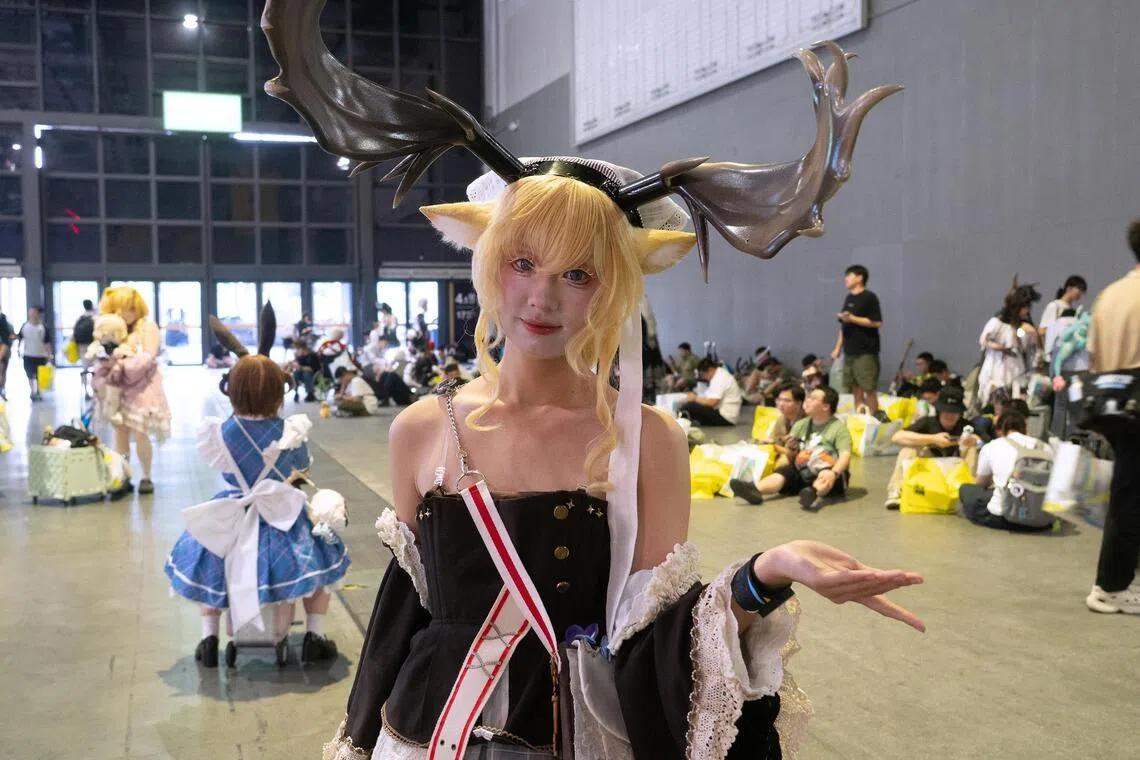
SHANGHAI – On a hot summer weekend in Shanghai, thousands of avid gamers and cosplayers streamed into cavernous exhibition halls to see their favourite characters from a mobile game come to life.They joined snaking queues to play mini-games at a replica of Wuling City, a fictional location that blends traditional Chinese elements such as Jiangnan-style residences and stone lions with sci-fi futurism, collect fan art and exchange gaming strategies.A cosplayer who gamely posed for a photo pressed into my hand an acrylic pixel-art keychain, which I found out later was a reimagined dragon persona of a blue-haired Arknights character named Chen.This was Disneyland for Arknights fans, who cheered at a dance performance featuring wolf-like characters Texas and Lappland – kindred spirits in a love-hate relationship spanning betrayal, romance and shared trauma – on an elaborate stage set with backup dancers.Some 70,000 tickets for the four-day event were sold in July, an indication of the loyal following commanded by the “tower defence” mobile game made by Shanghai “Big Four” mobile game studio Hypergryph. Arknights has been running for seven years now – an eternity by the standards of the fast-iterative nature of games played primarily on smartphones.Official cosplayers perform on stage before a large crowd of attendees during the Hypergryph Carnival at the National Exhibition and Convention Centre in Shanghai. The carnival ran from July 30 to Aug 2. ST PHOTO: INGRID YUIts longevity is a snapshot of what drives China’s mobile game industry today, which has spawned hit after hit capturing the hearts of gamers across the world, from Honour of Kings to Genshin Impact and Mobile Legends: Bang Bang.On the back of China’s more than 560 million mobile gamers, this category of digital entertainment has become an economic driver and a creative industry in its own right, and potentially a key conduit for China’s soft power.BreakoutOf late, Chinese video games appear to be hitting their stride, with the 2024 breakout Black Myth: Wukong – based on Chinese mythology – catapulting this category of digital entertainment into global consciousness. More than 30 million copies of the game have been sold, with more than half outside China, showing that China can make a bestselling video game, a field traditionally dominated by foreign studios.On Aug 20, a 15-minute trailer for Black Myth: Zhong Kui, the sequel to Wukong, was released. It set Chinese social media gushing over its animation quality and updated combat mechanics. In the same month, the highly anticipated wuxia role-playing game Phantom Blade Zero, co-produced by Hong Kong action star Donnie Yen, opened for pre-orders at a volume that exceeded expectations of its maker, S-Game. But if Chinese studios are just now gaining recognition for PC and console titles, it is a much different story in the mobile games space, where they have already dominated global charts for years. These hits span anime-style open-world games, multiplayer online, and puzzle games. Mobile Legends: Bang Bang counts millions of players in the Philippines, Indonesia, Malaysia and Singapore, while Shanghai gaming giant miHoYo has been credited with propelling industry revenues to a new level with its wildly successful Genshin Impact, first released in 2020. Overseas revenue from China-developed games grew from US$18.6 billion in 2024 to US$20.5 billion in 2025 (S$23.5 billion to S$25.9 billion), driven by mobile games. Daniel Camilo, a Chinese video game industry observer based in Shenzhen, said that the major reasons for Chinese games’ success in South-east Asian and global markets are their low cost of entry and their quality. “Most Chinese global hits are free-to-play games that have greatly elevated quality standards and expectations for mobile games,” he said, adding that Genshin Impact was a watershed moment for China’s industry.The game introduced top-notch production values and content on mobile platforms, offering an open-world game (which allow players to freely explore their environment) with fully developed narrative arcs and lore, and gameplay that could appeal to both casual and core gamers, he told ST.By 2025, the game had accumulated some 300 million registered players, half of them outside of China. “Genshin Impact alone triggered a boom in development of more ambitious gacha games (not just) within miHoYo itself but also from other Chinese studios and publishers,” said Camilo. Gacha games have randomised rewards based on spending real or in-game currency, a highly successful way of monetising free-to-play games, although the fact that they are similar to gambling have drawn regulatory scrutiny in China and elsewhere.Industry growthKigurumi cosplayers at the Hypergryph Carnival in Shanghai. ST PHOTO: INGRID YUIn August, the vitality of China’s still-growing gaming industry was on display at ChinaJoy, the top gaming conference in Shanghai, the country’s hub for mobile games and e-sports. It attracted nearly 900 exhibitors from 39 countries – the most in its 23-year history. The number of exhibitors showcasing games, from an island living simulator with AI-powered virtual cats to strategy games based on Aztec culture, was a vibrant indicator that this is China’s moment in the sun.A total of 1,771 online game licences were issued in China in 2025, the highest number in seven years. The flipside of the burgeoning supply, however, is a fiercely competitive domestic industry. In particular, the anime-style mobile games market in China triggered by the Genshin boom went through a major reshuffling from 2022 to 2023, after a period of rapid expansion during the Covid-19 pandemic.In such a competitive landscape, Arknights’ longevity reflects not just the game’s solid fundamentals but also the team’s ability to keep the game going for its fans, Hypergryph co-founder Zhong Qixiang, or Light Zhong, told ST.Zhong pointed to the studio’s efforts at world building, the continuous evolution of Arknights’ gameplay beyond its original “tower defence” genre, and large-scale offline events that help to build brand influence and user loyalty. This included a concert earlier in 2026 featuring the game’s score, which was attended by nearly 80,000 people.Fans of Arknights often point to its elaborate lore and storyline as one of its major selling points, akin to how Lord of the Rings created a fantastical yet detailed and believable world. In 2023, Hypergryph published a 450-page book detailing the world of Arknights, including the technology, biology, races, regions and organisations of the fictional world of Terra. This also helped to shape a believable world in which players could invest their own emotions and imagination, said Zhong. Stacy Liu, cosplaying as Skadi the Corrupting Heart from Arknights, at the Hypergryph Carnival. ST PHOTO: INGRID YUArknights’ immersive world building was one of its strengths that captivated Stacy Liu, a gamer who works in the state-owned sector in Anhui province and travelled to Shanghai to attend the Hypergryph festival in late July. The 31-year-old has cosplayed Skadi the Corrupting Heart, a character from Arknights, on and off since its launch in 2019, and spent three hours that day dressing up in her cosplay ensemble that cost roughly 1,000 yuan (S$190).She cited the game’s main draws as a striking visual aesthetic, rich musical score and immersive world building. “The conventions here now are exceptionally well-executed,” she said. “They are grand in scale, and the attention to detail in the set designs is truly impressive.” Soft powerZeng Xiaofeng, vice-president at Niko Partners, a market research and consulting firm focused on video games and e-sports in Asia, the Middle East, and North Africa, said that the Chinese domestic market is highly competitive, making overseas expansion a no-brainer.In addition, China’s gaming industry benefits from a massive domestic market and a deep talent pool, he told ST. In addition to major players such as Tencent and NetEase, many companies primarily focused on overseas markets include FirstFun, RiverGame, and Microfun.“South-east Asia is an important market for Chinese mobile game developers due to its cultural proximity and low market-entry barriers. However, the most profitable opportunities remain in high-ARPU (average revenue per user) markets such as the US and Japan,” he said.“Going global should be a long-term strategy for the Chinese mobile game industry, and it will continue to dominate and expand the market,” he added.Can Chinese mobile games ultimately extend the country’s soft power, or at least be a platform for greater appreciation of Chinese culture? Hypergryph’s Zhong believes so.He said Arknights reflects a reinterpretation of “New Chinese” aesthetics; for example, in the game, a family of characters known as the Sui are infused with elements of traditional Chinese culture, such as poetry, wine, farming and textile production. “This not only adds depth to the characters and greater dramatic tension to their stories but also allows younger players, as well as audiences overseas, to naturally experience the distinctive charm and contemporary vitality of Eastern aesthetics through the game’s narrative,” he said.An attendee cosplaying as Mostima from Arknights poses for photos. ST PHOTO: INGRID YUIn recognition of its role in promoting Chinese culture to the world, Arknights was selected to be on China’s list of Key National Cultural Export Enterprises and Projects for three consecutive two-year periods, including 2025 and 2026. The game has racked up overseas revenue of more than 5 billion yuan since its inception in 2019 and is known for incorporating Chinese architectural aesthetics, dialect music, classical poetry and printmaking techniques. Zhong said: “Within our company, there has always been an understanding that works created by a Chinese team at their core will inevitably carry the cultural foundations of Chinese civilisation. Their works – and indeed the teams themselves – are part of Chinese culture and part of the broader story of China.” Tencent’s Honor of Kings: World, a spin-off of Honor of Kings, the top-grossing mobile game of all time, was released in April, shortly after Roco Kingdom: World – a creature-collecting game with social elements akin to Pokemon meets Animal Crossing – went online in China. All these games invariably draw from Chinese history, folklore, mythology and music.Can collecting cute critters and hack-and-slash combat with Chinese elements be enough to win China global influence? The jury may be out, but millions of gamers have already cast their vote for these mobile games’ production quality, gameplay innovation and operational expertise.
From Genshin Impact to Arknights: What drives China’s mobile games industry?
Full Article
Original Source
Read the full article at Straitstimes →KhanList aggregates and links to publicly available news content. We do not host full articles from third-party sources. Always verify important information with original sources.