
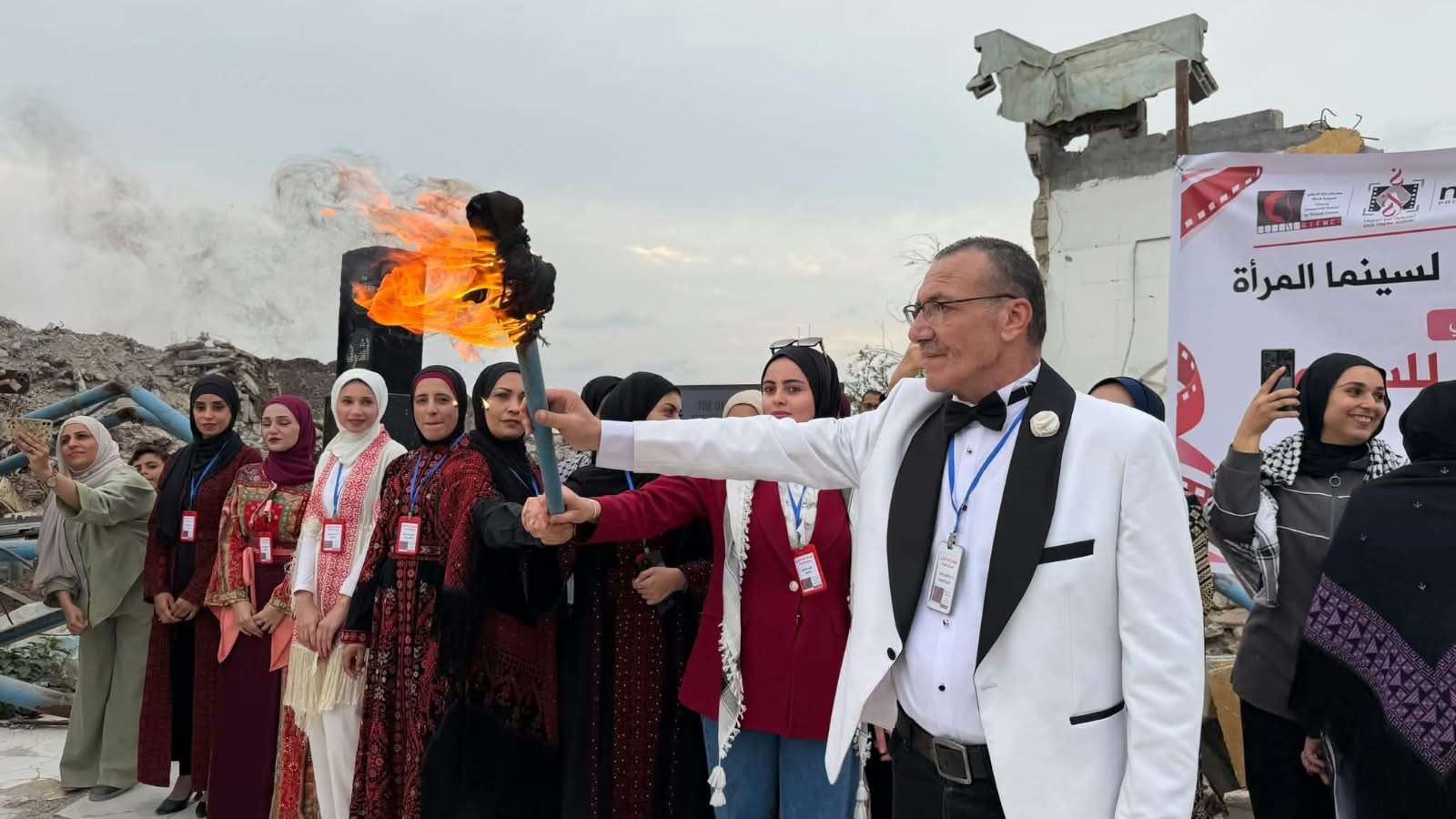
"These are the 25 women I have been training together with my team for the past eight months." The message was quick and abrupt. It was texted to me by my dear friend, the pre-eminent Palestinian filmmaker Mai Masri. I have known Mai and followed her extraordinary work closely for decades. The last time I had seen Masri in person was when we hosted her at Columbia University for the screening of her latest documentary, Beirut: Eye of the Storm (2021). Before that, we had also hosted the New York premiere of her 3000 Nights (2015). On our campus, as on many others, Mai Masri's name is held in the highest respect, love and admiration. Her legendary documentaries, like Under the Rubble (1983), Wild Flowers: Women of South Lebanon (1986), War Generation (1989) and Children of Fire (1990), have consolidated her significance as one of the most gifted, principled and iconic Palestinian filmmakers of her generation. New MEE newsletter: Jerusalem Dispatch Sign up to get the latest insights and analysis on Israel-Palestine, alongside Turkey Unpacked and other MEE newsletters I received Mai's message in late October. This was at a time when two dominant news stories were fighting for people's attention in the US. The first was the song and dance of the so-called "election" in the Israeli settler colony, which The New York Times was flooding into the news cycle when no one could care less which genocidal Zionist was to lead the obscene cult in the Israeli garrison state. The second top news story was the publication of Matthew Cole's book Princes and Thieves: Jared Kushner and Mohamed bin Zayed's Secret Plot to Remake the Middle East (2026), from which Vanity Fair had published an excerpt. Mai's message was a godsend, a reason to continue to have hope in humanity. 'Life from death' "Yesterday," Mai added in her text to me, "we launched the Gaza Cinema Academy, which I co-founded with Ezzaldeen Shalh in Gaza." She then texted me a whole slew of pictures and videos from the miraculous event. The festival highlights the miraculous steadfastness of Palestinian women This event took place during the Gaza International Festival for Women's Cinema, which ran from 26 to 31 October 2026. It is an annual film event dedicated to "supporting women's cinematic creativity from Palestine and around the world". The Gaza Cinema Academy was officially launched on 26 October. Screenings during this festival took place in person for brutalised and displaced Palestinians, in the destroyed al-Nakheel hall in al-Bureij, in the central Gaza Strip. Under Masri's caring and competent hands and those of her colleagues, the festival highlights the miraculous steadfastness of Palestinian women, transforming the hunger, loss and murderous violence of genocidal Zionists into independent cinema that is directed, produced and written by Palestinian women. The festival premiered in late October 2025, in the open air in Deir al-Balah, opening with Kaouther Ben Hania's world-renowned The Voice of Hind Rajab (2025). Heart of Gaza Mai and I had been communicating on WhatsApp ahead of the launch of the academy, and I had asked for more details. The launch in Gaza on 26 October was the second after one at the Venice Film Festival in September, she explained. "I am very excited that this launch will take place in Gaza with the participation of the 25 young women I have been training together with Ezzaldeen Shalh and our team for the past eight months," she added. The women screened their short films during the Gaza International Women's Film Festival: "On the final night of the festival, Saturday 31 October, the women will receive their diplomas and the awards will be distributed to the winners." And then she sent me this video. "Here's a short video we made a few months ago about the film training programme," she wrote. I began watching the video, and it was impossible to hold back my tears - not because I am surprised by this sublime sense of defiance of the Palestinian resistance, but because these scenes from the heart of Gaza restore our damaged humanity on the peripheries of the Palestinian genocide. This precious short video shows Mai sitting at her laptop in her living room in Beirut, while her students gather around her picture in the heart of Gaza. "Masa al-kheir lil-jamee. Tahiya tayiba min qalb Gaza [Good evening, everyone. Warm greetings from the heart of Gaza]... You may have seen the news of the genocide in Gaza, but death is death, but even more difficult is to stay alive, and carry the feeling of death inside you..." How the Gaza genocide is redefining world cinema Read More » As Mai's colleague begins to describe how they put this class together, the young filmmakers come closer to the camera one by one, gently interrupt him and share with the camera why they are part of this class. Mai shared with me that the plan is to turn the film training programme into a cinema academy from 2027, with a two-year programme and a university-accredited diploma in partnership with Al-Quds Open University, the largest in Palestine. Al Jazeera has covered the festival and provided brief descriptions of some of the films that were featured, among them: "A Sack of Flour, an 11-minute documentary by the emerging filmmaker Mona Abu Qass, draws on her personal experience to examine Israel's use of starvation against Palestinians in Gaza during Israel's genocidal war on the enclave." Festival director Ezzaldeen Shalh has shared his vision of the films being featured in the festival. "Though their subjects differ, the films turn individual pain into broader human stories, revealing war's psychological and social scars," he told Al Jazeera. "They preserve stories that might otherwise never reach the screen, transforming suffering into cinematic testimony and bringing Gaza's stories to audiences beyond its borders." At this point, I asked Mai for a short interview about the academy she has helped establish. Mai Masri's classroom Hamid Dabashi: When did you think of this academy? Mai Masri: I was contacted by the founder of the Gaza International Women's Film Festival, Ezzaldeen Shalh, more than two years ago and invited to run the women's film training programme. I immediately agreed and started online teaching and mentoring of 25 young women in March 2026. We created a programme whereby I would be responsible for the online training together with my team of professional trainers, and Ezzaldeen would provide local teachers in Gaza to give the women hands-on training. Early in 2026, Ezzaldeen and I had the idea of turning the training programme into the Gaza Cinema Academy, which would provide a two-year academic and technical university-accredited programme open to men and women students of all ages and backgrounds. I was not new to the idea of film training in Gaza, as I had initiated a training programme for 20 aspiring filmmakers in Gaza in 1995. I think it was the first of its kind in Gaza. HD: How did you manage the obstacles of reaching your students in devastated Gaza? MM: The internet is very bad in Gaza - and in Beirut, where I live, for that matter. Both places suffer from electricity shortages as well. In Gaza, they are very innovative in the way they deal with these matters, relying on solar energy whenever possible. The students also live in precarious conditions, many of them in tents without electricity or running water. Transportation is also a major problem. Many of the students have to ride on donkey carts to get to class. It's a miracle they manage to overcome these conditions, arrive in class on time, and make such creative films. HD: How did you select your students? MM: We interviewed more than 60 students and chose 25 based on their passion to learn filmmaking and what they wanted to express in their films. HD: How did you manage to get them cameras and other equipment? MM: There were some cameras and equipment already in Gaza before the war. It was difficult to find new equipment (cameras, microphones, computers and mobile phones). We had to buy them at highly inflated prices. HD: What are your aspirations for the students and the work they will now begin to produce? MM: After eight months of training, the women have progressed remarkably. They produced several short films at various stages of the programme. For their final graduation films, they worked in teams of five and produced 10 short films, some of which are impressive. My aspiration is that they will continue with the programme for another year so that they will consolidate their knowledge and experience in various areas of filmmaking, including scriptwriting, directing, cinematography, editing and animation. I hope the skills they acquire will enable them to continue making films and to find work in Gaza and abroad. HD: What are your thoughts on how to bring their films to global attention? MM: We have screened the 10 short films at the Gaza International Women's Film Festival, which took place in October 2026. Next, we plan to screen them as a long feature documentary package at various international film festivals, after which we will release them on educational and online platforms. We will work with our distributor, Alaa Karkouti of MAD Solutions, who is also a founding member of the academy, together with other distributors such as Watermelon Pictures in the US, to bring these films to global attention. All revenues will go back to the women who made the films. Under the rubble By the time I finished my conversations with Mai, a new report had been presented to the United Nations by the indefatigable special rapporteur on the occupied Palestinian territories, Francesca Albanese, titled "Truth under the rubble: media in the time of genocide" (A/81/249). The report examines "how the destruction of truth has become integral to the destruction of a people" and how major international media organisations and technology platforms have contributed to and concealed atrocities in Gaza. Such reports do not quite grasp the power, the grace, the steadfastness and the defiant soul of Palestinians like Mai Masri It identifies three interconnected patterns. The first is "the elimination of Palestinian media workers - through killing, maiming, arbitrary detention, torture, intimidation and the systematic labelling of them as 'terrorists' - to suppress the documentation of crimes". The second is "the construction of an information regime in Israel through media restrictions, censorship, propaganda, hate speech, genocidal incitement and denial". The third is "the role of influential international media and digital platforms in marginalising Palestinian voices and reproducing Israeli narratives, normalising legal distortions, which ultimately legitimised atrocities". The report proceeds to identify this pattern as amounting to "mediacide". Such critical reports are of course vital to keep the world alerted to how news outlets like the BBC and The New York Times report with obscene vulgarity what is happening in Gaza and the rest of Palestine. At the same time, such reports do not quite grasp the power, the grace, the steadfastness and the defiant soul of Palestinians like Mai Masri, who refuse to let their truth be concealed by genocidal Zionists, extending from the US to Europe to the settler colony itself. European settler colonialists had no blasted clue whose life, liberty and sovereignty they were playing with when they aided and enabled the Israeli occupation of Palestine. The views expressed in this article belong to the author and do not necessarily reflect the editorial policy of Middle East Eye.
From Gaza's ruins, Palestinian women are rising to tell their stories on film
Full Article
Original Source
Read the full article at Middleeasteye →KhanList aggregates and links to publicly available news content. We do not host full articles from third-party sources. Always verify important information with original sources.