
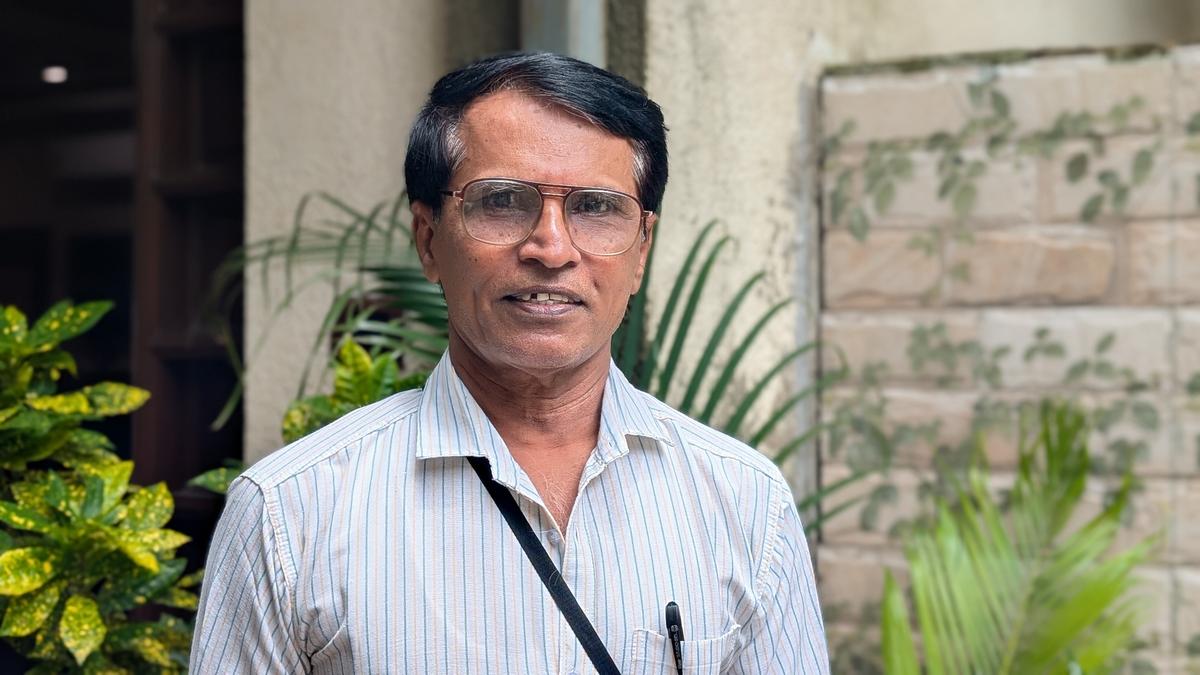
Bhupathi alias Abhay alias Mallojula Venugopal alias Sonu is a former Maoist who has become a coordinator at the Village Council Capacity Building and Training Centre at Gondwana University. | Photo Credit: Vinaya Deshpande Life has taken a 180-degree turn for Bhupathi alias Abhay alias Mallojula Venugopal alias Sonu. He was once a dreaded Maoist, who had a bounty of ₹6 crore on his head, with the police of six different States chasing him. Less than a year after surrendering before the Maharashtra Police, an event that had led to the breaking of the back of Maoism in Maharashtra, the 70-year-old man now looks at a different future.“I am the first person to end Maoism in this country. But what were we doing? There was no personal rivalry between the Maoists and the government. We were representing the tribals. We fought with the system as the representatives of the adivasis. Conflicts will stay till the tribals don’t feel safe, till they feel that ‘Dada’ (a Maoist) should have been there for them. Conflicts will stay till there are no radical changes, till there is no real rehabilitation for the tribals,” he said while speaking with The Hindu in Gadchiroli.When The Hindu spoke with him, he was awaiting the result of the interview he had given for the position of a coordinator at the Village Council Capacity Building and Training Centre at Gondwana University. He has now been selected for it. He said he was happy to get the opportunity to work at the Gram Sabha level.According to the University notification, the coordinators will visit various villages in Gadchiroli district to supervise the functioning of the Gram Sabhas and to create awareness among the local tribal communities about their rights, particularly under forest-related legislations such as PESA. They will receive a monthly stipend of ₹30,000 and travel allowance.“Even today, our intention is to bring awareness among people. Many tribals are not aware about their rights. Why did we come out of the movement? Because we could not work for people, with arms. To struggle for them, we came out. There is no party anymore to go back to it. There is no need to go back to the party. We have left arms now. We can’t work with arms. There are different ways of working,” he said, adding that he was not inclined to join any mainstream political party either, despite getting several invites. He also refused the possibility of forming a political party. He expressed concern about the government acquiring fertile land of the tribals for development projects, leading to flashpoints.Last year, Bhupathi’s letters, distributed widely among the Maoist cadres of the erstwhile ‘Red Corridor’, had led to many Maoists surrendering themselves. Sixty of them had chosen to lay down their arms along with him on October 15, 2025, in the presence of Maharashtra Chief Minister Devendra Fadnavis.Before surrendering, Bhupathi was a senior polit bureau member of Communist Party of India (Maoist) and a dreaded Maoist leader who was at the forefront of the armed Maoist movement in the country for nearly four decades. He was one of the most prominent ideologues and military strategists of the banned CPI (Maoist). He served as a top-ranking member of both the party’s polit bureau and its central military commission.When asked about his interview for the current job, he spoke about his disconnect with the system. “I was asked during the interview about when was PESA formed. I told them, it was legislated in 1996. Then, I was asked when the PESA rules were made. And I did not know that they were made a whopping 12 years after the law was made. Who makes rules 12 years after bringing in a law? Why weren’t the rules made then itself?” he asked.He says that life after surrender has had its own challenges, and he is keen to relocate to his own native place. “Several of us who had surrendered, want to move out of police surveillance and go back to our own village to settle there,” he said. Adding that they were not aware of the one year direct police surveillance after surrender, he said it was causing an issue particularly for the young women who are unable to get married in their village, as they are kept under surveillance in Gadchiroli. Police said that the official procedures regarding the making of the government documents to mainstream them take time. Published - September 02, 2026 07:35 pm IST
From dreaded Maoist to Gondwana University coordinator in Gadchiroli
Full Article
Original Source
Read the full article at Thehindu →KhanList aggregates and links to publicly available news content. We do not host full articles from third-party sources. Always verify important information with original sources.