
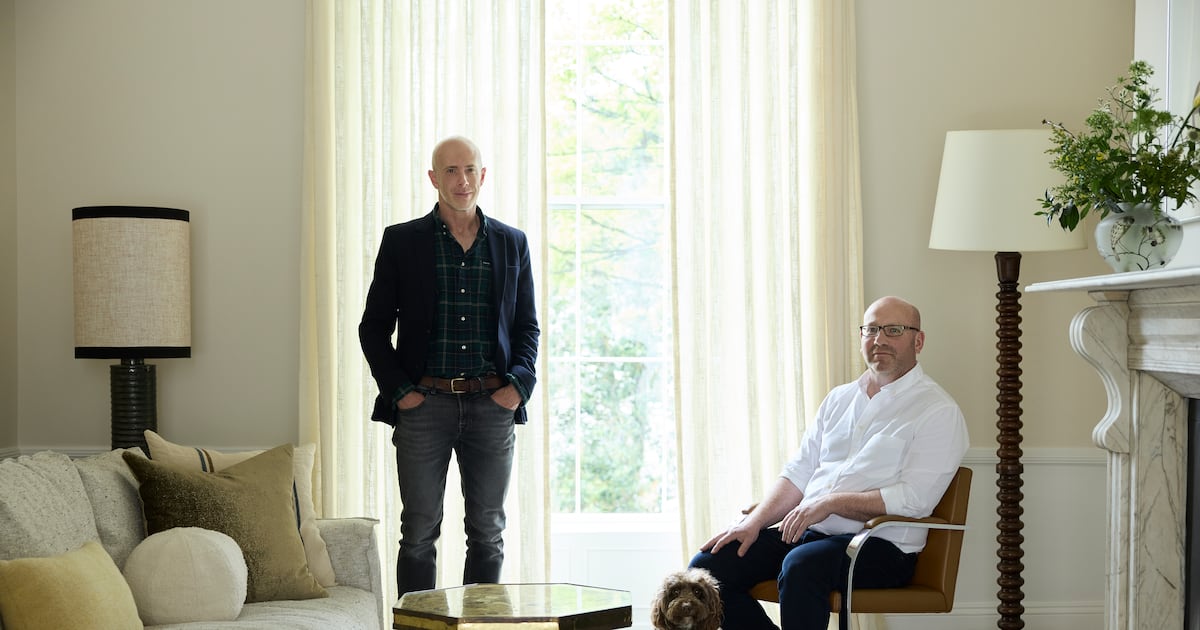
Design duo bought a Georgian townhouse near Dublin city centre and restored it as a showcase for their work in architecture and interiorsJohn Kelly and Eoin Lyons have created one of Dublin’s most beautiful office spaces in their own home, which was built in 1815 on Dublin’s Pembroke Road. The old saying that the cobblers’ children go barefoot may ring true for certain professions, but it wouldn’t inspire confidence in architects and interior designers, if they took this approach with their own offices.The couple behind the LyonsKelly architecture and interiors practice could never be accused of neglecting their office space because they are too busy working for others. John Kelly and Eoin Lyons have created one of Dublin’s most beautiful office spaces in their own home, which was built in 1815 on Dublin’s Pembroke Road.They bought the Georgian town house, which had been used as offices, in 2022, and have been gradually restoring it ever since. “When we bought this house it had been derelict for about 15 years,” explains architect Kelly. “It was in an awful state and we hadn’t really intended putting the office into it, we were just going to live in it. But as the job progressed, we came to the conclusion that four storeys for two men and a cockapoo was probably a bit too much space, so we started debating putting our office into it and how you might make that work.”They received planning permission to return the top two floors to residential use, and their original plan was to keep their home separate from the office. But then they realised the entire building was a showcase for their work in architecture and interior design, so they decided to create a hybrid space. The sleeping quarters remain private, but the basement and first floor now accommodate their 15-strong design team, while the reception rooms, tastefully restored by interior designer Lyons, are used for client meetings.READ MORENeither of them spend much time in the kitchen, so instead of putting it in one of the large reception rooms, they placed it on the first floor landing, which typically would have been used as a lobby or small reception room. Those rooms would often have featured an amber or yellow glass door, so they commissioned Glass Haus in Navan to create an amber glass door in a nod to the past.This mix of office and home is now inspiring their clients to seek something similar. “We’ve a project, another Georgian house which was always in offices, and we are taking it from feeling like an office building to more like what we have here,” Kelly says. “There’s a diningroom that can be used as a boardroom. There’s a sittingroom that can be used for casual meetings and a number of hot desks around the place. People are coming to us more and more for that sort of thing.”He says there is a growing interest in restoring Georgian houses, but the planning process scares people. “It is a long, drawn-out planning process, but it’s fair, because I always think the Georgian houses of Merrion Square and Fitzwilliam Square are our equivalent of Italian palazzos, so there needs to be a very careful planning process around them.”Planning problems typically arise when people aren’t familiar with the process. “A lot of the time when planning applications get clogged up, it’s because people are bringing in an architect from somewhere else who hasn’t got the necessary experience dealing with Dublin City Council’s conservation department. Getting a conservation consultant for a couple of hours to advise them will save them an awful lot of heartache, pain and money down the line,” he says.“We have a Grade 1 conservation architect we work with, Caroline Whately, and she’s brilliant. And then it’s very much about working with the constraints of the house. You need to identify what’s important about the house and then work with the client to say ‘We can do this but we can’t do that’.”John Kelly and Eoin Lyons bought the Georgian town house, which had been used as an offices, in 2022, and have been gradually restoring it ever since. Entrance hall: John Kelly says there is a growing interest in restoring Georgian houses, but the planning process scares people. Stairwell featuring amber glass. The couple commissioned Glass Haus in Navan to create the amber glass door in a nod to the past. Tall Georgian windows with original glass. Choosing the right craftspeople is crucial when it comes to sensitive restoration work involving cornices, timber and fireplaces. “When people come into a house, they want to see the original character and then see what you’ve added to it,” he says. Lyons and Kelly worked with Clonlough Contractors on this project because of that company’s expertise in conservation.“Sometimes people go into an old house and the first instinct is, ‘How do I get double glazing into this? And how do I insulate it?’ We have all the original glass and we actually took out any modern glass and replaced it with old, reclaimed panes of glass, because that’s a huge part of the character of an old house. Get a good company who can seal everything and get them working properly so there isn’t wind blowing around them.”In recent times, the design firm has seen many examples of historic houses that were damaged during the exuberant spending spree of the Celtic Tiger years. “An awful lot of properties were destroyed because people went into them and thought, ‘Oh, I need to get double glazing in there. That wall is crooked; I need to straighten that. The floor is wobbly; I need to straighten it.’ And by the time they were finished, they had obliterated the original character of the house,” Kelly says. “People might say, oh the doors are only old pine, we are going to rip them out and put in mahogany, but that’s 200-year old Norwegian pine and it’s far better than any mahogany.“You can’t undo what has been done, but you can do the best you can do now. The most sustainable way of doing anything is doing it so well that no one wants to rip it out in 20 years’ time. Here we’ve stripped all the ceilings and left them raw and left the original cornices raw. There’s beautiful character in the ceiling.”In contrast, the furniture and carpets are modern. “You have to be very careful with a house like this to not turn it into a museum. It has to be comfortable to live in.” They encourage people to ignore the feeling that they have to fill a house like this with heavy brown furniture.Lyons says getting the balance right is the most important thing. “Sometimes people just throw a load of modern things into a room and it doesn’t really work. But here, it works because everything is in proportion. They’re contemporary pieces, but they are for the space. And that’s really more important than the style. Choosing the right size radiators for the room is also important to consider.”'We have all the original glass and we actually took out any modern glass and replaced it with old, reclaimed panes of glass, because that’s a huge part of the character of an old house.' The mix of office and home is now inspiring LyonsKelly clients to seek something similar. Ornate antique fireplace in Georgian reception room. Reception room with wall given over to books on design. He cautions against trying to make everything look perfect. “Nothing is ever perfect, so go with the non-perfectness. It’s okay to have a crack here and there. It adds character to it.”Instead of the bare floorboards you might expect in a house like this, he opted for a wool and sisal carpet “which makes it cosy and adds to the insulation. Our colours are all warm, the materials are warm to touch and we’ve tried to use natural materials as much as possible.”‘We share steps, railings and gates with our neighbours, so we were very lucky that we have good neighbours who wanted to come in with us on that’— John KellyThe attic and floors have been insulated, and underfloor heating was added in the basement. “The underfloor heating almost mimics how the old fire ran in the basement, 24 hours, 365 days a year. And that drives the damp out of the walls and keeps a constant, low level background heat on which is very beneficial for the whole house,” Kelly says. “It’s not cold in winter, and in summer you are able to open the windows at the front and back of the house to get cross-ventilation.”They used modern technology where possible to minimise invasive construction work. “For example, we did a very modern Bluetooth lighting system which meant we didn’t have to chase the walls. There are very good alarm systems now that are wireless so you don’t have to bring in cables. What the planners don’t want you doing is cutting into old floor joists and things like that, and damaging walls if you don’t need to do it.”Integrating all the pipes and cables needed for modern living can be a challenge in a house like this and they often end up boxed off in a corner. They found a novel solution to this predicament. “In all these houses, there would have been two fireplaces at least on each floor, so you end up with lots of redundant chimney flues,” Kelly explains. These flues are about 40cm wide and are now being used to carry waste pipes from the bathrooms upstairs, as well as other cables and pipes.They couldn’t avail of the Vacant Property Refurbishment Grant because the property included an office as well as their residence, but they did receive grants from Dublin City Council’s Built Heritage Investment Scheme, to help them replace the roof and restore the granite steps at the front of their house.Kitchen space on upper floor. Working space with exquisite historical cornicing on unpainted ceiling. Quiet garden space with cobbled area, privacy-enhancing hedges and curved pebble pathway. “In terms of adding value, the steps were one of the best projects we did here in this house. We share steps, railings and gates with our neighbours, so we were very lucky that we have good neighbours who wanted to come in with us on that,” he says. The railings were restored to their original glory by Cavan blacksmith Alan Clarke. “Now we often stand out or sit on the front steps with the neighbours and have chats.” He says Pembroke Road has a really nice neighbourhood buzz. “Baggot Street is a vibrant urban village. There are great pubs and restaurants and still a couple of independent shops.”The couple agree that they are privileged to live and work in such a house. “We are very lucky,” Lyons says. “It is a beautiful part of the city.”IN THIS SECTION
From derelict D4 Georgian to deluxe home office: ‘Four storeys for two men and a Cockapoo was probably too much’
Full Article
Original Source
Read the full article at Irishtimes →KhanList aggregates and links to publicly available news content. We do not host full articles from third-party sources. Always verify important information with original sources.