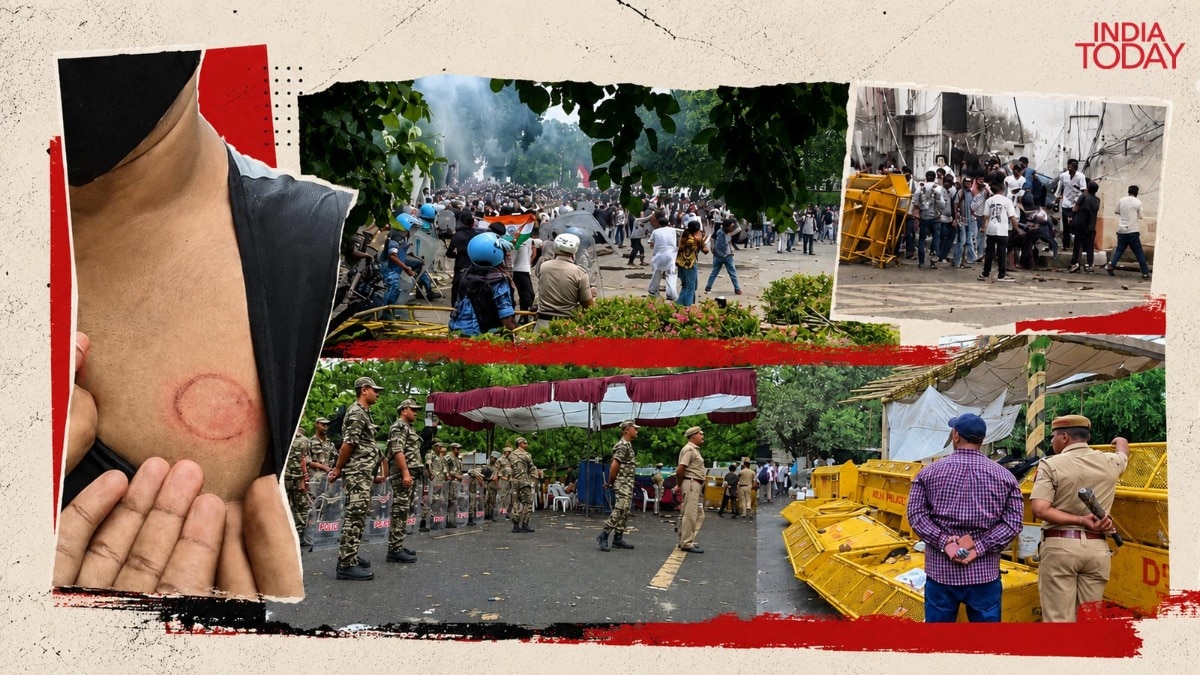
July 20 marked the day the hunger strike at Jantar Mantar erupted into a mass protest, with thousands demanding the Education Minister's resignation before marching towards Parliament on the opening day of the Monsoon Session. As the crowds dispersed, the scars of the crackdown — and the stories left behind — remained. India Today Digital returned to the protest site the next day to capture what unfolded after the headlines. Here's our report...From crackdown to comeback: How police action drew more protestors to Jantar MantarThe Gen Z Revolution — that is how many young protesters describe the ongoing demonstration at Jantar Mantar, which has now entered its 24th day.If July 20 was meant to disperse the movement, many here believe it achieved the opposite. The lathi charge, tear gas and the images of injured students quickly spread across social media, transforming the police action into a rallying point. By Tuesday morning, July 21, Jantar Mantar was drawing not just those who had been on the streets a day earlier, but also students, young professionals and families who said they came after witnessing the crackdown.For many, it was no longer only about an education protest; it had become a question of standing with fellow students (or just being there for the youth) who they felt had been treated unfairly.When our team at India Today Digital reached the protest site today, the overwhelming emotion was not fear but that of anger. Many first-time protesters that we spoke to said the events of the previous day had hardened their resolve rather than weakening it in any way. Their demand remained unchanged. They were (now loudly) seeking accountability from Union Education Minister Dharmendra Pradhan and meaningful reforms to an education system they say has repeatedly failed them.STORIES WRITTEN IN BRUISESAmong those standing at the protest site was Hardik, a 20-year-old law student. He showed our camera person a large bruise on his chest, which he said was caused by a tear gas shell fired during Sunday's clashes. His injury told a story beyond words, one of struggle, fear and what he described as excessive police force used on students and other protestors by those who are responsible for law enforcement.Hardik was not alone. Many other protesters displayed injuries on their legs, hands and other parts of their bodies, claiming they were sustained during the clashes with the police a night before (July 20).WHAT REALLY HAPPENEDOn the morning of July 20, as announced earlier, the CJP called upon its supporters to assemble at Jantar Mantar before marching towards the Parliament. They were demanding the accountability and resignation of Union Education Minister Dharmendra Pradhan.However, police invoked prohibitory orders under Section 163 of the Bharatiya Nyaya Sanhita (BNS) and denied permission for the march.As thousands of young protesters gathered, the situation escalated quickly. Barricades were breached as big groups attempted to move towards the Parliament, turning the protest site into a flashpoint."Democratic protests are our right. A march to the Parliament cannot be considered a threat to any leader or a politician. It is simply our way of making legislators hear what we feel," said Upasna, 22, who travelled from Mumbai to participate in the protest.Like many others present that day, she alleged that protesters were lathi-charged during the confrontation.WE ARE FIGHTING FOR OUR RIGHTS"Do you think everyone gathered here is anti-national? How can anyone say that?" asked Chinmay, a Delhi resident pursuing his graduation from Delhi Technological University (DTU)."I have been living in Delhi since 2006. I believe this is our right. What happened yesterday must be discussed and raised as an issue. We are fighting for our rights, and we will continue to do so," he told us about the serious injuries that he sustained due to the police force that was used on protestors without any regard or warning.More than 90 per cent of the protesters that we spoke to were between 18 and 25 years old, placing them firmly within Gen Z. Many said they had returned to Jantar Mantar after the July 20 police action, not despite the warnings, but because of them.Several described the crackdown and alleged threats as a turning point that strengthened their resolve to be a part of the ongoing protest for as long as it would take.For many, coming back to the protest site was an act of solidarity with those who were injured; for others, it was a way of showing that intimidation would not deter them from demanding accountability."Far from it," Hardik said.THE CHARM OF 'SONAM SIR'Hardik's experience was echoed by several others, who alleged they were subjected to excessive force during the clashes."I am a law student. I never imagined I would come out to protest. But after seeing Sonam sir (Sonam Wangchuk) and how he was dragged to the hospital, I couldn't stop myself. I came out not for myself but to support fellow young Indians who cannot be blamed for repeated exam leaks. We have been offered nothing but uncertainty. Now we cannot remain silent," Hardik told us."I was hit by a tear gas shell. The policemen could have fired it from a distance where I was standing, but they didn't. They wanted to hit me, and they did," he added.Nearby stood Adrian, another protester, showing bruises on his leg that he said resulted from baton blows from the "insenstive lathi charge on July 20.".For many present, these injuries had become symbols of what they believed was a disproportionate response to their demonstration.Among the protesters was Alina, 19, who joined the movement on July 16 after Sonam Wangchuk had announced his indefinite hunger strike. "The July 20 protest became much bigger than anyone expected," she quipped. According to her, several "unwanted elements" entered the protest and contributed to the violence."There were people who were not part of the original movement. They were there only to create chaos, and that led to the clashes," she alleged.Several protesters also alleged that some of those involved in the lathi charge were not in police uniform. “They were carrying the same sticks as the police,” claimed Alina, adding that officers did not intervene to stop them.The concern was echoed by several others, who alleged that the protest’s original focus, which was justice for NEET aspirants and the demand for the Education Minister’s resignation, began to blur as outsiders joined the gathering, changing both its character and the course of events.According to official figures, many protesters were detained during the July 20 clashes. Authorities also said around 120 police personnel, including five IPS officers, sustained injuries. There is, however, no official data on the number of students injured.During our visit, several protesters claimed that many students had suffered serious injuries. Some also alleged that two to three protesters remained untraceable after the clashes, though these claims could not be independently verified.The bruises may begin to heal, but the anger has only deepened. As the protest enters another day, Jantar Mantar remains a symbol of a generation unwilling to back down. For many young protesters, July 20 was not the end of a confrontation, it was the moment their movement found a louder voice.- EndsPublished By: Rishab ChauhanPublished On: Jul 21, 2026 23:59 IST
From crackdown to comeback: Police action drew more protestors to Jantar Mantar
Full Article
Original Source
Read the full article at Indiatoday →KhanList aggregates and links to publicly available news content. We do not host full articles from third-party sources. Always verify important information with original sources.