
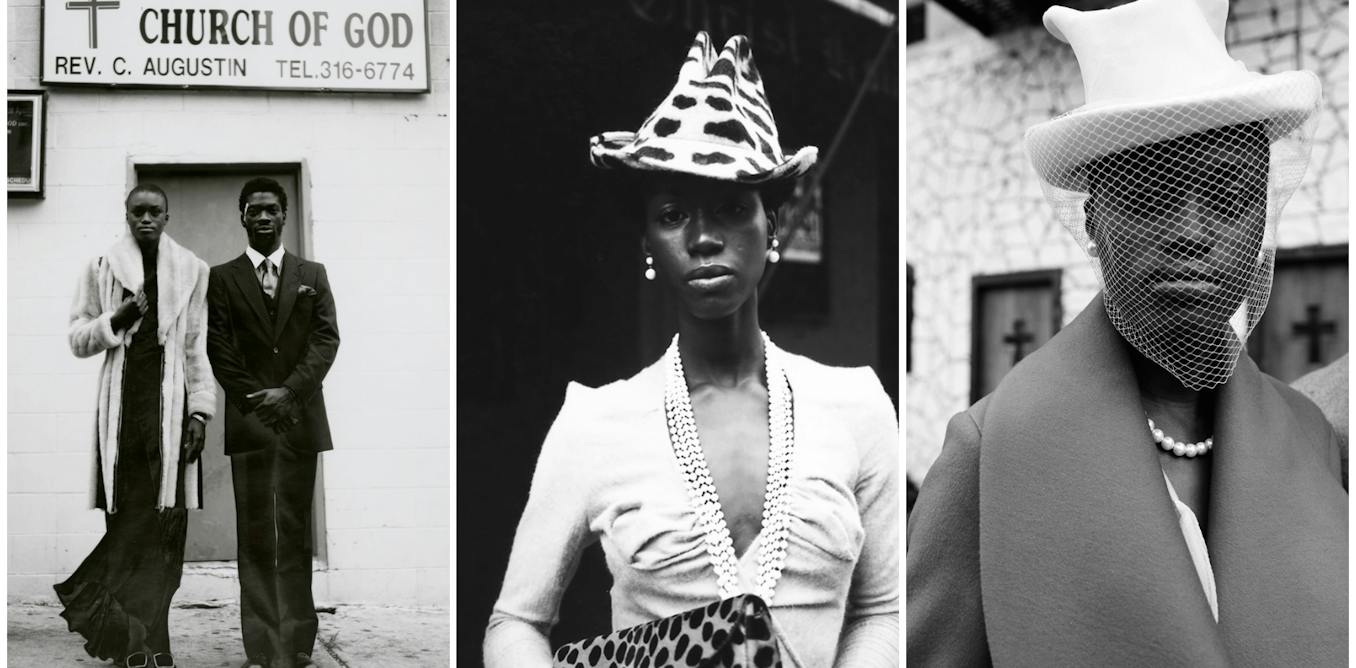
For some, the lesson in needing to look presentable to society began with a reprimand about scuffed shoes. For others, it was a warning about stray hairs, an untidy hairline, trousers that needed pressing or a last-minute stain. A parent was often ready to send you back to the mirror, unwilling to let you leave looking as though nobody at home had taken the time to care for you. Behind these admonitions was an uneasy mixture of affection and discipline. Taking pride in one’s appearance communicated dignity, but it also reflected the demands of respectability in a world where Black people have often worked exceptionally hard for recognition routinely afforded to others. No one needed to grow up attending church to appreciate the ethic of “Sunday Best.” Rooted in traditions of dressing for worship, the practice reflects a collective belief that appearance can express reverence for an occasion and regard for those with whom we share it. Melodie McDaniel, untitled photo, from the series Sunday Best (© Melodie McDaniel/AGO/Sunday Best/) ‘Sunday Best’ exhibition at the AGO At the opening of the Art Gallery of Ontario’s “Sunday Best: The Power & The Glory of Black Style,” the crowd understood the assignment. Attendees arrived dressed to impress, bringing sartorial flair to the celebration. Conceived and curated by a transnational team, including AGO curator Julie Crooks and fashion historian Jason Cyrus, with Amanda Bock and Clare Sauro, “Sunday Best” brings together garments, photographs and personal effects spanning Black diasporic life from the 1880s to the present. Displays of church fashion recall generations of Black women and the splendour of dress for Sunday worship. Elsewhere, the distinctive uniforms of the Black Panther Party are on display, a nod to the role clothing and fashion play in political organizing. The exhibition also honours Black dandies, alongside those who have challenged conventions of gender through the way they dress. Among them are Toronto-based trans soul singer Jackie Shane and the late fashion icon André Leon Talley, a long-time editor at Vogue magazine, whose styles helped to expand the possibilities of Black self-presentation. The exhibition also contains references to ballroom culture that show how Black traditions of dress and performance have been inherited and reimagined for self-expression and communal recognition. Renewed attention on Black fashion The exhibition traces how Black styles and cultural practices travel through migration. Visitors may recognize traces of traditions from their own families. A hat may evoke an auntie preparing for church, a family photograph the sober pride of relatives posing for a formal portrait. The curators bring these expressions of Black life together, drawing connections between diverse traditions. The exhibition arrives amid renewed public attention to Black fashion. Last year, New York’s Met Gala put Black dandyism on the global stage with its theme, “Superfine: Tailoring Black Style.” “Sunday Best” contributes to this conversation by showcasing the communal rituals that give style meaning. The exhibition calls attention to the pressures under which Black people have fashioned themselves. Njideka Akunyili Crosby, The Beautyful Ones May Have Arrived (©Njideka Akunyili Crosby/AGO/Sunday Best) Respectability and beauty In an iconic 1956 photograph, Gordon Parks depicts Joanne Thornton Wilson and her niece Shirley Anne Kirksey standing beneath a neon “Colored Entrance” sign outside a department store, in Mobile, Alabama. Their elegant and dignified dress contrasts with the indignity of segregation. For generations, dressing well could be understood as a defence against racial scrutiny or a means of improving one’s social standing. But no degree of sartorial excellence could guarantee protection from discrimination. The demands of respectability also placed constraints on those whose expressions of gender or sexuality challenged accepted conventions. Covers of Ebony magazine on display offer another perspective. As a Black-led publication, Ebony helped cultivate images of Black beauty and achievement in the United States that spoke to how Black communities understood themselves, free from the stereotypes and expectations of mainstream audiences. Across these histories, the attention given to one’s appearance carried meanings beyond the judgments of others. Dressing for worship could express reverence, just as a carefully chosen outfit might bring pleasure or communicate regard for others. The Sunday best tradition thus emerges as an ethic of dignity and care, fostered within Black communities even when those qualities went unrecognized by the wider society. Jamel Shabazz church Ladies NYC. (Jamel Shabazz / @Jamel Shabazz) Black queerness The exhibition’s treatment of Black queerness unsettles the presumed divide between church traditions and ballroom culture. Black churches have held complicated relationships with queer people, offering spaces for artistic expression alongside experiences of exclusion. Through these church communities, Black queer people have inherited styles and sensibilities they continue to reinvent. Consider drag performer Kennedy Davenport’s viral appearance on The Pit Stop. Reacting to another queen’s outfit, she sang: “Black stockings, white shoes, shouldn’t be allowed in the church.” Her playful critique drew on the rules of Black church fashion, finding humour in a set of esthetic rules passed down through generations. Black queer performers have also helped shape gospel music and traditions of Black religious life, including in spaces where their sexuality was not fully accepted. In “Sunday Best,” the proximity of church fashion to ballroom culture highlights how these traditions inform one another. Through inventive clothing and performance, ballroom turns resourcefulness into glamour, creating spaces where beauty and ambition earn recognition. Read more: Black style and resistance: The Met Gala, dandyism and blackface in Canada A ‘habit of care’ In the exhibition, everyday grooming tools share space with dresses and photographs. Hairbrushes evoke the private rituals behind a public appearance. Many of these belongings have survived for decades. In her book Ordinary Notes, writer and scholar Christina Sharpe describes regard as “a habit of care.” She says: “It is appreciation and esteem. It is the right of repair.” Her words invite us to consider the attention given to these belongings and the lives they represent. Melodie McDaniel photograph from Sunday Best series, Harlem, NY. ©Melodie McDaniel/AGO/Sunday Best/) The curators extend this ethic of care to bring these histories together. From garments and paintings to archival photographs and moving images, their staging treats Black cultural expression as worthy of preservation and public appreciation. Behind the displays lies the painstaking labour of conservation, ensuring these materials will encountered by new generations. Black artists have long struggled for recognition in Canadian institutions, giving moments like these added weight. In 2019, the AGO hosted “The Feast”, marking 30 years since the groundbreaking exhibition “Black Wimmin: When and Where We Enter.” The gathering brought 100 Black women and gender-nonconforming artists and cultural workers into AGO’s Walker Court. At the opening of “Sunday Best,” the carefully dressed crowd offered another expression of this cultural legacy. Across the gallery, objects once worn with pride had been kept with care, their stories deserving of the same attention. Sunday Best: The Power & The Glory of Black Style is on view at the Art Gallery of Ontario until Feb. 28, 2027.
From church pews to ballroom floors, AGO’s ‘Sunday Best’ showcases the power and glory of Black style
Full Article
Original Source
Read the full article at Theconversation →KhanList aggregates and links to publicly available news content. We do not host full articles from third-party sources. Always verify important information with original sources.