
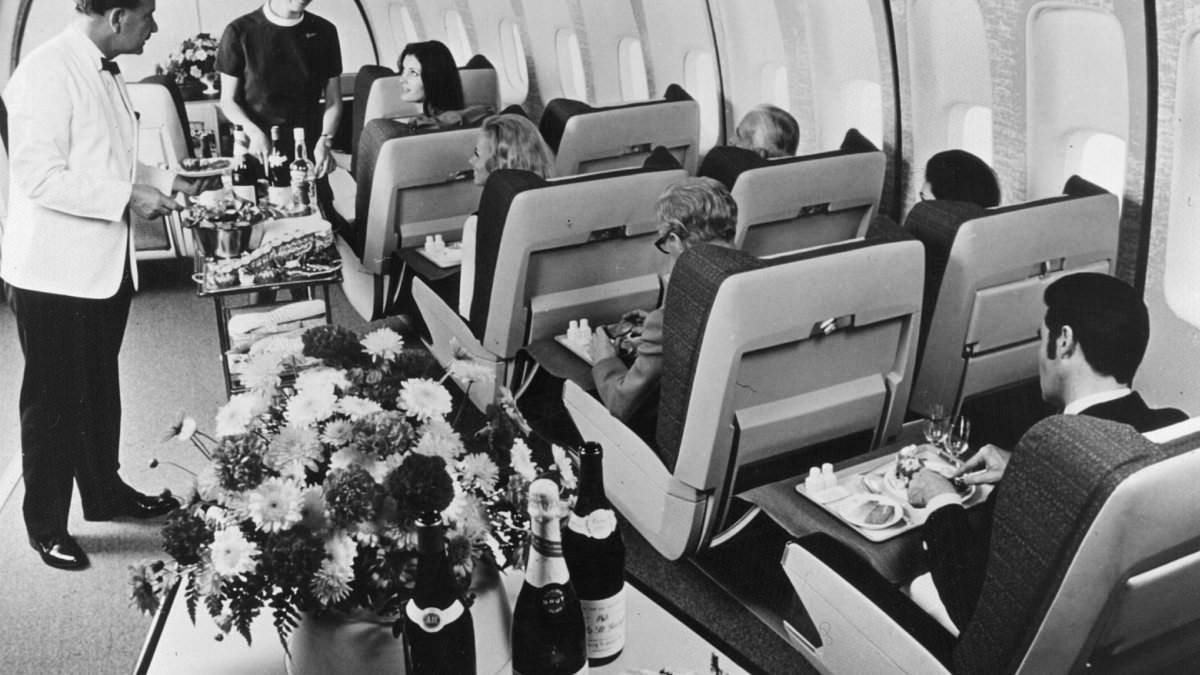
During the 'golden age' of aviation, back in the 1950s and 1960s, airline passengers boarded planes looking pristine, oozing with the glamour of silver-screen icons. Forget the matching tracksuits now associated with Heathrow's departures lounge: women wore expensive pearl necklaces, gloves and dresses, men donned Italian suits and even children were clad in tailored formal wear, with bow ties for young boys. These affluent passengers travelled in a style that few could afford or even imagine – a different situation entirely from the £20 flights offered by budget carriers such as easyJet and Ryanair today.And as the getups were expensive, so too were the airfares. A ticket could cost as much as a whole month’s salary; a one-way ticket from Britain to Rome during the golden age would cost the equivalent of £3,000 in today’s money, according to Key Aero. Pan American World Airways, or Pan Am, introduced the Tourist Class in 1948 – and that's when things really took off (quite literally).Service was on par with style. Travel on planes has morphed from stylish to budget-friendly over the decades Flying was once a very glamorous affair, with passengers dressed up to the nines You could expect champagne and silver service, with standout food served on every flight Before the era of budget flights, back in the 1950s seats were more spacious and comfortableIn-flight meals could have up to five courses, with reports of steak and lobster being served not uncommon. Silver service was the norm, with white linen tablecloths and real silverware used.You could even pay a porter to collect your baggage after the flight. So, what on earth has happened? A major factor in this decline is airline deregulation, which means carriers can set their own prices and routes.Notably, in the US in 1978, this meant new airlines could enter the market – and prices could drop.In the UK, the 1980 Civil Aviation Act marked the start of this era, which culminated in the 1987 privatisation of British Airways. Seat-price competition was key. The deregulation between Britain and Ireland in 1986 brought reductions in fares of more than 50 per cent – and passenger numbers doubled.As a result, flying became more accessible, cabins became fuller and the path was paved for the introduction of low-cost carriers. Passengers could expect white tablecloths and silver service Flying was reserved for the wealthiest. Pictured: Marilyn Monroe on board a jet in How To Marry A Millionaire Pan American World Airways flight attendants wore stylish uniformsThe world's first low-cost carrier was Pacific Southwest Airlines, which launched in 1949.But the aviation landscape has changed even more dramatically since then. The launch of easyJet in 1995, for instance, made flying even more accessible.Airlines realised that passengers would rather forgo free food and drinks on board in exchange for cheaper flights.And this mentality has become even more pronounced in recent years.British Airways ended complimentary meals in economy class on short-haul flights in 2016 – and other airlines have also scrapped extras since.This year, Delta Air Lines has announced it is scrapping in-flight food and drink service on hundreds of flights to cut costs. Airports have changed too - pictured is a cafe at Gatwick Airport in 1960 Two models, sitting in an Iberia 747 (first class section) plane dressed smartly A stewardess taking payments for a one-way ticket bought onboard the planeFurthermore, Ryanair has even said that passengers are not permitted to bring hot drinks on board during boarding.Legroom has also significantly decreased over the decades.Economy class seats once had around 34 to 36 inches of legroom – but nowadays offer as little as 29 inches, and sometimes even 28 inches.Cabin crew uniforms have changed too, in favour of comfort and practicality. Today’s crews favour sleek, practical designs, but over the decades they’ve donned everything from military-style suits and pillbox hats to mini skirts, go-go boots and eye-catching shoulder pads.In the 1930s, the role of cabin crew was to clean the cabin, adjust the clocks, carry buckets of fuel to the plane, ensure passengers did not throw things out of the window and even help push the plane into the hangar before going home. As such, uniforms were highly functional and conservative – think structured jackets and skirts, hats and gloves, simple colours. By the 1950s, airline travel was becoming more commonplace – and with that came an update to uniforms.Cinched waists, knee-length pencil skirts, white gloves and pillbox hats were the order of the day, with an emphasis on femininity and glamour. Fashion designers got involved in later decades, adding to the sophisticated feel. The introduction of budget airlines - including easyJet - has also transformed the landscape Legroom has decreased significantly over the decades, too - with many passengers finding themselves crammed into their seats nowadaysBut by the start of the 21st century, impractical accessories became a thing of the past, and the focus was instead on branding and comfort.As well as a change in airlines, the transformation of airports has contributed to the marked difference in aviation.Gone are the days when you could waltz up to the boarding gates to say goodbye to a loved one before they boarded a plane. They have become larger hubs, with much stricter security, especially following the rise in plane hijackings during the 20th century – and, of course, the horrific events of September 11, 2001.Commercialisation and airline competition might have us dreaming of more glamorous days luxuriating in jets over five-course meals.But it's not all bad. At least now many more of us get to see more of the world – even if with a tad less pizazz.
From champagne and silver service to tiny seats and airport chaos: How we lost the golden age of air travel
Full Article
Original Source
Read the full article at Dailymail →KhanList aggregates and links to publicly available news content. We do not host full articles from third-party sources. Always verify important information with original sources.