
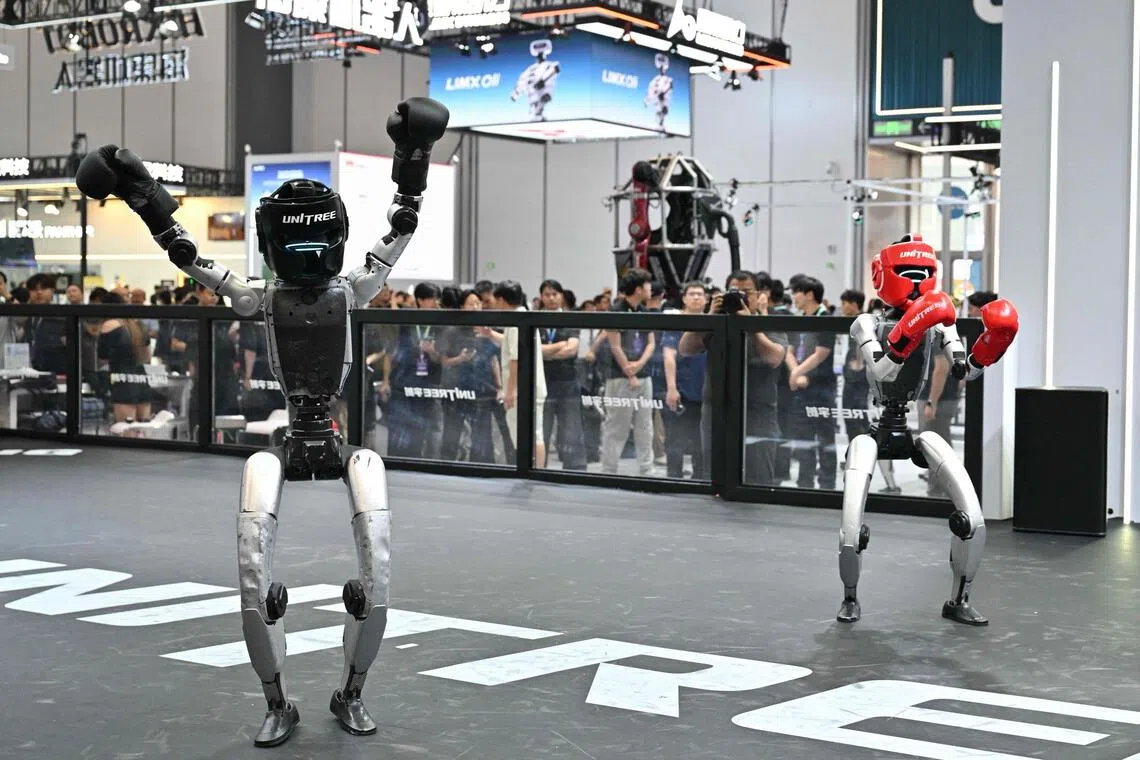
BEIJING – Inside a boxing ring, two agile humanoid robots traded roundhouse kicks and punches. Two booths away, a less nimble robot spent nearly two minutes trying to fold a T-shirt before its human handler finally stepped in.These contrasting scenes played out at Beijing’s World Robot Conference on Aug 20, the day after investors sent shares of Hangzhou-based Unitree Robotics soaring as much as 629.44 per cent in its trading debut in Shanghai, to a valuation that many analysts say has raced ahead of current fundamentals.Experts said the blockbuster listing of the poster child for China’s humanoid robotics push shows that investors are placing enormous bets on what these robots could eventually become, at a time when the industry is still figuring out how to turn current capabilities into reliable, commercially viable applications.China - the world’s largest producer of humanoid robots - is betting it can close that gap and is increasingly putting both its industrial might and capital markets behind that effort.Unitree raised 6.1 billion yuan (S$1.15 billion) in its initial public offering (IPO) that was more than 8,000 times oversubscribed, making it the first humanoid robot maker to list on mainland China’s stock market.Its debut came just weeks after top Chinese memory chipmaker ChangXin Memory Technologies (CXMT) staged another blockbuster Shanghai listing in late July.Analysts said the two high-profile listings point to a broader effort to steer capital towards strategic “hard technologies”, as Beijing pursues industrial upgrading and greater technological self-reliance amid an intensifying tech rivalry with the United States.Hard tech broadly refers to technologies rooted in advanced science and engineering that typically require research and development, capital and manufacturing capabilities. It includes semiconductors, artificial intelligence (AI) and robotics.Marina Zhang, an associate professor at the University of Technology Sydney, said the timing of Unitree’s IPO on the first day of the World Robot Conference in Beijing, is highly symbolic.“The message Beijing wants to send is essentially that China has moved humanoid robotics from laboratory experimentation into industrialisation,” said Zhang, who researches the intersection of technology and geopolitics.“Beijing is trying to create the expectation that embodied AI could become another electric vehicle (EV)-like industrial success,” she said, referring to the integration of AI into physical machines and systems.Capital pours into “hard tech”Zhang said China’s capital markets are increasingly being used as an instrument of industrial policy.“It’s not simply to finance mature companies, but to help scale strategic technologies. These are areas Beijing views as essential to industrial upgrading and technological security, particularly under US controls,” she said.In late July, the US banned imports of new Chinese humanoid and quadruped robots, along with certain components, citing national security and cybersecurity risks to critical AI infrastructure.China also has a comparative advantage in industries where technology must be combined with manufacturing, suppliers, engineering and rapid cost reduction, said Zhang.“Robotics fits that pattern much better than purely software-based innovation,” she said.More than 3,000 robot-related products by over 300 Chinese and overseas companies are being showcased at the conference which runs till Aug 23.In recent years, Beijing has elevated humanoid robotics and embodied AI from an emerging technology into strategic industries, with embodied AI mentioned in China’s government work report for the first time in 2025.Since then, capital has poured into the sector.In the first quarter of 2026, China’s domestic embodied AI sector recorded more than 50 financing deals worth around 20 billion yuan, according to figures from Chinese investment databases IT Juzi and Centi.Chinese state media Xinhua reported that 116,000 new companies were registered in China’s humanoid robotics sector in the first half of 2026.Even within China’s robotics industry, the scale of investor enthusiasm for Unitree caught some by surprise.At the robot conference, Lumos Robotics founder and chief executive Yu Chao told The Straits Times that industry players had expected Unitree to command a market capitalisation of around 100 to 200 billion yuan. Instead, it hit about 445 billion yuan on its first trading day before closing at 341.8 billion yuan.Yu acknowledged that the valuation had run ahead of the maturity of the industry’s real-world applications, but said short-term valuations mattered less than its longer-time trajectory.“As long as the overall trend is upward, whether something is overvalued or undervalued at a particular point in time is not that important,” he said.From spectacle to commercial realityA Robbyant wheeled humanoid robot developed by Shanghai Ant Lingbo Technology Co., works at a drug store during the 2026 World Robot Conference in Beijing on Aug 20. PHOTO: AFPThe bigger question for the industry is whether humanoid robots can prove their economic worth, as the industry’s yardstick for progress is already changing, he said.“Industry benchmarks for humanoid robots used to be how fast they can run or whether they can dance well. But now, people are more concerned about the practical applications, the success rates and the return on investment,” said Yu.His two-year-old start-up has since earlier this year deployed humanoid robots at a Mitsubishi factory in Suzhou to handle mechanical parts, he said. Three of the robots displayed at the conference had been shipped directly from the factory floor.At the conference, the emphasis was on putting robots of all sizes to work. “Worker robots” were seen demonstrating skills needed for factories, warehouses and homes, such as sorting parcels, lifting boxes and checking out groceries.Robotic capabilities will also be put to the test from Aug 22 to 26 at the second World Humanoid Robot Games in Beijing, where robots will compete not only in sports such as tug-of-war and weightlifting, but also in scenario-based events designed to mimic real-world applications, such as emergency response and hotel services.Even Unitree’s founder and chief executive acknowledged that the industry has some distance to go.Speaking to a packed hall at the robot conference on Aug 20, a day after his company’s market debut, Wang said robotics would have its true “ChatGPT moment” – a breakthrough that could trigger mass adoption – when a humanoid robot could be placed in an unfamiliar home and complete about 80 per cent of tasks based on text or voice commands alone.That breakthrough could arrive “in two to three years if things move fast, or five to 10 years if they move slowly,” said Wang, giving a more conservative outlook than at the same conference in 2025 when he estimated one to three years in a faster scenario and three to five years if progress was slower.Today’s humanoid robots are still less efficient than human workers and generally have to be retrained from scratch for each task, which is the main obstacle for the industry globally, he said.While robots can reliably plan broad movements, they still struggle with the precision required in the “last few centimetres or millimetres” of a task, he said, adding that Unitree is working on what he calls a “self-evolving development loop” aimed at closing the gap.Founded in 2016, Unitree gained widespread attention with its dancing and kung-fu fighting humanoid robots at the annual Lunar New Year gala in 2025 and 2026.Wang’s own profile has risen alongside his company’s. He was seated in the front row at Chinese President Xi Jinping’s rare meeting with some of China’s most prominent tech leaders in Feb 2025.Visitors walk past a giant humanoid robot at the Topsun booth, during the 2026 World Robot Conference, in Beijing, China on Aug 21. PHOTO: REUTERSThe rapid rise of Unitree mirrors the wider boom of China’s humanoid robot industry.Morgan Stanley estimates China’s broader robotics market could more than double from US$47 billion in 2024 to US$108 billion by 2028, while the global humanoid robot market could eventually reach US$5 trillion by 2050.Global humanoid robot shipments topped 22,000 units in the first half of 2026, nearly 300 per cent higher than a year earlier, according to a Counterpoint Research report published on Aug 20.Five Chinese manufacturers – AgiBot, Unitree, Galbot, UBTech and Leju Robotics – accounted for 86 per cent of shipments, with AgiBot and Unitree occupying the top two spots.A separate industry report released on Aug 20 by the China Humanoid Robotics and Embodied Intelligence Committee of 100 gave a more optimistic outlook. It estimated that China shipped more than 40,000 humanoid robots in the first half of 2026, accounting for 97 per cent of global shipments. The discrepancy likely reflects different methodologies and yardsticks.UBTech is already listed in Hong Kong while AgiBot, Leju Robotics and Galbot are reportedly considering or preparing for IPOs.Counterpoint said it expects global shipments to exceed 50,000, up 210 per cent from 2025 and projects that the industrial and service applications will overtake entertainment, performance and research as the main drivers of demand over the next five years.But rapid growth in production has yet to be matched by convincing evidence of commercial value outside the exhibition hall, said Ni Tao, founder of Yangtzeer.com, a website tracking technology innovation in China’s Yangtze River Delta.China has made tremendous progress in humanoid robotics and embodied AI but has yet to produce convincing milestones that show robots moving beyond “flashy showcases of their dexterity and athletic potential into real-world deployments that create genuine commercial and societal value,” he said.“Making this pivot will be essential to the long-term, sustainable growth of China’s robotics industry,” he said.
From boxing to folding shirts: China’s humanoid robot boom faces real-world test
Full Article
Original Source
Read the full article at Straitstimes →KhanList aggregates and links to publicly available news content. We do not host full articles from third-party sources. Always verify important information with original sources.