
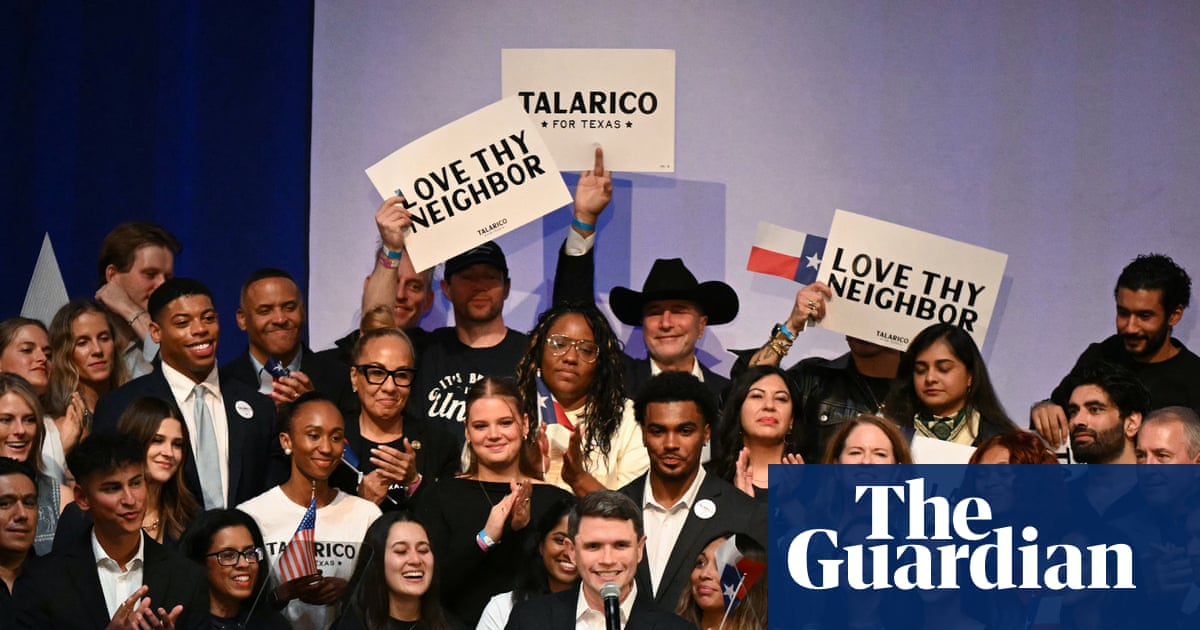
Democratic victories in Texas came down like a deluge on election night after decades of drought.James Talarico defeated Texas attorney general Ken Paxton to become the state’s first elected Democratic US senator in nearly 30 years. Gina Hinojosa will soon be Texas’s first-ever Latina governor and its first Democratic governor since 1995. Texas Democrats also flipped 20 state House seats, three seats on the state Board of Education, all four Texas supreme court seats and all three Texas court of criminal appeals seats up for election.Wendy Davis, a former state senator and 2014 Democratic gubernatorial candidate, likened navigating the historic groundswell to trying to drink out of a firehose: “Who knew that winning was such hard work?”Davis, who rose to national prominence for her filibuster of the state senate’s 20-week abortion ban, knows how difficult it is to run as a Democrat in Texas. She lost the governor’s race to Greg Abbott, then Texas attorney general, by more than 20 percentage points. Four years later, in 2018, Beto O’Rourke got within just under 215,000 votes of defeating Senator Ted Cruz. Much like Davis, who now supports down-ballot Democrats through her Pac Blueprint Texas, O’Rourke gave hope to a new generation of Texans through a grassroots statewide 254-county tour during his run for senator and his volunteer-led voter engagement organization, Powered By People, which he launched two years later.Map of Texas counties showing the ones that flipped from voting for Trump in 2024 to voting for James Talarico in 2026For organizers who’ve spent over a decade trying and failing to mobilize voters against an increasingly hostile Republican-led government, “Blexas” felt firmly in pipe-dream territory. Which is why this down-ballot flip came as such a shock, especially to liberal Texans made cynical by year after year of disappointments.“A lot of us have not known a world where that was possible,” said Aimee Prudhomme, 39, executive director of Powered by People, who, in January, will live in a Democratic-led Texas for the first time since childhood. For many of the organization’s staff, this will be their first. “We kept trying to fight for it and then kept having our hearts broken, time and time again in this state.”Burn it all downAfter O’Rourke lost in 2018 and the Texas Democratic Party (TDP) failed to materialize wins for its down-ballot candidates in 2020, dozens of the party’s executive committee members signed a letter demanding that chair Gilberto Hinojosa (father of governor-elect Gina Hinojosa) initiate sweeping changes to the party’s direction. Among those leading the charge was Kendall Scudder, a former Democratic state senate candidate from religious, rural east Texas, home to some of the “saltiest, grittiest Democrats out there”, as he put it. When Democrats failed to win again in 2024, Hinojosa resigned and Scudder ran to finish out the remainder of Hinojosa’s term – and won.Now leading the state party, Scudder has championed several changes that echoed the demands party members made years prior. One was instituting a taskforce to re-evaluate the location of the party’s headquarters. Scudder’s assessment was that organizers outside the capital of Austin had a harder time getting party leaders to pay attention to their issues without knowing someone on the inside who could help.To break up the saturation, Texas Democrats moved the headquarters from Austin to Dallas, while maintaining an office in the capital city and opening offices in Amarillo, Eagle Pass and Houston.Texas Democratic Party chair Kendall Scudder speaks at the Texas Democrats watch party at the Hyatt Regency in Austin on 3 November. Photograph: Sara Diggins/The San Antonio Express-News/APThe 2020 letter also asked for an overhaul of the party’s approved vendors list, which Scudder described as consisting of holdovers from old-guard Democratic operatives that made it harder for newer, innovative talent to be considered for services like ready-to-use digital branding. A new, transparent request-for-proposal process resulted in all vendors now owned by at least one person of color.“We became this corporate party for defending institutions, and I’m sorry, defending institutions is not standing for something,” Scudder said. “So if those institutions are gonna burn to the ground, let’s not try to rebuild them the way they were – let’s build them the way they should be built.”In 2024, the party was hopeful Senate challenger Colin Allred could oust Cruz. But even with county-level financial support from Democratic megadonor George Soros by way of Texas Majority Pac (TMP), he lost to Cruz by over 8 points.Katherine Fischer, executive director of Texas Majority Pac, described the 2024 loss as a moment of intense scrutiny and reflection between the TMP and TDP: “It was sort of like a slap in the face.”Fischer, a former campaign staffer for both of O’Rourke’s statewide races, said the loss “pushed us in Texas to run a bunch of experiments, test new ways of talking to voters, that produced a lot of innovative techniques”.Partner upThat new strategy began with the Texas Democratic Party and its allies working in lockstep under a $30m coordinated campaign called Texas Together.Consisting of TDP, TMP and Powered by People, Texas Together supported Democrats in their candidacy by sharing resources – such as access to quantitative voter data and discounts for mail ads – while also working independently in tandem.As the state party focused on growing internally, the TMP focused on connecting candidates with voter research and fundraising and hosting paid virtual civics classes connecting the effects of policy, like minimum wage, on being able to afford groceries. Meanwhile, Powered by People focused on mobilizing young people aged 18-29 to vote for Democrats despite their resistance to identify with either major party. Between the three groups, organizing and delegating more than 30,000 volunteers to campaigns and across projects became a shared effort.Texas Senator-elect James Talarico and Governor-elect Gina Hinojosa, both Democrats, cheer with drinks while being surrounded by supporters at Whataburger in Austin on 4 November. Photograph: James Talarico/X/Reuters“We agreed as different entities, different bodies, that we all had the same goal,” said Prudhomme. “Working with these groups, it’s very apparent what’s possible when we can truly coordinate together.”Scudder said a coordinated effort of this scale required all organizations to play to their strengths and stick to their identified niches and lanes, so as to avoid duplicating efforts, fighting with one another over strategy or stepping on toes. “We knew we were going to be out-raised and out-spent, so how do we get as efficient as possible?” he said.Actually put Democrats on the ballotAs part of this concerted effort, Texas Democrats worked to find candidates for every state and federal race for the first time. With the help of Davis, O’Rourke and other star-power politicians, the coordinated campaign hosted 40 recruitment rallies, interviewed 1,385 candidates in target districts and recruited 104 candidates for the 2026 election. For 90% of recruited candidates, this was their first run for public office.In 2024, Republicans won five US House seats and 22 state House seats without contest from Democrats. This year, at least 29 Democrats won their state House seat, many of them against Republican incumbents.At recruitment rallies, Democrats encouraged attenders to nominate leaders within their communities who might otherwise not nominate themselves. Davis talked to prospective candidates, particularly working mothers, who were anxious to run but spoke passionately about affordability and education.Senate candidates James Talarico and Ken Paxton campaign at the University of North Texas on the first day of early voting. Photograph: Bloomberg/Getty ImagesAmong the candidates recruited to run in Texas’s down-ballot races was Stefanie Bord, a former science teacher and active volunteer with Moms Demand Action, an anti-gun violence organization. Running for a state House district in Houston, Bord’s experience as a precinct chair for Harris county gave her an edge that other first-time candidates didn’t. When the Abbott campaign sent out AI-generated mailers alleging Bord had “failed to support” his so-called affordability plan, she pointed out the flyer’s inaccuracies and informed voters: “Just in case everybody doesn’t know it, I am not an elected official – I am a mom!” Bord, the first Democrat to run in her district since 2020, beat her Republican opponent by 290 votes.Prudhomme said she believes these down-ballot races are where Powered by People, O’Rourke’s youth voter engagement organization, made the most impact. In Tarrant county, where Democrats flipped three state house seats, voters in their network made up over a third of the margin that won. In Brazos county, Democrat Janet Dudding beat the Republican incumbent by 309 votes, just a fraction of the 1,438 voters with the network who voted.“I believe that James and Gina wouldn’t have won as resoundingly as they did [nor] flip Tarrant county as decisively as we did” without these down-ballot races, Davis said.Broaden messaging without abandoning progressive principlesRe-engaging Democrats in once-deemed unwinnable areas also meant challenging the narrative around conservative voters. Last year, Democrat Taylor Rehmet flipped his House seat in north Fort Worth on the outskirts of Dallas. TMP used his race as an opportunity to test new strategies.First, they opened up their targeting. When Rehmet advanced to the runoffs, they targeted every primary election voter, regardless of who they previously voted for. However, rather than attempting to persuade voters to support Rehmet, TMP surveyed voters about what would influence them to vote for him. Second, they piloted their paid virtual civics classes with Texans who were less likely to vote, which they found were 10 times more effective at turning Texans out to vote than using traditional methods like phone banking and mailers, Fischer said.This strategy shift to meet voters where they were echoed the intentional shift in the Democrats’ messaging to Texans across party lines: focusing on issues that impact people daily, like affordability and healthcare, over “culture war” rhetoric. Instead of explicitly talking about banning books with queer or racial themes, Hinojosa campaigned on ending the state’s interference in local public school systems. Talarico ran on ending corruption in government and state overreach in the private healthcare decisions of all Texans.Ultimately, Democrats won on a populist message of economic relief that echoed the exhaustion that voters had begun to externalize. “I was helping [voters] connect the dots, and man, they were connecting the dots with us, or for us, too,” said David Villalobos, statewide political director of Texas Organizing Project.Scudder, who got his start in politics defending his lesbian parents against Republican attacks, understands that to bring more people in, you need to broaden the lens with which you address issues.“Sometimes in our efforts to be inclusive, we have put people in boxes. Yes, suicide rates are through the roof in trans and LGBT communities. And a lot of that ties into things like being unhoused; a lot of that ties into economics, right?” Scudder said. “If we can focus on these things we all have in common, we can not allow communities to bear the brunt of a lot of these attacks, but face it together.”
From Beto to ‘Blexas’: how Democrats flipped Texas during the midterm elections
Full Article
Original Source
Read the full article at Theguardian →KhanList aggregates and links to publicly available news content. We do not host full articles from third-party sources. Always verify important information with original sources.