
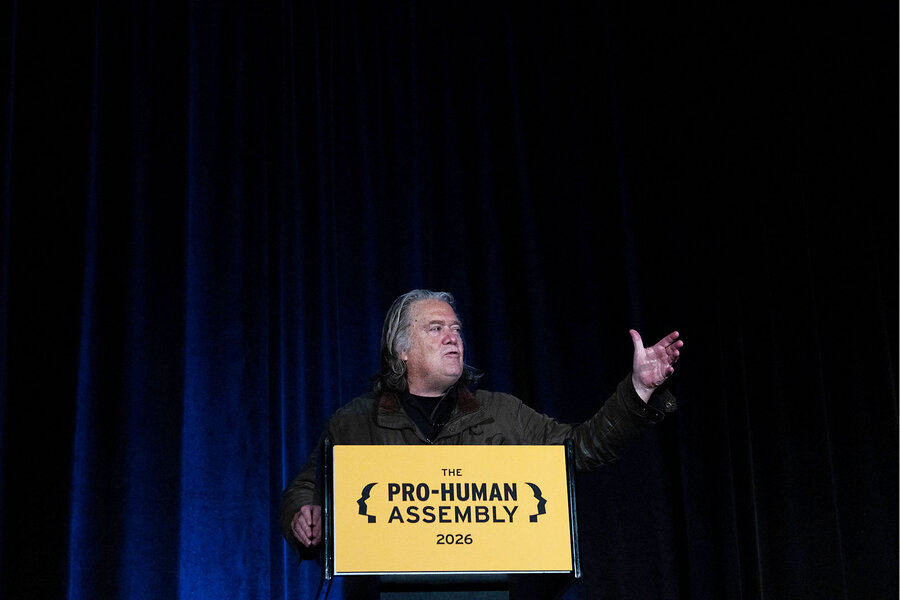
Republican and Democratic politicians came together in Washington with panelists ranging from tech experts to parents to faith leaders, all agreeing on one thing: artificial intelligence must not run wild.To make sure it doesn’t, they offered proposals that ranged from requiring AI companies to be more transparent, to supporting whistleblowers, and to instituting an immediate pause on cutting-edge AI models.Hosted by the nonprofit Future of Life Institute, the Pro-Human Assembly 2026 was the first of its kind and invited leaders across politics, faith, entertainment, and advocacy to discuss how to preserve human agency amid rapid AI growth. The event came a week after researcher Jacob Coxon, who worked for Anthropic, quit his job, saying publicly that the technology could destroy humankind within a few years and accusing companies of focusing on competition over safety. That warning brought together unlikely collaborators such as independent Sen. Bernie Sanders of Vermont and former Trump adviser and right-wing commentator Steve Bannon, who spoke back to back at the assembly.“I don’t think you could find any two harder partisans than Bernie Sanders on the left, and [myself] on the right,” said Mr. Bannon. “And I think that speaks to ... the threat. We have to rise above it. This is a hinge in history.” Anna Rose Layden/ReutersIndependent Sen. Bernie Sanders of Vermont discusses the need for AI legislation during his remarks at the Pro-Human Assembly 2026 in Washington, Sept. 15, 2026. AI’s risks have been documented. A July report from the United Nations said the technology offered great promise, but “the gap between rapidly improving capabilities and effective risk management methods may lead to catastrophic outcomes.”The participants at the assembly want to close that gap. The intensity and breadth of the attention on AI, however, make it clear that they will have to overcome not only those who say regulations can stifle innovation, but differences within the big-tent group of people who want to curb AI. “Having such a diverse and growing community of stakeholders won’t necessarily make things easier,” warns Daniel Schiff, co-director of the Governance and Responsible AI Lab, who was not part of the event on Tuesday.Agreements and disagreementsArtificial intelligence encompasses a vast array of functions, ranging from programs that guide military ordnance to code that can help make travel reservations. The concern stemming from Mr. Coxon’s post arises because companies are building AI models that can improve themselves, meaning they have the potential to escape developers’ boundaries and act in unexpected and potentially damaging ways, including shutting down internet sites through denial-of-service attacks as a means to some larger end.For all their diversity, participants at the event agreed on a lot: AI should serve humans and not the other way around; tech self-regulation has failed; and there is stark danger in technology companies racing blindly ahead.“The future we all want is a future built by human hands, shaped by human engagement, answerable to human beings,” said Democratic Rep. Lori Trahan of Massachusetts, who is a co-sponsor of a bipartisan AI reform bill.Republican Rep. Chip Roy of Texas told the room of about 200 attendees that “we are humans that have to figure out how we’re going to live in our God-given abilities ... where technology is a tool for us, not us a tool for technology.” Caitlin Babcock/The Christian Science Monitor.Visitors mingle outside the Pro-Human Assembly in Washington, Sept. 15, 2026. The event invited leaders across politics, faith, and entertainment, among others, to discuss how to handle rapid AI growth. Such bipartisan agreement is uncommon. Lawmakers’ approach to the development of AI, like most issues, has been split along sharp partisan lines. Democrats have generally pushed for more regulation, while Republicans say the United States needs to remain competitive with China.But the solutions these speakers presented were wide-ranging and sometimes conflicting. Virtually all of them acknowledged AI can have positive impacts, while still saying urgent action is needed to mitigate potential harm. But that left room for interpretation as to when, exactly, AI use strays from harmless to harmful. Senator Sanders and Democratic Rep. Greg Casar of Texas want Congress to permanently ban superintelligence, a theoretical version of AI that could surpass human capabilities across a wide range of areas. Mr. Roy wants light-touch guardrails that represent public opinion and input. Mr. Bannon wants to rely on presidential action to force a slowdown in AI development.Dr. Schiff says AI’s broad impact makes coming to an agreement tricky.“There’s a lot of really hard stuff to figure out, and that stuff has to be figured out in every setting, every sector, in classrooms, in hospitals, in government use of AI,” he says. “That doesn’t mean that there isn’t room for consensus or convergence. ... But it will still be a hard road ahead.”Regulation in historyGenerally, with a new technology, innovation leads and regulation is slower to catch up. But AI’s rapid growth and what experts see as potentially existential consequences of irresponsible development could change that pattern.“When something is seen as a national security threat, whether it’s economic or military ... that hastens the process of different sides coming together and figuring out a solution, because the stakes are higher,” says Margaret O’Mara, a historian at the University of Washington.The challenge comes, she says, when companies race to stay ahead of competitors, potentially ignoring hesitations about things like safety. “No one wants to be the first one to slow down when the other ones are steaming ahead,” says Dr. O’Mara.Still, she points to examples of past technologies that posed the potential for harm but that have been regulated, such as nuclear and chemical weapons. Deepen your worldviewwith Monitor Highlights.Politics with respectGet political stories with respectful analysis.There's a world of new ideas in everyBooks newsletter.There's more to life, enrich yours withCulture & Learning weekly.Follow humanity's discoveries withScience & Nature stories in your inbox.Gain a spiritual perspectivefrom the stories in your inbox.Want to understand the deeper impact of critical events? Learn the Monitor's insight.Already a subscriber? Log in to hide ads. AI is not inevitable, says Dr. O’Mara, rather it’s “the product of a series of human decisions and a broader political and economic structure that enabled them.”Staff writer Laina Gustafson contributed reporting. ALREADY A SUBSCRIBER? LoginReal news can be honest, hopeful, credible, constructive.The Christian Science Monitor was founded in 1908 to lift the standard of journalism and uplift humanity. We aim to “speak the truth in love.” Our goal is not to tell you what to think, but to give you the essential knowledge and understanding to come to your own intelligent conclusions. Join us in this mission by subscribing.
From Bernie Sanders to Steve Bannon, diverse AI-safety advocates grow louder
Full Article
Original Source
Read the full article at Csmonitor →KhanList aggregates and links to publicly available news content. We do not host full articles from third-party sources. Always verify important information with original sources.