
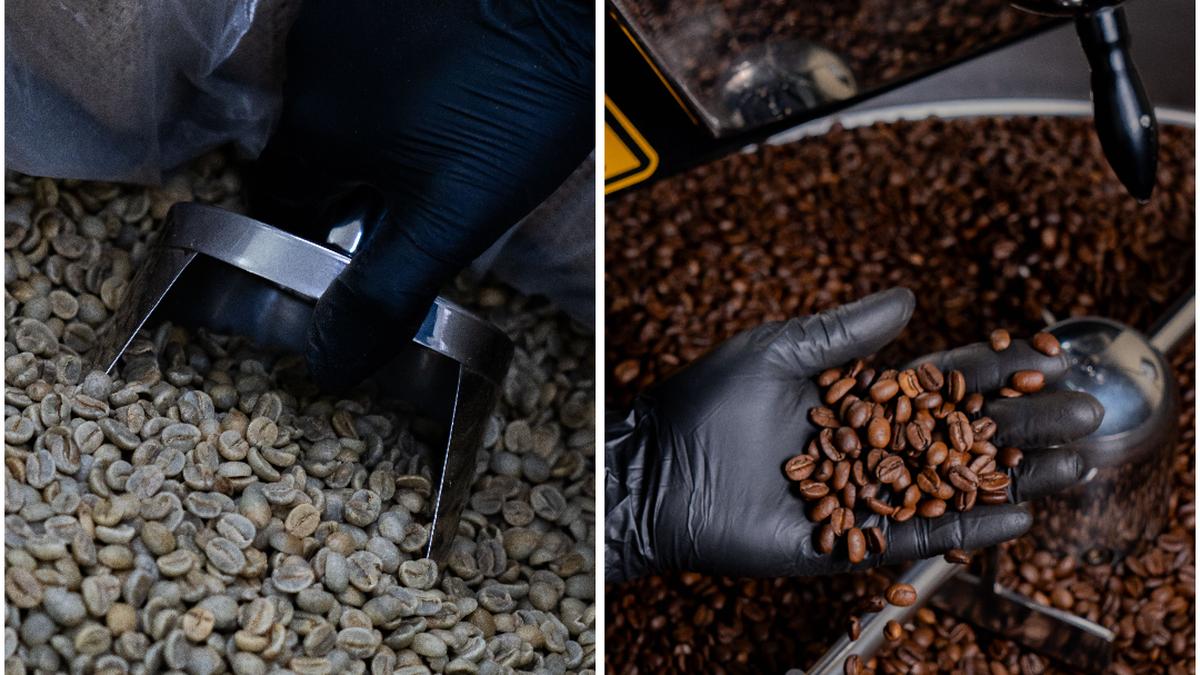
My first coffee tasting did not take place in a plantation in South India, overlooking rows of coffee bushes. It happened in the heart of Jaipur. For the first time, I learnt that coffee, much like wine, has its own language of flavour — fruity, nutty, floral, chocolatey, and that if you concentrate a little harder countless other nuances. The city, better known for ghee-laced sweets, dal baati churma and laal maas, is brewing its own coffee revolution.With names such as Curious Life Coffee, Alchemist Coffee Company, and Roastery Coffee House helping shape Jaipur’s speciality coffee scene, the term ‘artisanal coffee’ is no longer a novelty. One of the entrants in the growing space is Coffee Sutra, founded in 2021. To make coffee more than just a cup, it now has a roastery lab that opened last year. Inside The Coffee Sutra Roastery & Lab in Mansarovar, Jaipur | Photo Credit: SPECIAL ARRANGEMENT The Coffee Sutra Roastery & Lab in Mansarovar takes visitors through the journey of coffee, from bean to cup – from processing techniques and bean varieties to the nuances of roasting. A bean roaster lets visitors watch the roasting process up close, while an espresso machine and a range of pour-over equipment offer a glimpse into the craft behind each cup. Along the way, you get to sample a range of brews, each offering a different flavour profile.Dushyant Singh, who founded Coffee Sutra in 2021, has spent more than 15 years in the hospitality industry.When second-generation entrepreneur Dushyant decided not to join his father’s textile export business in Jaipur, it did not go down well at home. Born into a family that had built a base in textile exports, Dushyant was expected to carry forward the legacy. He chose the food and hospitality business out of a passion for culinary culture and a desire to build his own path rather than join his family’s business in Jaipur.His association with coffee deepened through his travels and interactions with farmers, roasters, baristas, and coffee professionals around the world, eventually inspiring him to bring those experiences back to his hometown. “While familiar favourites such as cappuccinos, lattes, and cold coffees continue to be popular, there is also growing interest in speciality coffee, single origins, manual brewing and understanding where the coffee comes from. Most of our beans come from Karnataka, particularly Chikmagalur, Sakleshpur, and Coorg, which are famous for their rich, balanced flavours,” says Dushyant. In terms of volume Dushyant says, “we currently roast and utilise between 2.5 to 3 tons of green coffee every month”. Since they started Coffee Sutra now has three outlets across the city. Coffee beans before roasting process | Photo Credit: SPECIAL ARRANGEMENT We started off by learning about the different bean varieties. Know your beanThe two main types of coffee beans are Arabica and Robusta, each with distinct characteristics. Arabica plants are more delicate, thriving in cooler climates and at higher altitudes of around 800–2,000 metres. Their beans are typically oval-shaped and are known for producing a smoother, more nuanced cup, often with fruity, floral or sweet notes.Robusta, on the other hand, is hardier and grows well at lower altitudes of up to 800 metres, with greater resistance to pests and diseases. Its beans are rounder and contain more caffeine than Arabica, resulting in a stronger, bolder and often more bitter flavour profile.“India was primarily a Robusta-growing country, but with the growing interest in Arabica, we are now seeing a lot more Arabica being cultivated as well. During harvest time, we travel to the estates and stay there for a week or two, which helps us build a relationship and trust with the estate owners. We taste the coffees available that year and then book our lots for the entire year. For a company like ours, we buy around 25 tonnes of coffee every year, so it is important for us to be there during the harvest and understand the coffee firsthand,” says Dushyant.Prices can fluctuate almost every day, says Dushyant. “There are two reasons for this. Brazil is the biggest producer of Arabica, while Vietnam is the biggest producer of Robusta. So, if something goes wrong in either of these regions because of climatic conditions, it affects the supply. And coffee is ultimately a game of demand and supply — if supply falls while demand remains high, prices change.”The making of a bean Coffee Sutra roasting machine | Photo Credit: SPECIAL ARRANGEMENT Giving a tour, he also explained the different drying techniques for coffee beans, each of which plays a role in shaping the final flavour.Drying processIn the natural process (sun-dried process), the coffee cherry is dried whole, with the pulp intact, allowing the bean to absorb fruity flavours as it ferments, resulting in a cup that is often fruitier and tangier.The honey process sits somewhere between natural and washed processing: the outer pulp is removed, but the sticky mucilage is left on the bean as it dries, lending the coffee a distinct flavour profile.In the washed process, the pulp and mucilage are completely removed, and the beans are thoroughly washed before drying, producing a cleaner and more defined cup. He also explained how moisture control is important for coffee: “If the moisture level of the coffee falls below 10%, the flavour of the coffee will be destroyed. If the moisture level rises above 12%, mould will grow on the beans. To maintain quality, the moisture level must be kept within the optimum range of 10% to 12%,” says Dushyant.“If moisture is not carefully managed, especially during rainy weather or if the beans are kept directly on the ground where they can absorb ground moisture, the entire crop can spoil, resulting in a bad taste for the consumer,” he further adds. The heat factor Maillard reaction is one of the key stages of coffee roasting, which gives the colour and smell | Photo Credit: SPECIAL ARRANGEMENT He also took us through the roasting process, explaining the Maillard reaction, one of the key stages in coffee roasting, occurring when amino acids and sugars in the beans interact as they heat up. It is responsible for developing much of the coffee’s flavour, aroma and characteristic brown colour. “Roasters carefully control the temperature and duration of this reaction to shape the final profile of the beans. Much like the browning of a roti as it cooks, the Maillard reaction is where colour and aroma begin to come together,” he says.After the process, we got to try some of the coffee. We were given the official Speciality Coffee Association Arabica Cupping Form to score each coffee across aspects such as aroma, flavour, acidity, body, balance and sweetness. The tasting began with the dry fragrance of freshly ground coffee, followed by the wet aroma released when hot water was added. Dushyant then guided us through the technique of slurping and sipping.He also explained how the tasting notes might differ for different people; for instance, for me, a coffee with a honey-dried process had the tasting note of a mango, which lingered longer in the mouth and also tasted like a ripe berry. As we kept tasting, the flavours became more pronounced, noting it down for a final score. We also witnessed the different brewing techniques, like the French press, pour-over, and steeping methods. “I travel extensively to learn from people across the coffee ecosystem, and those experiences come back into our work at the Lab. We then adapt what we learn to our own understanding of coffee and to what makes sense for the Indian consumer. The Gabi Drip Master, for instance we incorporated into our ecosystem after witnessing it in South Korea,” says Dushyant.By the end of the tasting, coffee no longer seemed like an instant-made-in-two-minutes drink. Here, each bean had a story shaped by its variety, where it was grown, how it was processed, dried, roasted, and brewed.The Coffee Sutra Roastery & Lab in Mansarovar hosts booking-based coffee experiences, including workshops, training programmes, brewing sessions and coffee tastings. The Coffee Sutra Roastery & Lab coffee tasting experience is priced at ₹3,500 plus taxes per person. To book contact 9116927479.The writer was in Jaipur on invitation by Coffee Sutra.
From Bean to Cup: A beginner’s guide to coffee tasting at Coffee Sutra, Jaipur
Full Article
Original Source
Read the full article at Thehindu →KhanList aggregates and links to publicly available news content. We do not host full articles from third-party sources. Always verify important information with original sources.