
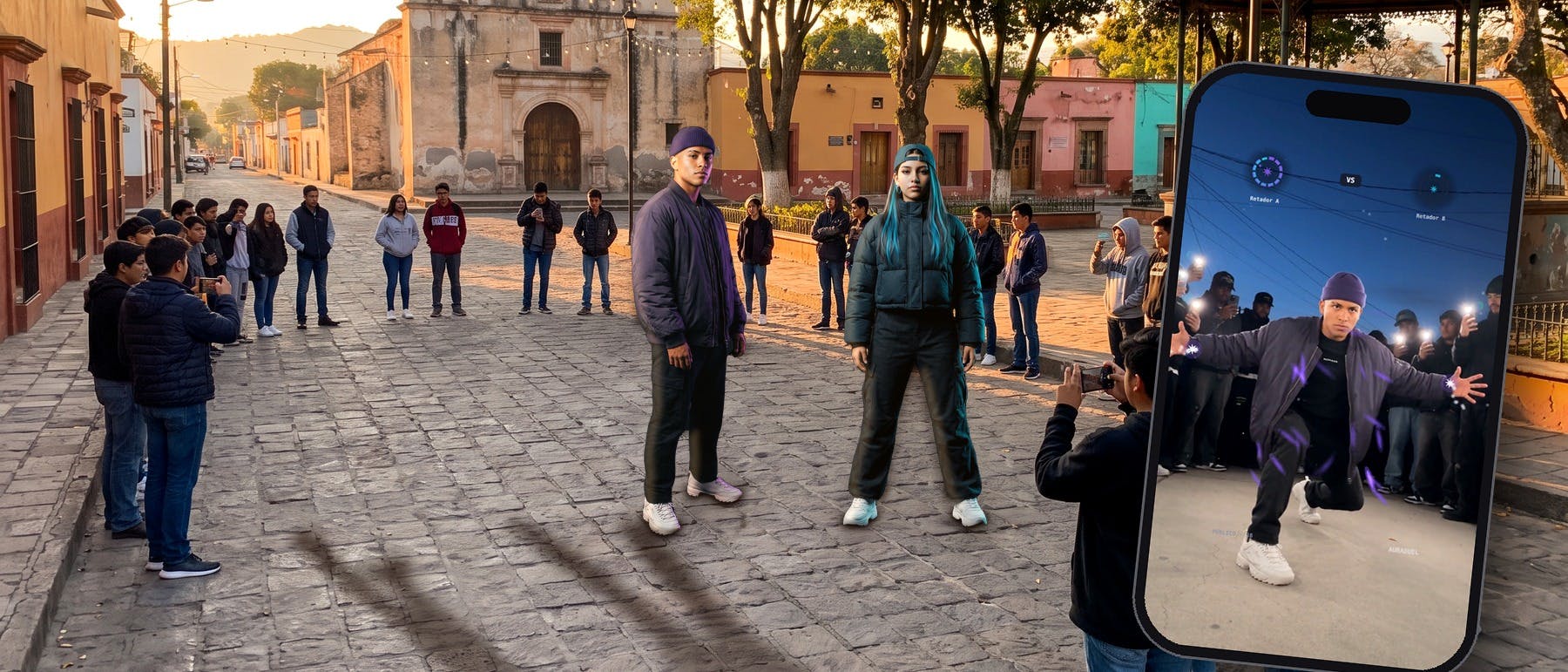
In August 2026 the aura battles left TikTok and reached the street. Two teenagers stand face to face in a plaza, a circle forms around them, someone plays a beat, and each one tries to win with presence, gestures and nerve. No rap, no dance routine, no equipment. The crowd decides who has more "aura". I watched dozens of those videos and I saw two things at once. The first was a real sport waiting for a scoreboard. The second was a lot of kids being laughed at in front of a camera. I decided to build the scoreboard, and to make the laughing impossible. The first commit was on August 20, 2026. The app went live on the App Store on September 5. What follows is what happened in between. Research first: what "aura" actually is Before writing code, I spent a day on cultural research: press, academic pieces, youth-culture newsletters, and hundreds of comments from the players themselves. The findings changed the product. Aura is a social ledger, not an aesthetic. Teenagers give and take "aura points" from each other all day. Composure adds, embarrassment subtracts. The verb matters more than the noun. "Farming" comes from gaming: repeat to accumulate. It turns charisma, which the previous generation treated as innate, into something trainable and measurable. The battle is a cypher without a microphone. It descends from the Latin American freestyle circle, from ballroom, from breakdance, with the entry barrier removed. You only need to stand up. The engine is not ego. It is the fear of cringe. Being "unbothered" is armor against permanent public embarrassment. The game punishes visible effort. Aura disappears the moment people notice you want it. Irony is the permission. Humor lets you compete for status without admitting you care about status. The real value is leaving the house. A Mexican winner said he did it "to have fun and get out of the house". The trend rebuilt a third place that had disappeared. Two design conclusions came directly from that research. First, the street rewards emotional management, not technique, so an app that only measured technique would miss the point. Second, formats survive and memes do not. Freestyle is still here twenty years later. AURADUEL had to be a format, a sport with rules, not a filter. The psychology: a game that cannot humiliate you The rule that shaped everything was written before the first line of code, and it is not technical: Losing aura is aggregated, capped, and always recoverable. That sentence became a hard rule in the product canon. Nobody sees who voted for whom. The loser's screen recognizes what they did well before it shows the result. There is no leaderboard of shame, no exportable clip of your worst moment, and no mechanic that rewards the crowd for piling on. The behavioral review went further. For the youngest band of players, the public vote is not adjustable. It is off. No live applause meter visible to the circle, no exportable reel, score from the app only. And because the system cannot tell a young child from an older teenager with certainty, the protected mode is the default. If in doubt, the app behaves like the most protective level. Two more decisions came from the same place: Consent on screen before every battle. Not once at install. Every time. The camera sees your body, and you should say yes each time it does. Everything about your body stays on the phone. Pose and hand tracking run on the device. No video and no landmark ever leaves it. No camera video or pose landmarks are transmitted off-device. There is also a smaller psychological detail I care about. When someone barely moves, the score used to label them "Creative", because creativity happened to be the highest of their near-zero dimensions. That is noise dressed as feedback. Now the app says "Awakening Aura". It is honest and it invites you to move, instead of handing out a compliment that nobody believes. Why the score is hybrid The camera cannot measure nerve. It can measure the body: how much of the time you are moving, how wide your movement is, whether you use the whole stage or one corner, how many clean peaks of energy you produce, and whether you keep it fair. So the app scores what the body does, and the crowd scores what the body means. In the two-phone mode, spectators scan a QR and vote from their own phones, and the verdict blends the app's measurement with the stands' vote. Voting is always free. There is nothing to buy that changes a result. That last sentence is another hard rule: paying never improves your result. Cosmetics customize your challenger. They never add a point. No loot boxes, no vote buying, no betting. The free version is basic, but it has to be beautiful, because the free player is the one who brings the next ten. Creative decisions Everything is rings. The logo is a charging orb: a segmented ring, 12 segments, filling up. The rank system mirrors it: four tiers, Bronze to Legend, three sub-levels each, twelve segments in total. The in-game HUD is two score rings and the orb. No health bars borrowed from fighting games. A plaza of the future. The home screen is a night plaza with two challengers standing inside a glowing ring, a sky with stars and the occasional shooting star, and your own challenger and rank in two pills at the top. It looks like the place where the battles actually happen. Six photoreal challengers. The avatars are real characters, generated once from full-body photos, cut out with a segmentation model and placed on each avatar's own color gradient. Every avatar has its own motion clip in the wardrobe preview, driven by motion control from movements I recorded myself. Three are free, three are paid, and the free ones are not worse. They are different. Frames with a ladder of wow. Rank frames escalate: bronze has a light sweep, silver twinkles, gold is a rotating segmented ring with sparks, legend is a twelve-point crown with a breathing halo. The frames you earn should feel better than the ones you buy, or the whole promise breaks. Buttons you can feel. The interface uses a retro-futuristic "arcade-holo" system: 3D relief drawn with stacked shadows, a press that sinks three pixels, a glow on the active state. On a phone, a button should feel like a button. The difficulties, and how each one was solved Building alone means every problem is yours. These are the ones that changed the product. The green screen ate a jacket. The cyan challenger wears a teal puffer. Chroma key by color removed her along with the background. The fix was to stop keying by color and segment the person with a vision model, then erode the edge to kill the green halo. Motion control reframed everyone. The video model that animates the avatars copies the framing of the reference clip, and it fills the frame. Characters came out cropped at the ankles. The fix was to pad the source images with air and add an automatic gate that checks seven body points in every frame before a clip is accepted. One clip failed the gate twice and was replaced with a different movement instead of being forced through. The score lied about hands. In the first real tests, waving your hands saturated the "Impact" dimension to the maximum while standing still. Peaks are now weighted by their energy and capped, instead of counting every wave the same. Calibration was done with three real rounds, filmed, scored, and compared against what a human would say. The two-phone duel died when a screen locked. The room closed the moment the creator's phone went to background, because the disconnect handler closed the room. Apple's reviewer reported exactly that symptom: two devices waiting for each other. The fix was presence with grace: a disconnect only records when you left, the room stays open, and your rival sees "waiting" instead of "this room does not exist". A secret reached production for two minutes. The web build must ship without the payments key, and the iOS build must ship with it. One test suite rebuilt the bundle in between and the wrong one was deployed. It was replaced within minutes, and a pre-deploy guard now refuses to publish any bundle that contains the key. The lesson is written in the project's lessons file so no future session repeats it. Apple said no, then yes Build 1 was rejected twice. The first time, on September 2, it was metadata: the listing had no working link to the Terms of Use. Two minutes in the web console, resubmitted the same day. The second time, on September 3, it was four points: Screenshots contained the word "free". Under the guidelines, that counts as a price reference. The reviewer could not find the in-app purchases. Premium was reachable only through an icon with no label. Two devices waited for each other and never paired. That was the screen-lock bug above. There was no "Restore Purchases" button where the reviewer expected it. All four were real. None of them was argued. Screenshots were redone without price words. Premium got a visible entry from the home screen, the play screen and the profile. The duel got presence with grace. Restore Purchases got a button in the Premium screen and in the wardrobe. The reviewer notes were rewritten with the exact sequence of taps to reach every purchase and to run the two-device duel, and the reply in Resolution Center opened with an apology. Build 2 was resubmitted the same day, at 22:27 UTC. On September 5 at 09:42 UTC, about 35 hours later, AURADUEL 1.0 was live, with all 16 items approved: the app version, the subscription group, two subscriptions, and twelve cosmetics. What the numbers say From the first commit to the store: 16 days, 364 commits, 896 unit tests in 107 files, 17 end-to-end specs that run against the real app in a headless browser, including a two-client test of the duel over the real database. None of that was written by a team. It was one person, a construction job during the day, and Claude at night. I am not a software engineer by training. I studied geology, I was a photographer, I competed in bodybuilding. What I brought was discipline and an eye. What Claude brought was the ability to turn a rule written in plain Spanish, "losing aura never humiliates anyone", into code, tests and a store listing. What is next The English listing is ready for the next submission. The web version at auraduel.app points iPhone users to the store and keeps working as a PWA everywhere else. And the first reels of real battles are done. If you are 16 and you have a friend and a phone, you have everything you need. Farm your aura. Built for RevenueCat Shipaton 2026. AURADUEL is on the App Store: https://apps.apple.com/app/id6804470297
From a TikTok Trend to the App Store in 16 Days: The AURADUEL Story
Full Article
Original Source
Read the full article at Hackernoon →KhanList aggregates and links to publicly available news content. We do not host full articles from third-party sources. Always verify important information with original sources.