
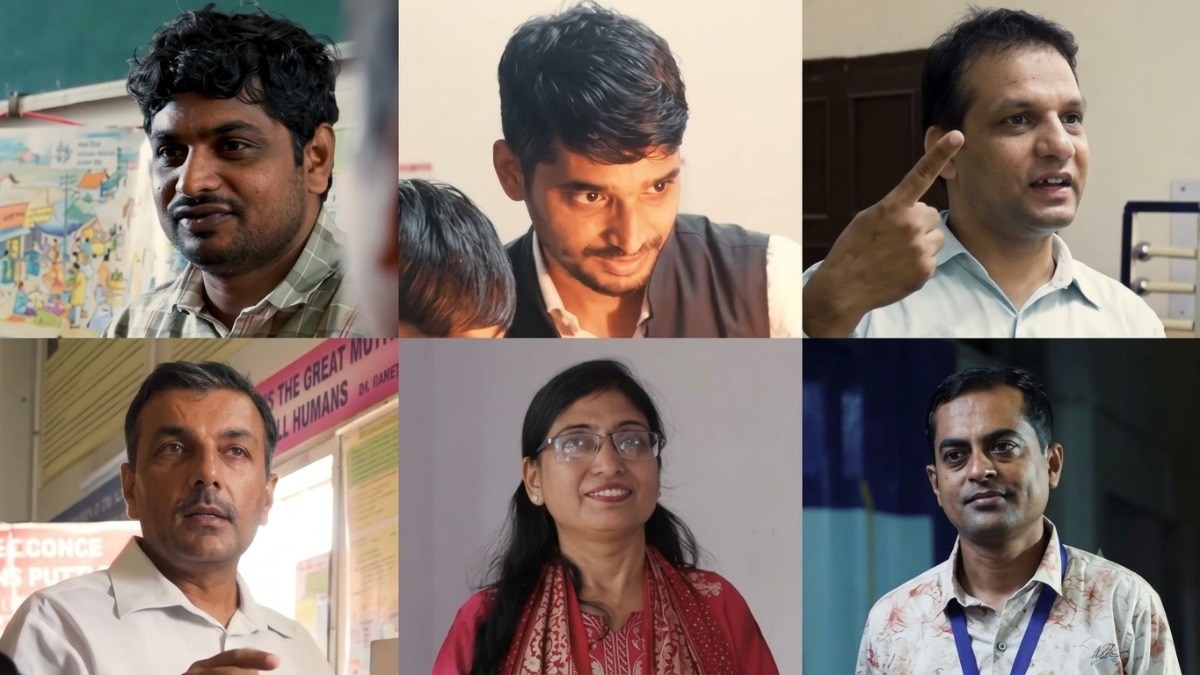
From a 7D VR lab and AI learning app to mobile science labs and virtual mathematics classrooms, these National Teacher Award winners are using technology to change what students can access in government and rural schools across India.These National Teacher Award winners have brough advanced tech to rural govt schools. (L to R top: Rajesh Kouluri, Nitinkumar Mahendrakumar Pathak, Ravi Jaiswal | L to R bottom: Anil Kaushik, Vartika Gulati, Palash Chowdhury) (Photos: X/@EduMinOfIndia)A 7D VR lab. An AI-powered learning app. A mobile science laboratory. A virtual mathematics classroom.These may sound like facilities from a well-funded private school or a university campus. But they are not.They are part of what teachers across India's government and rural schools have built to change how children learn.Among the 82 educators who were conferred the National Teacher Award 2026 by President Droupadi Murmu on Saturday are teachers who have taken technology far beyond smart boards and PowerPoint presentations. They are using it to tackle a much older problem: how to give students access to learning experiences that were once out of reach.FROM ONE SCHOOL TO MILLIONS OF TEACHERSFew examples are as striking as Rajesh Kouluri, a teacher from Andhra Pradesh. His Hello Dhruthi AI-based learning app, built with interactive lessons and educational games, has helped more than 15,700 students across 2,574 schools.His WhatsApp Quiz Bot has supported another 21,000-plus students.But the bigger number comes from the digital ecosystem he created. RAJCLASSROOM has reached more than 2.5 million teachers, while his digital pedagogy programmes have trained over 2 lakh teachers.Shri Rajesh Kouluri, Teacher, MPPS Chinamallupeta Nellimarla, Vizianagaram, Andhra Pradesh, has made notable contributions to AI-enabled FLN, digital education and rural student mentoring.His Hello Dhruthi AI-based learning app, featuring interactive lessons and educational pic.twitter.com/X4kxgrYTjg— Ministry of Education (@EduMinOfIndia) September 5, 2026This is no longer technology being used by one teacher for one classroom. It is technology being used to multiply what a teacher can do.A 7D VR LAB IN A TRIBAL SCHOOLThen there is Nitinkumar Mahendrakumar Pathak in Gujarat.At Rangpur Primary School in Vansda, he helped turn a resource-constrained tribal government school into a technology-rich learning space.The school has a 45-computer IT lab, a 7D VR/AR lab, an offline school server called the Rangpur Server and a student journalism studio called R NEWS.Shri Nitinkumar Mahendrakumar Pathak of Rangpur Primary School, Vansda, Navsari, Gujarat, is recognized for his leadership in converting a resource-constrained tribal Government Primary School into a nationally acclaimed hub for digital, experiential, and eco-friendly education. pic.twitter.com/6Z69kR2K1a— Ministry of Education (@EduMinOfIndia) September 5, 2026The interesting part is not simply the equipment.It is the idea behind it: students in a government primary school should not have to wait until college, or until they move to a city, to encounter technologies that can expand how they learn.WHEN SCIENCE LEAVES THE CLASSROOMRavi Jaiswal, a science teacher in Chandigarh, has taken a different route.He created a CV Raman Dome Theatre, a Mobile Science Lab on a cart and an outdoor Science and Knowledge Park using recycled materials.That changes the question from "How do we teach this chapter?" to "How can students actually experience this concept?"Shri Ravi Jaiswal of Government Model High School, Chandigarh serves as a Science teacher with over 16 years of dedicated service. His core competencies span innovative pedagogy and experiential learning, highlighted by his creation of low-cost, scalable solutions like the C.V. pic.twitter.com/DuNjIThzBN— Ministry of Education (@EduMinOfIndia) September 5, 2026Similarly, Anil Kaushik from Haryana built a Mathematics Lab containing more than 40 original teaching-learning models, along with a 12-section Virtual Mathematics Lab featuring interactive puzzles and O-Lab activities.For students who struggle with abstract equations, the difference can be substantial: mathematics becomes something they can see, manipulate and investigate.Mr. Anil Kaushik from GMSSSS Sanghi, Rohtak, Higher Sec., Haryana, made outstanding contributions to secondary education through pedagogical innovation, digital resource creation, and community involvement.To make mathematics accessible and engaging, he established a pic.twitter.com/pMHiWXWL5F— Ministry of Education (@EduMinOfIndia) September 5, 2026DIGITAL CONTENT THAT TRAVELS BEYOND ONE CLASSROOMTechnology can also solve another problem: a good lesson should not disappear when the school bell rings.Vartika Gulati, a Mathematics and Science teacher in Rajasthan, has created more than 200 e-content modules for platforms including DIKSHA, PM eVidya, Shiksha Vani and Shiksha Darshan.Her classroom innovations are similarly low-cost. Algebra can be taught using groundnuts. Geometry can involve kites. Digital content becomes another tool rather than a replacement for the teacher.Dr. Vartika Gulati from GGUPS Tumli Ka Bas, Chaksu, Jaipur, Rajasthan, a Mathematics and Science Teacher, stands out for her low-cost educational innovations, digital integration, and inclusive pedagogical leadership.She makes abstract concepts accessible by grounding them in pic.twitter.com/5lWTjqlOtt— Ministry of Education (@EduMinOfIndia) September 5, 2026And in West Bengal, Palash Chowdhury has taken digitisation even further, introducing biometric systems, app-based parent communication, smart classrooms and AR/VR at his primary school, while even helping make open-source educational software available in Bengali.Shri Palash Chowdhury of Sri Ramkrishna Sarada Vidyapith Primary School, Purba Bardhaman, West Bengal, has made significant contributions to improving student nutrition, advancing digital education, promoting inclusive and community-driven school development.To eliminate pic.twitter.com/TYX5TzfB79— Ministry of Education (@EduMinOfIndia) September 5, 2026THE TECHNOLOGY IS ONLY HALF THE STORYWhat makes these teachers interesting is not that they use AI, VR or digital tools.It is where they are using them and why.They are putting sophisticated tools into classrooms where students may otherwise have limited access to technology, laboratories or specialised learning resources.The National Teacher Awards are therefore recognising something bigger than digital teaching.They are recognising teachers who looked at what their students did not have and asked a different question:What can we build so they can have it?- EndsPublished On: Sep 5, 2026 21:01 IST
From 7D VR labs to AI apps: Meet teachers transforming India's rural classrooms
Full Article
Original Source
Read the full article at Indiatoday →KhanList aggregates and links to publicly available news content. We do not host full articles from third-party sources. Always verify important information with original sources.