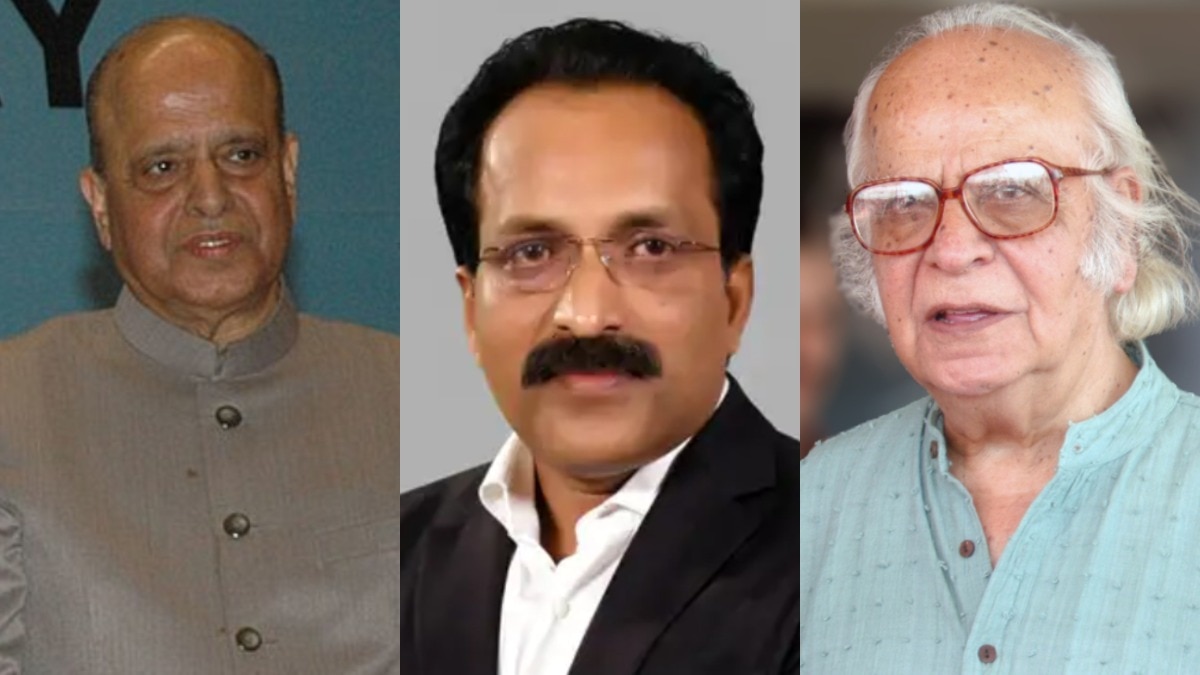
ISRO, India's space agency that has led the country's space missions for decades, has also played a significant role in shaping major education reforms. At the centre of this journey are names such as Yash Pal, K Kasturirangan and former ISRO chairman S. Somanath. Why has ISRO repeatedly emerged as the organisation governments turn to when major reforms are needed?Kasturirangan, S Somnath and Yashpal (R to L)A paper reform task force was announced by Prime Minister Narendra Modi on Sunday evening in a short portrait-format video beginning with "Hello friends", continuing his recent style of communicating directly with students. The announcement came days after changes in the National Testing Agency (NTA) and the resignation of Education Minister Dharmendra Pradhan. At the centre of the new task force is the use of technology to secure India's examination system.Former ISRO chairman S Somanath will lead the technology component, alongside Infosys co-founder Nandan Nilekani, who chairs the task force, and IIT Madras Director V Kamakoti.The announcement also revives a familiar pattern in India's education reforms. From the Yash Pal Committee in 1993 to the National Education Policy (NEP) 2020 led by K Kasturirangan, scientists associated with India's space programme have repeatedly been entrusted with some of the country's biggest education reforms.A NEW PUSH AFTER THE EXAM CRISISThe task force comes after repeated concerns over examination security. More than 100 alleged paper leak incidents have been reported across the country in the last eight years, raising questions about the credibility of public examinations. T he controversy surrounding the NEET examination, which saw two major crises in three years, triggered protests and renewed scrutiny of the examination system.The government has positioned the new panel as a technological response to these concerns. Chaired by Nandan Nilekani, the committee includes former ISRO chairman S Somanath, IIT Madras Director V. Kamakoti and experts from different fields. Its mandate is expected to focus on using technology to make examinations more secure and reduce the possibility of paper leaks. The detailed roadmap of the task force is yet to be made public.A LONG ASSOCIATION WITH EDUCATION REFORMSThe inclusion of another former ISRO chief is not an isolated decision. Over the last three decades, the government has repeatedly turned to scientists from India's space programme while redesigning the education system.The first major example came in 1993, when the Ministry of Human Resource Development appointed a committee under Prof. Yash Pal.Before becoming one of India's leading educationists, Yash Pal had played a key role in developing India's space applications programme and was closely associated with ISRO's Space Applications Centre.His committee produced the landmark report Learning Without Burden, which argued that school education should move away from rote learning.It recommended reducing the load of textbooks, making classrooms more child-centric, reforming examinations and encouraging conceptual understanding instead of memorisation. The report later became the foundation for several school education reforms.Yash Pal continued to influence education policy over the next decade. His ideas shaped debates around curriculum reform in the early 2000s, and he later chaired the committee that prepared the National Curriculum Framework (NCF) 2005.The framework promoted activity-based learning, critical thinking and continuous evaluation while reducing dependence on high-stakes examinations.KASTURIRANGAN AND THE NEPMore than two decades later, another former ISRO chairman was asked to lead India's biggest education reform exercise.In 2017, the Narendra Modi government appointed K. Kasturirangan to chair the committee that drafted the National Education Policy. Kasturirangan, who headed ISRO from 1994 to 2003, brought together his experience in science, public policy and higher education to prepare the report.The committee spent nearly three years consulting teachers, universities, industry bodies, scientists and governments across the country before the NEP was released in 2020.The policy proposed wide-ranging changes, including a new school structure, multidisciplinary higher education, greater emphasis on skill development, flexibility in subject choices and reforms in assessment. It also became the basis for the ongoing National Curriculum Framework that will shape school textbooks and syllabi.Officials who worked with the Education Ministry during the process have said Kasturirangan was chosen because he was viewed as academically credible, politically neutral and capable of handling a complex national exercise.Even after the policy was released, he continued to advise the ministry on its implementation and later headed the committee preparing the new curriculum framework.WHY Isro SCIENTISTS?The repeated selection of ISRO scientists for education reforms reflects a pattern rather than coincidence.Yash Pal and Kasturirangan were both scientists who later moved into public policy and institution building. Their experience extended beyond space research to academic administration, national commissions and long-term planning.Their work required coordination across governments, institutions and technical experts, skills that were later applied to education policy.The appointment of S Somanath to the examination reform task force continues that trend. Unlike earlier committees that focused on curriculum and learning, the current challenge is securing examinations in a digital environment.The government's emphasis is on technological safeguards, making the inclusion of a former ISRO chairman central to the panel's work.Whether the task force succeeds will depend on the measures it recommends and how they are implemented. But the decision follows a pattern seen repeatedly over the last three decades: when India has attempted major education reforms, it has often turned to leaders who first built their careers in the country's space programme.- EndsPublished By: Rishab ChauhanPublished On: Jul 27, 2026 15:24 IST
From 1993 to 2026: Why India turns to Isro for its biggest education reforms
Full Article
Original Source
Read the full article at Indiatoday →KhanList aggregates and links to publicly available news content. We do not host full articles from third-party sources. Always verify important information with original sources.