
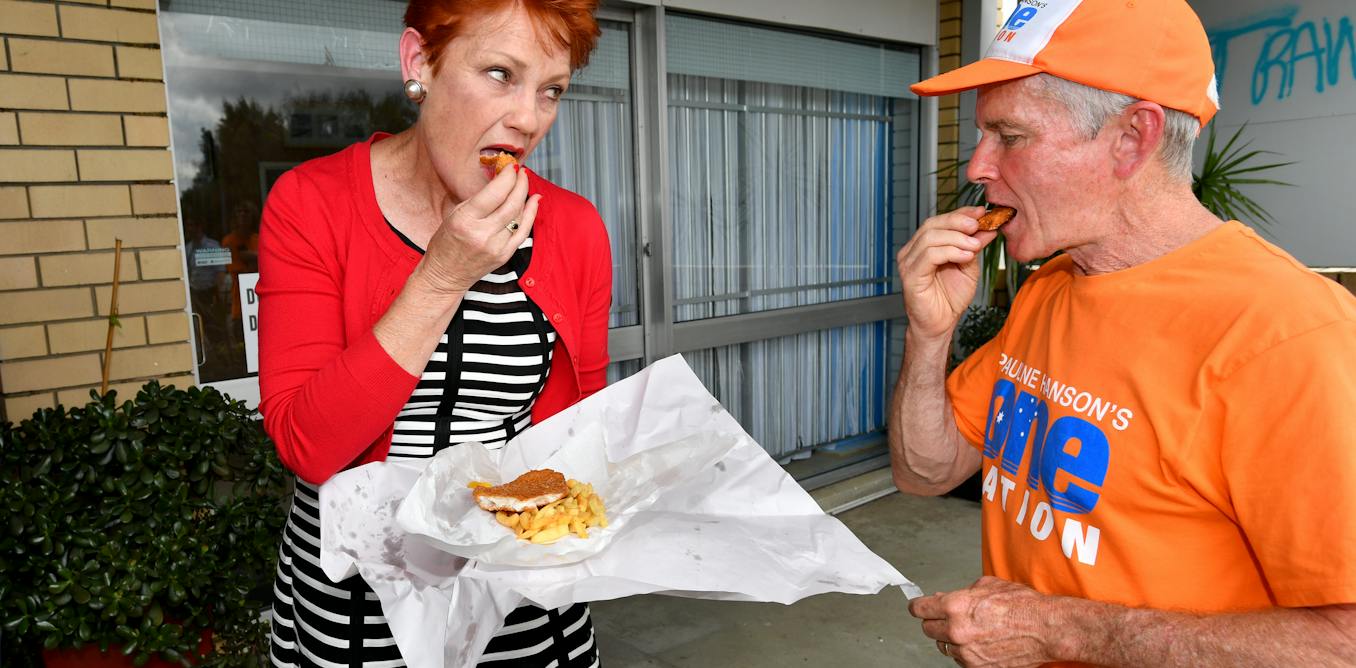
You might think Pauline Hanson is the racist face staring back from a mirror Australians don’t want to see themselves in. You might think the newfound popularity of her One Nation party reflects a well-deep frustration with the major political parties’ inability or unwillingness to deal with issues like housing. Or you might simply think Hanson represents the dog shit Australia stepped in three decades ago – and hasn’t been able to shake since. Some people console themselves that Australia’s compulsory voting system will save us from the Trump-shaped fate an angry minority of Americans voted in. But it is undeniable that Hanson’s political persona resonates with and appeals to a growing number of Australians. All these observations and more flow from John Birmingham’s new Quarterly Essay, Another Country: The Rise and Rise of One Nation. In it, he returns to his home town of Ipswich, Queensland, seeking to understand what Hanson’s recent rise says about us as a country. Review: Another Country: The rise and rise of One Nation, Quarterly Essay 104, by John Birmingham (Black Inc.) The Victorian state election, to be held on November 28 in Australia’s most progressive-leaning state, is “the first substantive test for One Nation and the Coalition”, said journalist Patricia Karvelas on the ABC this week. One Nation could play a significant role in a close-to-certain new Liberal Party-led government. And the result may carry implications for the next federal election, where One Nation threatens to wrest seats from the Liberal Party, the National Party, and even Labor. Pauline Hanson at the launch of the One Nation Victorian State Campaign in October. Joel Carrett/AAP Earlier this month, a Resolve poll showed support for One Nation at 25% of the primary vote, just three points shy of Labor, which is just leading, at 28%. The Liberal/National coalition is in third place, at 22%. Everyone, from politicians to journalists to political scientists, has tried to work out Hanson’s electoral appeal in the 30 years since she first won a seat in federal parliament. In that time, she’s been the subject of major books by Margo Kingston, Anna Broinowski and David Marr. What does Birmingham add to our understanding of the One Nation phenomenon – and who is voting for her, and why? ‘An overdue circuit breaker’ Best known as the author of the Generation X share-house slacker’s bible, He Died with a Felafel in his Hand (1994), Birmingham is also a “gonzo journalist” in the spirit and style of Hunter S. Thompson. Another Country is his third Quarterly Essay. John Birmingham. Black Inc. Birmingham was born in the United Kingdom, but raised in Ipswich. In Another Country, he travels back to the town 40 kilometres west of Brisbane, where Hanson famously (and successfully) ran a fish-and-chip shop, searching for answers. He wants to know how Hanson’s party has, since Labor won a second term in mid-2025, shed its skin as a fringe player and become a major national political force. In the months following Labor’s sweeping victory, the Liberals and National Party fell into a funk, dumping leaders and each other before reuniting, albeit shakily. The horrific shootings at Bondi last December and their aftermath provided “an instant of dislocation, one of those rare moments where everything changes”. Prime Minister Anthony Albanese’s approval rating flipped from positive to negative within a month. Then, the May budget was “not well received”, though that was to an extent driven by lopsided media reporting, especially (but not only) in News Corp Australia outlets. Between late May and early June, Birmingham reports, One Nation overtook Labor’s primary vote for the first time – though the ALP’s two-party-preferred lead remained. Since then, One Nation’s support has dropped slightly. Some have speculated that Hanson could leave the senate seat she has held since 2016 to contest a lower house seat at the next election. This would pave the way for her to become prime minister, should her party win enough seats. Birmingham begins his search by talking to friends and associates, including his now disabled oldest childhood friend (not a One Nation voter) and his friend’s NDIS carer, who tells him: “I don’t know whether she’s capable of being prime minister, but she is capable of resetting the political landscape”. He would vote for Hanson, he says, “just to break the monotony”. Jaundiced by dealing with impenetrable government bureaucracy, he sees her as an overdue circuit-breaker. Answers like this are moderately interesting. But they don’t come gift-wrapped in Birmingham’s insouciant phrase-making. He clocks One Nation’s “increasingly popular blood and soil nativism”. Her supporters are “aggrieved nostalgics”, while she is locked in “her very own forever war”, whose latest front is the “transgender insurgency”. Neoliberal collapse Birmingham’s argument is that a half century of governments pursuing neoliberal economic policies has “so reduced the ability of public power to constrain private capital” that what is left of the state has been captured by private interests and can “no longer check those interests in their natural pursuit of power and dominance”. When One Nation first rose to prominence, Australians had recently endured Paul Keating’s “recession we had to have”. The first chill winds of globalisation were being felt, especially in regional and rural areas. Hanson gave voice to rumbling resentment. Her maiden speech is remembered for its inflammatory remarks about Australia being “swamped by Asians”, but Birmingham reminds us she also blamed globalisation for the nation’s decline and warned the new Coalition government led by John Howard to “stop kowtowing to financial markets”, “international organisations” and “world bankers”. In the intervening years, Birmingham argues, the imbalance between “public power gutted” and “private power unleashed and unconstrained” has been disastrous for “the common good”. The nation has now entered an age of collapse – institutionally, ecologically, and in faith and hope. When Pauline Hanson rose to prominence, the first chill winds of globalisation were being felt, especially in regional and rural areas. Dave Hunt/AAP This might seem a bit apocalyptic, but Birmingham marshals statistics and analysis to support his case. The gap between rich and poor has widened to a chasm, he reports. In the two decades to 2024, wealth controlled by the richest 200 Australians grew from the equivalent of 8.4% of gross domestic product to 23.7%. According to Oxfam, the 20 richest Australians hold “more wealth than the bottom three million households”. As is well known, housing affordability for young people aged 25-39 has declined markedly since the 1990s. Australian Bureau of Statistics figures show that When the Baby Boomers were young, in 1991, 66% of them owned their own home or were paying off their mortgage. But when Generation X was young, in 2006, the percentage of home owners had dropped to 62%. For young millennials in 2021, the comparable figure was lower still – at 55%. Birmingham reports that Redbridge has found support for One Nation peaks, at 43%, among his own generation, “Gen Xers in their fifties”. He diagnoses it as “nostalgic deprivation”, a term describing “the gap between the future you were promised and the one now bearing down on you”. Equally important, “fierce nostalgia”, as David Marr described it in his 2017 Quarterly Essay, The White Queen, is not felt among millennials and Generation Z, who have been locked out of the housing market before they have even left home. “You cannot be nostalgic for a paradise you never knew,” observes Birmingham. Among these groups, One Nation enjoys thin support in the polls. High school and university students protesting the policies of Pauline Hanson and One Nation marched through Melbourne this year. Jay Kogler/AAP Nearly half of all new jobs created since 2000 have been taken by people who already have one, writes Birmingham. This has cemented the trend towards Australians needing to work two jobs to cover standard living costs. This is what a market does when allowed to be truly free: “It maximises profits and shareholder returns.” Birmingham cites the Australian Competition and Consumer Commission to describe what this can look like: Optus selling mobile phones, plans and accessories to those who can’t afford them and probably don’t want them. One customer went into a shop to buy a $20 pre-paid recharge and emerged with contracts worth more than $8,000. The 2017 banking royal commission found these market-based priorities manifested in dead people being pursued for rapacious fees. Simultaneously, a swathe of services, previously provided fully or partly by government, have been privatised, sometimes with disastrous results. The 2018 Aged Care Royal Commission reported on a study of 60 residential services where two thirds of residents were found to be “malnourished or at the risk of malnutrition”. Birmingham does not (but could have) included the truly alarming level of children found or alleged to have been abused in privately run childcare centres. We might also ask why governments, both federal and state, seem so willing to slough off their responsibilities to royal commissions. And that’s before you consider whether governments accept royal commissioners’ recommendations, or implement them effectively. According to Alex Fein from polling company Redbridge, the emerging and consistently expressed view among their respondents is “a real sense of having been failed by the political class”. They can’t really imagine circumstances any worse than they are enduring, she noted. “How could it get any worse than it already is? May as well try something new,” the respondents say. That “something new” is a potent driver of One Nation’s support, alongside growing weariness with the slow or stifled progress of the Labor government. Australians are reporting a real sense of having been failed by the political class, suggests Alex Fein from polling company Redbridge. Jason O Brien/AAP Birmingham argues Hanson “is not offering something new”. In his opinion, she “reads as an ignorant grifter who got lucky three times”. First, in 1996, when Liberal prime minister John Howard disendorsed her, enabling her to stand as an independent and tap into the growing (if then unrecognised) resentment against the effects of globalisation. Then, there was the 2016 double dissolution election where she was elected as a Queensland senator. And recently, there has been a collapse of our “agreed reality”, thanks to social media’s echo chambers. This social fracture has been intensified by “the derangement of COVID”, when whole years were “atomised, lonely and buffeted by history”. ‘Admirable qualities’ and early appeal Initially, Hanson was seen as an aberration, an outsider expressing views abhorrent to most Australians. But when journalists such as Tracy Curro on 60 Minutes, Maxine McKew on the ABC’s Lateline and David Leser in a Good Weekend profile began pressing her, there was pushback. They were seen by Hanson supporters as big-city elitists who did not know how the livelihoods of those in the regions and the bush were being destroyed. Hanson’s famous request for Curro to “please explain” the word “xenophobic” is a striking example of a double reading: some saw the moment as a journalistic win for Curro, while for others, identifying with Hanson, it illustrated “elite” smugness. When Hanson set up a political party, she attracted the attention of journalist Margo Kingston, whose account of One Nation’s unsuccessful campaign in the 1998 federal election, Off the Rails: The Pauline Hanson Trip, is a pathfinding work of book-length journalism. At the time, Kingston held a prestigious position covering politics for one of the nation’s leading newspapers, The Sydney Morning Herald – but she was becoming disillusioned with the way both politics and journalism were being done. She shared her ambivalence – with journalism and about Hanson, who didn’t play the usual professional politician’s games – during the campaign and in the book. It provoked lots of harrumphing from Kingston’s Canberra press gallery colleagues, particularly for how it transgressed Canberra norms. On several occasions, for example, Kingston gave Hanson free media advice – then wondered why she had done it. This is among the reasons the book still makes such compelling reading. Kingston shows how weird a high-stakes election campaign can be. The boundaries between the professional and the personal are nowhere near as solid as the participants like to tell us – and themselves. Off the Rails also provides an early portrait of Hanson that enables us to see her appeal, as well as her flaws and blind spots, from the perspective of someone who hated most of Hanson’s policies, but in many ways liked her. In return, Hanson liked Kingston’s honesty. Crucially, too, Kingston was willing to listen. Here’s an excerpt from a long interview where Hanson talks about her upbringing: Being reared in the shop and seeing Mum and Dad work the hours they did – my father, for 25 years he had that shop [Jack’s Café] and he worked 106 hours a week […] By the time we were old enough we used to peel the onions on the weekend, or we had our jobs – mop the floor or do the spuds or make the chips […] I left school when I was fifteen and I got a job at Drug Houses of Australia, clerical work, and you got paid $16.40 for the week. And here I was training seniors how to use the telex machine. Hanson continues, recalling how she worked another job as well as the café and would still need to give her parents board money, which made her realise “you don’t get anything for nothing”. That last sentence sounds like early murmurings of her resentment against welfare payments for Indigenous people. Kingston argues fiercely with Hanson about Indigenous policy throughout the book. The interview goes on to give a sense of how determined and resourceful Hanson was during two marriages in which she juggled work with raising five children. Her second husband was a plumber who “didn’t have the drive” to own his own business. She encouraged him to buy one and he did, eventually employing three full-time staff. She helped him run it. She “delved into real estate” and borrowed money to buy some flats. Because I used to rent out flats, I had to look after the tenants. And that was my sideline […] I’d go round and buy the carpet and at times there I lay the carpet myself. You’d be in there laying the carpets, or you’d paint the flats, or you’d be out mowing the lawn, dragging five kids. A later chronicler, Anna Broinowksi, made a documentary, Hanson: Please Explain, for SBS in 2016 – the year Hanson was elected to the senate. Hanson allowed the openly left-wing filmmaker extraordinary access over a year. Broinowski followed the documentary with a book, Please Explain, in 2017. Like Kingston, she balanced acknowledging Hanson’s “admirable qualities”, observed in private, with shining a clear light on the dangers posed by some of her beliefs. Last month, Broinowksi wrote on Hanson for The Weekend Australian: She is a wonderful host, self-deprecating and warm. She mixes a fantastic Ginger Bitch – a Bundy Rum cocktail named for her by an ardent supporter. She is industrious, disciplined and thrifty: she’d rather work on her farm than go to the gym, maintains a spotless household, has a keen eye for bargain fashion, and often eats once a day – preferably a counter-lunch with a beer. She once made me a delicious Thai curry with lemongrass she grew in her garden, appalled by my offer to buy it at Woollies. Between Kingston and Broinowski’s portraits, what emerges is a person who values honesty and hard work, but has little sympathy – let alone empathy – for anyone who in her eyes falls short on these values. In 2026, Broinowski observes a shift over the past decade: Hanson has “morphed into a skilful political operator, cynically repurposing the dog-whistle hits of her early career to expand her power”. Hanson’s party now has a good deal more money and access to resources, at least partly courtesy of Australia’s richest person, Gina Rinehart. One Nation has developed a sophisticated social media strategy, complete with purportedly political cartoons produced by a candidate in the Victorian election, Mark Nicholson. The cartoons range from provocative to cruelly tasteless. One recent cartoon made fun of independent senator Jacqui Lambie’s vaginal prolapse. Hanson laughed off the cartoon before apologising, but on November 15, Lambie told the ABC’s Insiders that Hanson had not apologised to her directly. Nor has she offered more than a non-apology apology for her comment in February on Sky News Australia (now News 24): “You say, ‘Well, there’s good Muslims out there.’ How can you tell me there are good Muslims?” The interview concerned the return to Australia from Syria of Islamic State wives and children. It also came just two months after a Muslim (born in Syria, now an Australian citizen), Ahmed Al Ahmed, risked his life to stop the Bondi shootings. Immigration and Hanson’s ‘enemy aliens’ Hanson has always had an Other to be feared. She has “fashioned a rotating portfolio of enemy aliens,” Birmingham writes. In 1996, it was Aboriginal people and Asians. After the September 11 terrorist attacks on America, it was Muslims. It is this fight Birmingham calls Hanson’s “very own forever war”. More recently, it’s been Africans. Does One Nation’s popularity in recent opinion polls mean Australians are becoming more likely to express racially intolerant views? Intuitively, the answer seems to be yes, but the data needs to be parsed more carefully. The “rotating portfolio” draws on Marr’s “fierce nostalgia” among Hansonites for an idealised view of 1950s Australia. Birmingham echoes this idea: for Pauline Hanson and the far right, politics is all about memory, all the time. Press them, and they will swear to imagining a bright future for Australia, but press harder, and that future starts to feel like a damp, grey Tuesday in 1953, with a Holden FJ in every driveway and no foreign silliness on the wireless at 6 pm, when the pubs all shut. He reports polling from Redbridge showing the impact of demographic change is reducing the influence of the older, whiter Australians who are Hanson’s core supporters. More than half the population is now either born overseas or has at least one parent born overseas. Birmingham puts it bluntly: among those Australian residents born overseas who don’t speak English at home, “things go pear-shaped for the orange roughie” in the opinion polls. It is a demographic trend likely to continue, unless this government or the next halts immigration altogether. In June, Hanson said at the National Press Club: “We cannot be a multicultural society. We are a multiracial society, but we must be monocultural.” Three weeks later, writes Birmingham, a DemosAU opinion poll found that 61% of respondents agreed that immigration should be substantially reduced, but only one in four people agreed Australia should be a monocultural country. In June, Hanson said: ‘We cannot be a multicultural society. We are a multiracial society, but we must be monocultural.’ David Crosling/AAP In November, after Birmingham’s Quarterly Essay had gone to press, the Scanlon Foundation’s respected Social Cohesion survey of 10,000 people found similar dual views. They found rising concern that high levels of immigration were negatively affecting Australians’ ability to find a job, alongside solid support for the view that migrants make Australia stronger. Mounting pressure on cost of living, accompanied by anti-immigration rallies featuring the incendiary presence of neo-Nazi groups, do appear to be wearing away at social cohesion. The Scanlon Foundation survey found support for the view migrants make Australia stronger has dropped from 78% of respondents in 2022 to 64% this year. The media’s role: proper scrutiny Here is where the media plays a role, for better and for worse. During Hanson’s long years in the political wilderness, Channel Seven helped maintain, even build her public profile, including her on its Dancing with the Stars program, as well as paying her to appear on its breakfast program, Sunrise. There is a parallel here with how Donald Trump was enabled to build a national profile by appearing on NBC’s reality TV show, The Apprentice. Late in his essay, Birmingham cites a passage from Hannah Arendt’s 1951 book, The Origins of Totalitarianism, that has renewed relevance in today’s social media-marinated age: “The ideal subject of totalitarian rule is not the convinced Nazi or the convinced Communist, but people for whom the distinction between fact and fiction, and the distinction between true and false, no longer exist.” More than anyone, Donald Trump, with his incessant cries of “fake news” for any fact that reveals him in a negative light, has been trying to create this “ideal subject”. Hanson and her backers admire Trump enormously and have imported both his playbook and his pet grievances into Australian politics. One obvious example: banning news outlets Hanson disagrees with from her media conferences. Hanson and her backers admire Trump enormously and have imported both his playbook and his pet grievances into Australian politics. Joel Carrett/AAP When the news media properly scrutinise One Nation and its policies, the mesmerising lure of simple solutions to complex problems begins to dissolve. As Birmingham notes, Hanson in parliament has consistently voted against decreasing the pay gap between men and women, and against increasing support for childcare or public schools. At the same time, she has regularly voted for cutting welfare expenditure, forcing recipients onto cashless debit cards, and cutting taxes on high-income earners. She even voted against the setting up of the Robodebt Royal Commission. “Hanson has gifted her enemies more than enough ammunition to blow apart any claims to populist credibility,” writes Birmingham. “She is basically a neoliberal shill.” She wasn’t originally, but she has become one. It remains to be seen what effect solid public interest journalism, including offerings like the Quarterly Essay, will have on public sentiment. It was uplifting to see the results of the midterm elections in the US, underscoring the truth of the adage: “You can fool all the people some of the time and some of the people all the time, but you cannot fool all the people all the time.” It was perhaps predictable that One Nation moved swiftly to remove glowing endorsements for all things Trump from their website. But it was certainly heartening to see this picked up and pointed out by John Buckley of The Sydney Morning Herald. To paraphrase Oliver Twist, please sir, I want some more good journalism.
Friday essay: nostalgia or neoliberal collapse? – John Birmingham investigates Pauline Hanson’s appeal
Full Article
Original Source
Read the full article at Theconversation →KhanList aggregates and links to publicly available news content. We do not host full articles from third-party sources. Always verify important information with original sources.