
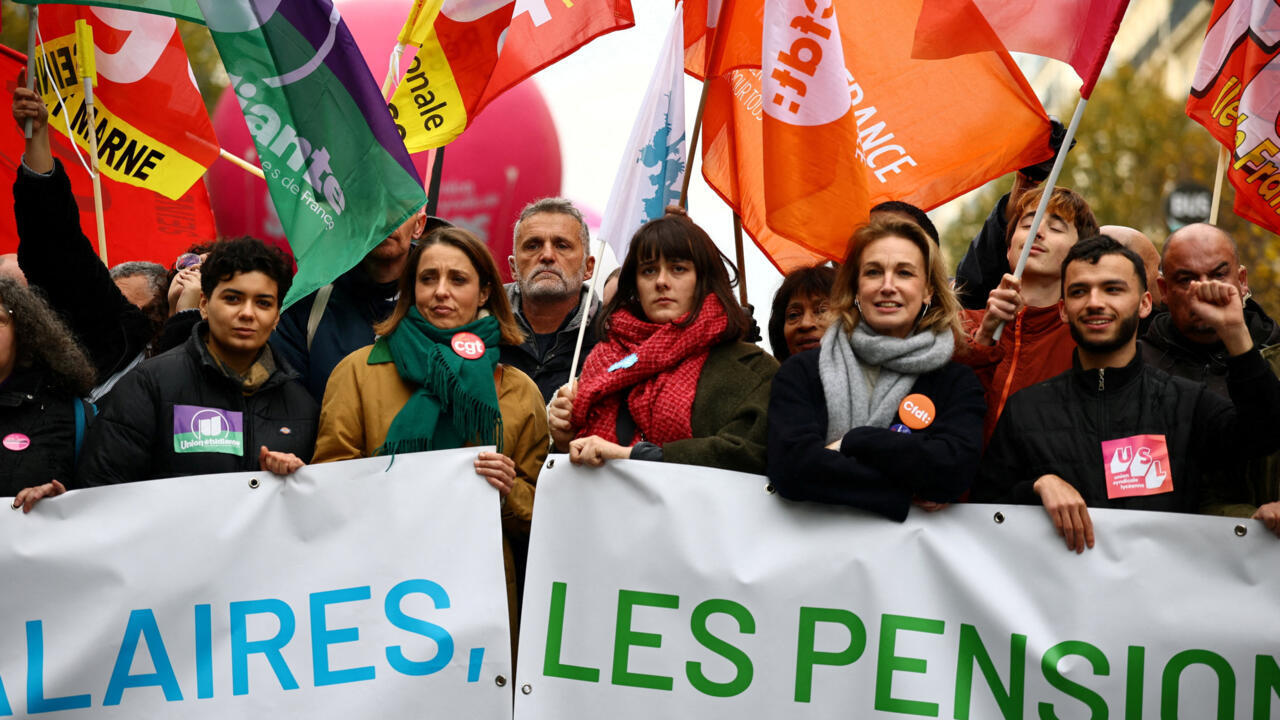
French trade unions have promised to call more strikes and demonstrations, arguing that a government proposal to increase the minimum wage fails to address the social crisis that has spurred protests across the country. Sophie Binet, head of the CGT union, says even after six weeks of action, workers and students are more determined than ever to keep up the fight. What began as student protests over conditions in French high schools have since been joined by workers in both the public and private sectors, as well as others angry over high cost of living, lack of investment in public services and stagnating salaries. This comes as the government races to adopt a deficit-cutting budget ahead of a presidential election next year. The CGT, one of France's biggest unions, is calling for another day of protest on Saturday. Its demands include the unfreezing of wages in the public sector, higher salaries across the board, more places in higher education and new teaching positions. Speaking to RFI on Thursday, secretary-general Binet says the government must "make immediate, substantial announcements" if they hope to bring the protests to an end. Sophie Binet, secretary-general of the CGT trade union, in RFI's studios on 19 November 2026. © RFI RFI: This Saturday will mark the sixth major day of action since this movement began. Do you think it might go on for a long time yet? Sophie Binet: Absolutely. What’s very clear is that none of the government’s manoeuvres have managed to take the air out of this movement. They’ve tried repression, they’ve tried banking on school holidays, they’ve tried sowing division among the unions, they’ve tried using the weather, and they’ve tried throwing up a smokescreen. None of it has worked. What I want to say to the government is this: we know we’re running a marathon, and we have the stamina to go the distance. On Tuesday [when unions held their most recent nationwide public sector strike], we passed the 30-kilometre mark. In a marathon, the 30th kilometre is always the hardest – but once you’re past it, you’re sure to reach the finish line. What I see is an unprecedented social mobilisation. In just two months, 11 national days of action have brought together 5 million people. What has taken place in France is truly massive – it’s an unprecedented start to this period of social unrest. That said, there is of course some fatigue among the protesters. French PM's move to increase minimum wage fails to convince unions RFI: On Tuesday, the turnout was 150,000 according to the police, and 500,000 according to the CGT. Government figures showed less than 3 percent of civil servants were on strike, compared to nearly 10 percent on 5 November. What do you make of this loss of momentum? SB: It’s not so much a loss of momentum, it’s just that not everyone can turn up all the time. There are periods that are a bit quieter, and others that are more intense. Quite simply, it’s a question of purchasing power. Going on strike is costly – it means losing income, which is expensive. People have clearly weighed the economic implications, but their determination remains unshaken, and the anger is very real. There must be a response to this mobilisation, otherwise it is set to become a drawn-out struggle. Our goal is to get immediate answers. Contrary to what the government or [President] Emmanuel Macron might say, our focus is not on the ballot box six months from now – it is on the here and now. What will they tell us so that we can finally make a living from our work? RFI: What can this government, which does not have a majority in parliament and is focused on making budget cuts, actually do? SB: This government possesses the powers of a government and can make political choices. We must go and get the money where it really is – in the pockets of shareholders, the ultra-wealthy and large corporations – in order to provide fair compensation for workers and fund our public services. RFI: The CGT has specifically criticised a planned increase in military spending. The draft 2027 budget allocates around €63 billion to defence, which is €6.5 billion more than in 2026. Why do you consider this to be too much? SB: The problem is that the only public budget that is increasing is the military budget. And today, hospitals are being closed in order to build cannons. The problem arises when this happens at the expense of everything else. And right now, what we are seeing is that our public services are in a state of total disrepair. We experienced an unprecedented summer, with firefighters tasked with battling mega-fires while essentially armed with nothing more than teaspoons – simply because they lack the resources to do their jobs. If there is one area that requires investment, it is public health, the state of our hospitals, along with adaptation to global warming and education. When millions of young people tell us that they lack the means to pursue their studies under decent conditions, that is a red alert. It means our country is no longer preparing for its own future. France moves to boost military budget, arms stockpiles in face of Russian threat RFI: What about the war in Ukraine? There is clearly an aggressor and a victim of aggression. Should we abandon Ukraine simply because we can no longer afford it? SB: No, that is not what we are saying. What we are saying is that the money should be taken from where it currently lies – in the pockets of large corporations and the ultra-wealthy. Among the many things the government could very easily do, it could re-examine the €211 billion in annual subsidies granted to businesses – subsidies provided without any conditions or requirements in return. Included in that €211 billion is what is known as the "tonnage tax" – a system of tax exemptions that benefits shipowners. It costs us between €3 billion and €5 billion a year, even though these shipowners have never made such high profits. Why don’t we, for instance, abolish this tax? Within that €211 billion, there are €8 billion in tax credits for businesses pursuing research and development – a setup that clearly creates windfall effects. Dozens upon dozens of reports have pointed this out. Why don’t we reallocate funds from this tax credit to finance our universities and research institutions instead? RFI: Are things worse in France than elsewhere? SB: Yes, it is worse in France than elsewhere. When you look at international comparisons, France is the European country that has increased its minimum wage the least. We started from a high level. After all, we still recall the general image of France – a country of social rights, a country with higher wages, a country that had a minimum wage back when the majority of European nations did not. And now, the French minimum wage lags far behind the German minimum wage, even though the Germans used to be behind us and didn't even have a minimum wage. In terms of wages, France has fallen behind at the European level. This is a result of Emmanuel Macron’s supply-and-demand policy, which has effectively compressed wages. Furthermore – again due to this approach – taxes on the wealthiest individuals and the largest corporations have been cut by €60 billion annually. That is €60 billion less for our public services. ‘Generational rage’ drives young Europeans to fight to be heard RFI: In your view, is a convergence of struggles across Europe possible? SB: We know that what is happening in France is giving others ideas – in Greece, Italy, Portugal, Spain and Germany. But first, it is worth noting that this so-called "Gen Z" movement did not start in France. It began in countries of the Global South, such as India, Bangladesh, Nepal, Morocco and others. What we are seeing in France may well be the first instance of this movement breaking out in a Western nation. In other words, we didn't invent anything. It is simply a wave that has reached our shores. What I find very interesting is that this is a wave coming from the South. It therefore shatters all preconceived notions about North-South power dynamics in our countries, and it highlights the demographic shifts currently at play. A distinctive feature of Europe is that young people are becoming a minority within our ageing society, one that renders them invisible – the first time this has ever happened in our history. We need proactive public policies focused on young people, because they are our future. This article has been adapted from an interview in French by RFI's Arnaud Pontus and lightly edited for clarity.
French union leader warns strikes will continue without higher wages
Full Article
Original Source
Read the full article at Rfi →KhanList aggregates and links to publicly available news content. We do not host full articles from third-party sources. Always verify important information with original sources.