
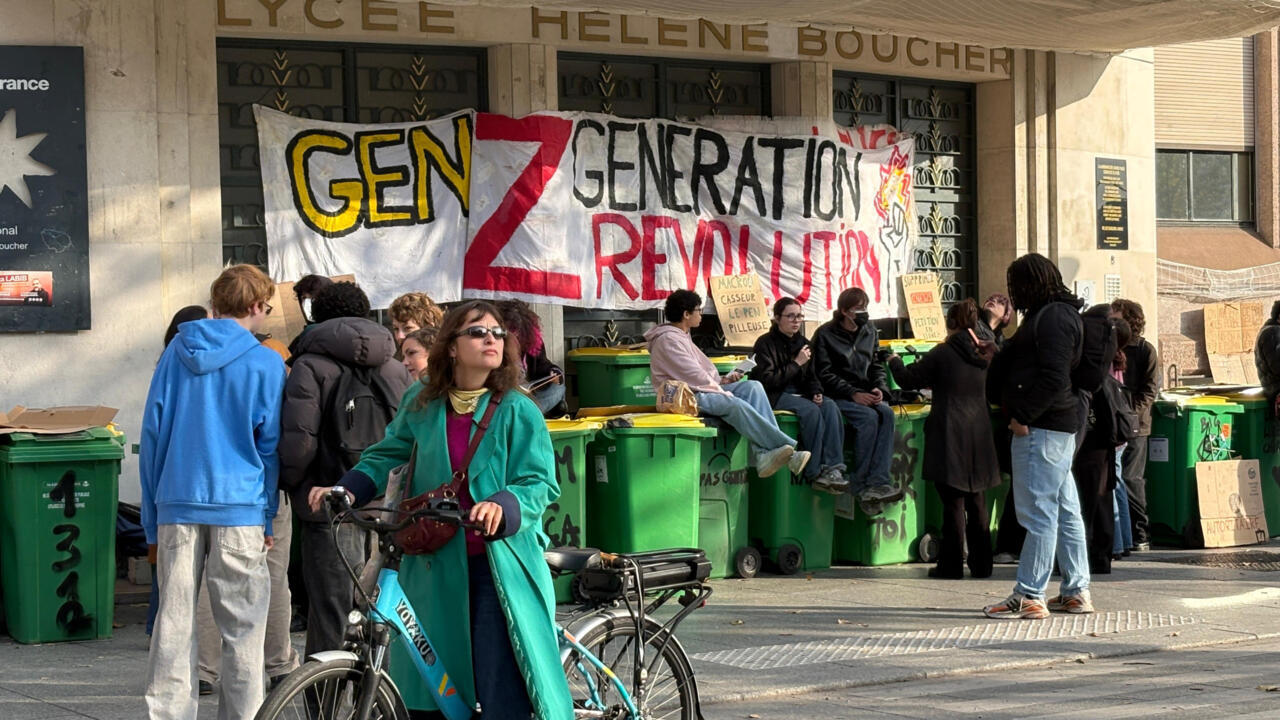
It began as a protest over crumbling classrooms and missing teachers, but France's student movement is now challenging the political establishment to give young people more of a say in decisions about their future. “There’s a massive hole in our classroom," says Marianne Gerbet, 19, who is in her second year of a literary classe préparatoire – intensive programmes to prepare students for the entrance exams for France's most prestigious universities – at Hélène Boucher high school in Paris. With winter approaching, she fears it will become increasingly difficult to study. "How are you supposed to sit a mock exam when water is falling on your paper?” she asks. The situation in poorer working-class neighbourhoods is far worse, she says, with “ceilings collapsing, rain coming through the roofs... rats running round your feet”. As at hundreds of high schools across France in recent weeks, Marianne and her fellow students have been blockading entrances in protest at run-down schools and a shortage of teachers, and over the Parcoursup online university admissions platform, which they say is unfair and overly selective. "It's a movement of solidarity," Marianne said, standing by a banner reading “Gen Z, Generation Revolution”, as riot police – sent in on Tuesday to break the blockade – allowed a handful of students to enter the school. “It’s not normal to have police in front of a school,” says Maya, 16, who claims she was tear gassed and chased by police at 7am that morning, after trying to build barricades out of green rubbish bins. French lawyers to sue interior minister over 'mutilation' of young protesters 'Collective exhaustion' Despite the police presence, and missing out on lessons, protesting students say they won't back down. “It’s a sacrifice,” Gerbet says. “We’re being told to go back to class, but how on earth are we supposed to study properly when we’re not in the right conditions?” Pupils will have to catch up, she admits, but returning to school without proper facilities is not the solution. There is “a contradiction” at the heart of the protests, acknowledges Alice de Brito, a 22-year-old representative of the National Union of Students of France (Unef). “They’re losing weeks of education because they want to have the right to study, it’s really crazy,” she notes, while underlining that without the blockades it wouldn’t have become obvious that teacher shortages were so bad. For 17-year-old Aissata Ba, the whole education system needs overhauling. “These blockades are the result of collective exhaustion,” she says. “We don’t have time to do anything. We’re at school from 8am to 6pm, we see our teachers more than our parents.” Spotlight on France, episode 152 © RFI Listen to a report and interviews on the student protests in the Spotlight on France podcast Too young to vote The younger generation as a whole doesn't have much to look forward to, says Rebecca Lyon-Caen, 16, who describes herself as a good student from a well-off family. “There’s a shortage of housing, jobs, the threat of AI and the international situation is worrying,” she says. “We don’t have the right to strike, and we can’t vote. We really feel that our voice is constantly being suppressed. It’s frustrating, because we have things to say.” This frustration is shared by de Brito, who has been taking part in discussions with government ministers in her role as a union representative. “We’re really tired of not being taken seriously because of our age,” she says. “We want the government to take young people seriously and to start seeing us for what we are: young adults, not children any more.” How Gen Z is taking the fight for their rights from TikTok to the streets 'They think we're idiots' Initially, the government response largely focused on the rioting and looting that broke out on the margins of the demonstrations of 17 October that were otherwise largely peaceful. But on 26 October, following another weekend of protests involving teachers and unions, the government announced a series of concessions. These measures include up to €4 billion in low-interest loans to renovate schools, some 3,000 fully qualified replacement teachers to fill staffing gaps, 15,000 additional places in higher education and a proposed limit of 28 pupils per class. The education ministry also pledged to phase out Parcoursup by 2028. “None of the decisions we make are empty promises,” Education Minister Edouard Geffray said. “Everything we say will be done and respected within specific time frames and with figures.” But with presidential elections coming up in April and May next year, Ba is not convinced the government will make good on its pledges. “Who can tell us that they will be maintained and put in place?” she asks, questioning whether the announcements are intended to bring lasting change or simply “calm the revolt”. “We haven’t been heard,” she says, arguing that the 15,000 extra university places promised by the government fall far short of the 250,000 they are asking for. “We’re not satisfied with these crumbs,” said 16-year-old Marguerite, adding that a few weeks of missed lessons was a “relatively small price" to pay in their fight for better school conditions. As for Parcoursup, which student unions have contested since its inception in 2018, de Brito says the government’s proposed changes amount to smoke and mirrors. “They’ve agreed to stop it but they’re going to put in another website that does the same thing, with another name,” she says. “They think we’re idiots.” French teachers strike over 'unfair' classroom groups, lack of resources Years of underinvestment A spike in births in 2010 has led to a rise in the number of 16-year-olds now attending schools that have been underfunded for years, and where teacher numbers have not kept up with the number of students. The anger currently being expressed by students and teachers alike reflects years of neglect in the education system, says sociologist Fabien Truong. “It’s the underinvestment of the past 15 or 20 years that we are paying for today,” he told RFI. The consequences have become so serious, he argues, that the system is struggling simply to function. These protests should not be seen as those of a generation preoccupied only with its future, he noted. “It’s a feeling of anxiety about the present, even more than the future,” he said. “Pupils are fighting for schools that work now – with functioning buildings, teachers in classrooms and enough places in higher education.” The government insists it has heard the students’ concerns, but the dire state of France’s public finances means it cannot come up with the €10bn the student unions are demanding. However de Brito says the government "finds adjustments when it wants to". She cites the example of a July 2025 Senate commission enquiry which claimed up to €211bn had been handed to big French companies in reduced tax and social contributions. She also points to a voluntary military service plan announced by President Emmanuel Macron this year for the sum of €2.3bn – although the financing is spread out over the next four years. Sense of solidarity While the stand-off between the government and students is ongoing, de Brito says there are positives. The concessions obtained so far show that “if they continue [protesting and blockading], they can obtain more”. And they've been part of the dialogue, which she says “hadn’t happened for a long time”. The biggest source of satisfaction for her is the way high-school and university students of all backgrounds have come together. Pupils at Henri-IV, one of the capital’s most prestigious secondary schools, told de Brito they were protesting because they did not understand why students in poorer areas should be left behind “When you talk to high school students in the suburbs they talk about overseas territories, when you talk to overseas territories they’re talking about rurality... everyone is looking after each other,” she says. At the University of Créteil, where de Brito studies, students have organised tutoring for high school pupils who have missed lessons because of blockades. She has seen students from prestigious schools in Paris bringing their notes, giving them to other high schoolers so they can keep up. “That solidarity is the best thing I’ve seen come out of these protests,” she says, hoping it continues long after the protests end. “It’s great that we’ve built this collectively." Listen to more on the student protests in the Spotlight on France podcast, episode 152.
French students demonstrate solidarity in the fight for better schools
Full Article
Original Source
Read the full article at Rfi →KhanList aggregates and links to publicly available news content. We do not host full articles from third-party sources. Always verify important information with original sources.