
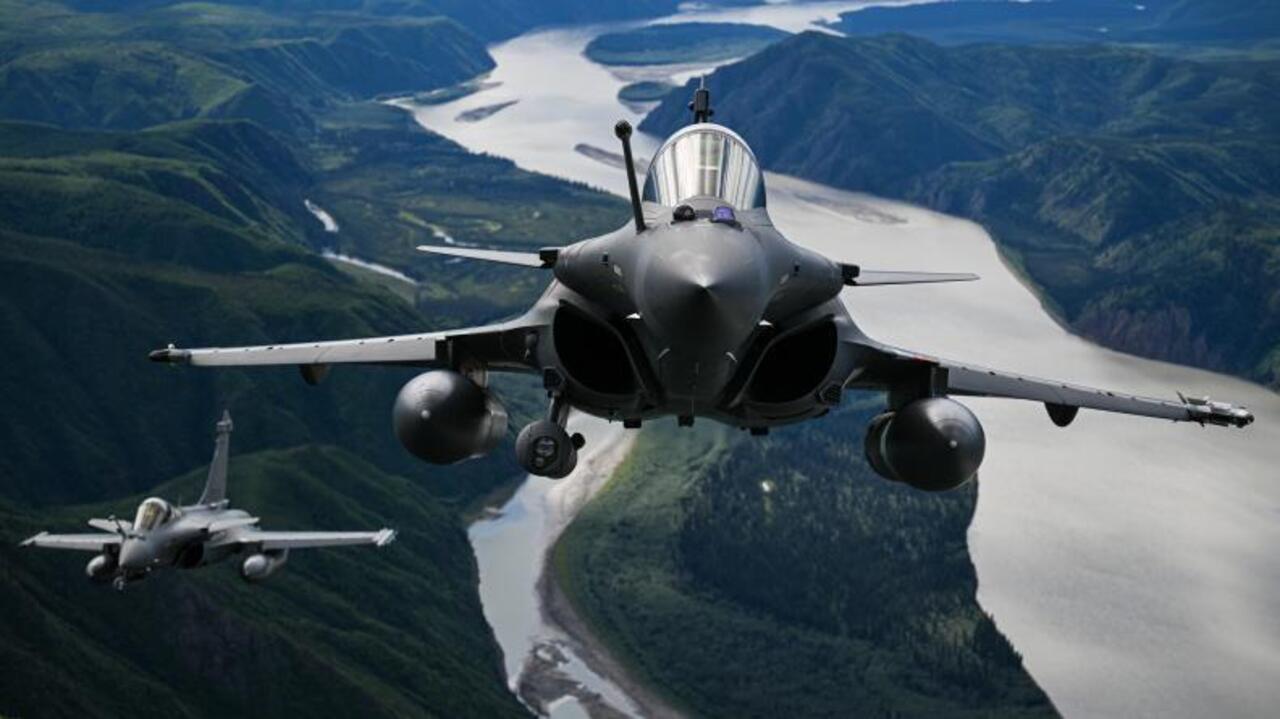
Four French Rafale fighter jets have embarked on a 40-day mission spanning three continents, highlighting France’s ability to deploy its air power around the world while strengthening cooperation with key international partners. Issued on: 12/09/2026 - 21:09 3 min Reading time The Pegase 26 exercise will take the aircraft on a 40,000-kilometre journey from the Arctic to the tropics and the Middle East, with nine stopovers before the mission concludes in Egypt. The two single-seater and two twin-seater Rafales departed Istres air base in southern France on Tuesday, supported by three refuelling aircraft, two transport planes and around 300 personnel. The operation, which took almost a year to prepare, is being overseen from a headquarters near Lyon. French officials say the exercise is designed to demonstrate the country’s capacity to defend its distant territories and support allies, while improving cooperation with strategic partners including Japan, South Korea, Indonesia and India. “In practical terms, we fly together, we land together, we work together,” Deputy Defence Minister Alice Rufo said before the aircraft left France. “If we’re called upon to act together in the face of a threat, we need to be immediately interoperable,” she added. “That doesn’t just happen. It must be prepared, and these exercises and missions allow us to prepare for that.” French intel claims China launched disinformation campaign against Rafale jets An Arctic route to the Indo-Pacific During the opening stage of the mission, the Rafales flew over Greenland before reaching Alaska, where they conducted exercises with US fighter jets. The journey from Istres to Alaska lasted almost 11 hours, with the fighters refuelling in mid-air five times. An Airbus A400M transport aircraft capable of landing on ice was also stationed in Greenland to provide support. Pegase missions have been held annually since 2018, but this year marks the first time the aircraft have travelled north over Greenland on their way to Alaska. “It’s important for us that we explore different routes,” said General Julien Sabènè, the commander of Pegase 26. “We never know, in case we need to go to the Indo-Pacific region and there are thermals and it’s difficult to go the other way around. That gives us another option, going up north.” The route carries particular political significance following US President Donald Trump’s repeated threats to take control of Greenland, a self-governing territory within the Kingdom of Denmark. Those remarks have strained relations within NATO, whose members are committed to defending one another. France has stressed the importance of working with Denmark and other allies as the Arctic assumes greater strategic importance. Global warming is opening new maritime routes in the region and making it more accessible to powers including Russia and China. “Climate change is changing the stakes and maritime routes are evolving,” Sabènè said. “There is a need for us to be present in the High North alongside our allies, and naturally alongside the Danes, who are an integral part of Greenland.” France's Dassault says stepping up Rafale warplane output Alliances and long-range capability The operation also demonstrates France’s ability to move combat aircraft rapidly between potential crisis zones in the Arctic, Indo-Pacific and Middle East while continuing to operate from French bases. The Rafales will travel through the Persian Gulf region via Qatar before completing their journey in Egypt. French officials say the mission underlines the country’s commitment to international law and freedom of navigation in regions where those principles are increasingly being challenged. Pegase 26 comes six months after President Emmanuel Macron offered to extend the protection of France’s nuclear deterrent to European partners amid concerns about the long-term reliability of US security guarantees. Some Rafale aircraft can carry nuclear-armed missiles and would probably operate alongside the same Airbus A330 MRTT refuelling planes during a long-range nuclear mission. Pilots from France’s Strategic Air Force, which is responsible for part of the country’s nuclear deterrent, are participating in the exercise. However, French officials have stressed that Pegase 26 is not a nuclear drill. The jets are carrying no live weapons, although mock conventional armaments have been fitted to add weight and alter the aircraft’s aerodynamics, making the training more realistic. Beyond its military significance, the mission is intended to send a broader message about the continuing importance of international partnerships at a time when major powers are increasingly questioning multinational institutions. Rufo said the operation showed that France could defend its sovereignty and exercise freedom of navigation while respecting international rules and working closely with its partners. “Sovereignty can only be effectively exercised within a network of partnerships, and the exceptional number of partners involved in this mission demonstrates that,” she said. (with newswires)
French Rafale jets take flight for 40,000-kilometre mission over three-continents
Full Article
Original Source
Read the full article at Rfi →KhanList aggregates and links to publicly available news content. We do not host full articles from third-party sources. Always verify important information with original sources.