
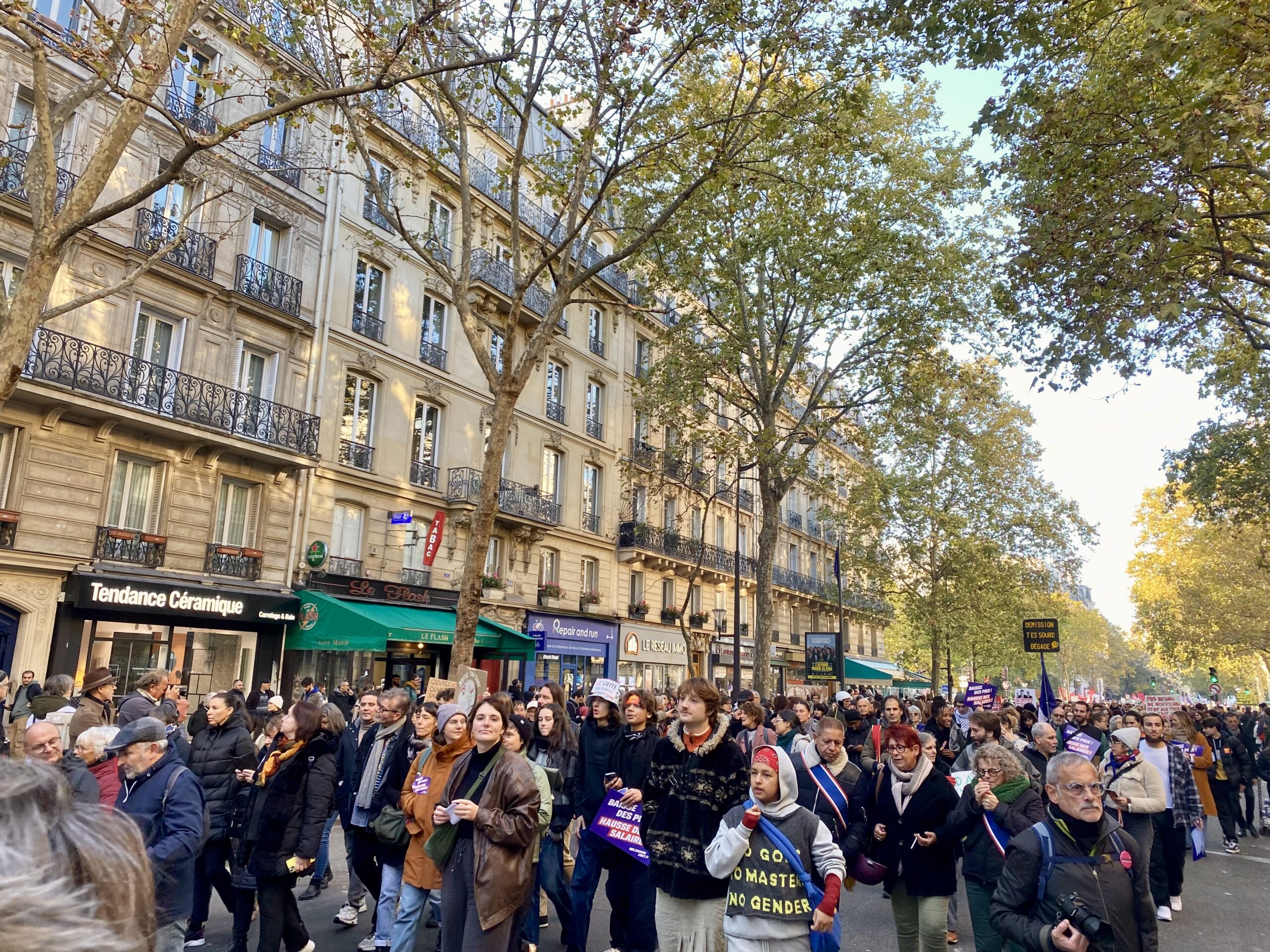
On Thursday, unions called for a general strike — which was joined by students, yellow vests and other groups — capitalizing on a collective feeling of betrayal over democratic rights.PARIS (CN) — Demonstrations surged across France on Thursday when a union-led general strike became the latest expression of a society demanding widespread change.An estimated 600,000 marched in cities across the country. Roughly 10% of public servants nationwide were on strike, according to the Ministry of Public Action and Accounts, in addition to roughly 16% of teachers.In Paris, along the sidelines of the Boulevard Voltaire, one man held a cardboard sign reading: “Money doesn’t buy happiness but it does allow us to buy a toothbrush and toothpaste.” A helicopter hummed overhead to surveil the “journée noir,” or “dark day,” as the cortège moved toward the Place de la Nation.“The message is the determination to obtain answers to this demand for an increase in purchasing power, the defense of public services and the defense of democratic freedoms,” said Danielle Tartakowsky, a historian specialized in social movements and demonstrations.Protesters marching down the Boulevard Voltaire in Paris on Nov. 5, 2026. (Lily Radziemski/Courthouse News)What started as ahigh school movement in mid-September is continuing to expand into a wider expression of social discontent. Unions and yellow vest protesters are organizing demonstrations in parallel to the students, and the groups have been marching alongside each other.“I’ve been supporting the youth movement since the beginning because their demands are very legitimate and useful,” said Florence, a woman marching in Paris who asked to go by her first name. “And I’m here now because it’s a general strike … [we’re all] fed up with this president and government. For one month, young people, nurses and firefighters were all complaining and no one in the government listened to them — it’s a scandal for a country like France.”Jacques Delphine, an activist who has been attending protests in Paris since the 1970s, applauded students for starting such a powerful movement and shedding light on widely shared goals.“It’s to live together, it’s community, it’s to think that together we can do something,” he said, observing the march in Paris. “Discuss, debate, progress.”A float resembling Eugene Delacroix's Liberty Leading the People with a tattered flag on Nov. 5, 2026. (Lily Radziemski/Courthouse News)Michel Pigenet, a historian specializing in contemporary labor and social movements, said the convergence of movements has exposed something deeper than individual demands — a collective sense of betrayal over the “French republican pact” and the promises made under its motto of liberty, equality, fraternity.“The French republic is not simply an institutional system with defined powers … because of the history of the republican struggle, it is also a promise,” he said. “A promise of emancipation through school, a promise of emancipation through public services, a promise of a power that isn’t just top-down power, but a power that delivers.”In his view, this is a crisis that has been intensifying for years.“The promise of upward mobility that schools once carried is now running on empty,” Pigenet said. “It wasn’t [only] about the piece of paper, the diploma … it was the idea that there would be progress, upward social mobility that would accompany this democratization of knowledge and learning — and that hasn’t materialized.”Students have been fighting to abolish Parcoursup, the country’s higher-education application platform, which has been criticized for having an opaque selection process that favors students from wealthy neighborhoods. On the streets, high schoolers decried their futures being decided by “robots” and “AI” without clear reasoning.The government conceded it would phase out the platform completely by 2028. But students are continuing to fight for better learning conditions, both physical and philosophical.Protesters walking down the Boulevard Voltaire in Paris on Nov. 5, 2026. (Lily Radziemski/Courthouse News)Workers have expressed similar discontent about politicians who seem detached from the challenges of day-to-day life.“Power seems increasingly foreign, external to its citizens — there is a verticality that discourages or exasperates, and the feeling of losing influence over what’s being decided contributes to this dissent … people no longer see themselves in those who govern,” Pigenet said. “That’s the backdrop to the current movement and the current anger, and it seems very profound to me, because it touches on things that are at the heart of the French political system and its political culture.”Subscribe to our free newslettersOur weekly newsletter Closing Arguments offers the latest about ongoing trials, major litigation and rulings in courthouses around the U.S. and the world, while the monthly Under the Lights dishes the legal dirt from Hollywood, sports, Big Tech and the arts.Additional Reads
French protesters converge for mass ‘dark day’ mobilization
Full Article
Original Source
Read the full article at Courthousenews →KhanList aggregates and links to publicly available news content. We do not host full articles from third-party sources. Always verify important information with original sources.