
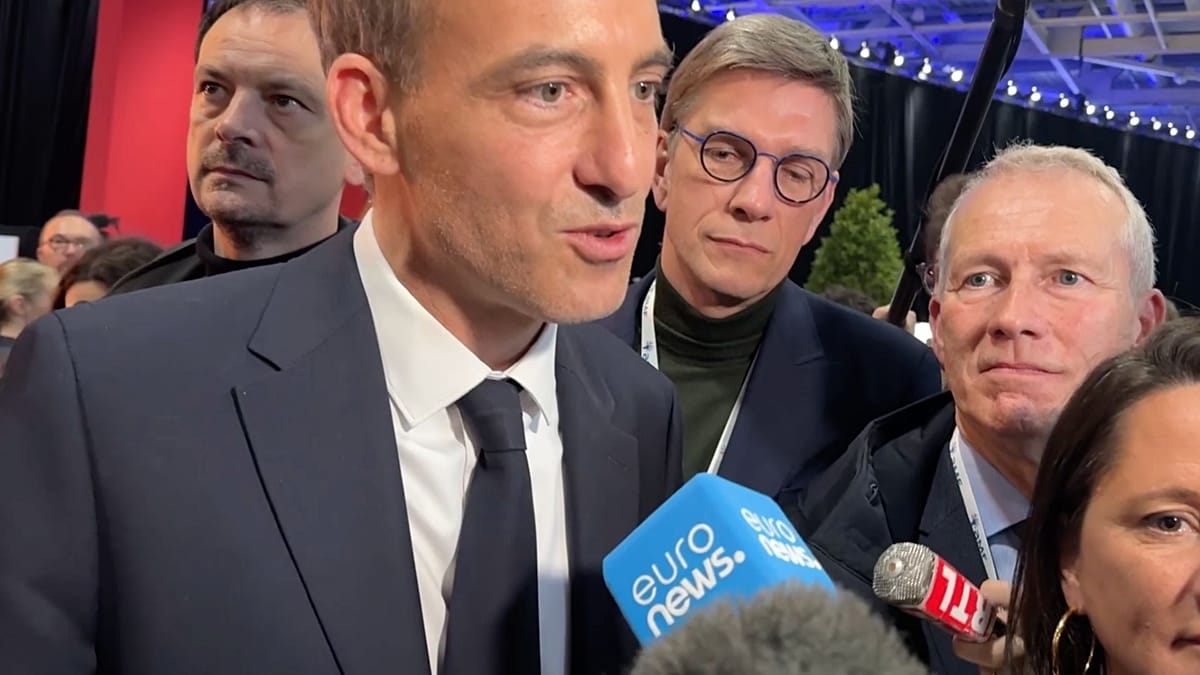
Presidential candidate and MEP Raphaël Glucksmann told Euronews that France's vote would "shape the destiny of the entire European continent", five months ahead of major elections in spring 2027. ADVERTISEMENT ADVERTISEMENT The centre-left hopeful, who leads the Place Publique party, warned that "the entire European project risks being lost if France falls into the anti-European camp", on the sidelines of a mayoral congress held in Paris on Wednesday. France's future relationship with Europe is a major campaign issue, amid divisions over European integration, French sovereignty and support to Ukraine. Referring to the trilateral summit held by Chinese President Xi Jinping, Russian President Vladimir Putin and US President Donald Trump on 18 November, Glucksmann called out "three masters of the world who are trying to share it." "The only obstacle in this sharing of the world is a powerful, independent and free Europe," he said. The backdrop of a divided French left Polls indicate that the far-right National Rally party's Marine Le Pen is currently heading the presidential race, followed by the hard-left France Unbowed party's Jean-Luc Mélenchon. Glucksmann, who supports a pro-European and social-democratic model is struggling to gain ground, polling around 8 to 11,5% — against the backdrop of a divided left-wing bloc and a broader fractured political landscape. France's traditional left and right have faced difficulties marking their territory ever since French President Emmanuel Macron was elected on a centrist platform with his En Marche party in 2017. Glucksmann's political opponents, including those within the hard-left France Unbowed party, portray him as a centre-left politician who offers insufficient political and economic change from Macron. In an interview with French broadcaster BFMTV in early November, he responded to this criticism by stating "if I were in the slightest bit attracted to Macronism, I would have accepted all the offers made to me over the past ten years." Divisions over Europe rife in campaign The future of Europe's long-term budget (2028–2034) has also become tied up with France's upcoming elections. Macron reportedly urged EU leaders to reach an agreement by December, warning that he may withdraw from negotiations if no deal is reached by then. A senior European diplomat acknowledged that the French election was the "primary concern" hanging over the talks. "The prospect of a potential Le Pen victory — and its consequences — is always in the back of everyone's mind," the diplomat said. Although the National Rally and France Unbowed parties' positions remain underpinned by different ideological priorities, both parties back greater national sovereignty and challenge aspects of European integration. Le Pen wants to strip powers from the EU and cap France’s net contribution to the bloc’s budget at €5 billion a year, declaring that "being pro-France does not mean being anti-Europe." Her party has also pledged to scrap a number of EU regulations and standards, particularly those tied to the business sector, agriculture, energy and environmental policy. Meanwhile, Mélenchon's party backs scrapping rules and regulations that do not align with French interests, including those concerning the EU migration pact and European defence. He has previously declared that France should "disobey anything coming from Europe that conflicts with the interests of the French people", adding that France should "amend the treaty that forms the basis of the European Union, because otherwise we will perish politically, socially, and industrially, since we are not in a position to resist." His party has also called for a reduction in France's net contribution to the EU budget by around €9 billion, a proposal reiterated by the party's finance spokesman Eric Coquerel in October. Questions loom over future Ukraine support Raphaël Glucksmann advocates significantly strengthening France and Europe's military and financial support for Ukraine. He proposes seizing approximately €210 billion in frozen Russian state assets to finance Ukrainian assistance, expanding European military cooperation and protecting parts of Kyiv's airspace against Russian missile and drone attacks. On Ukraine, the National Rally has declared that it will not continue to provide financial assistance to Ukraine, instead pledging to honour "existing commitments", citing the European Union's €90 billion support loan, as well as "material donations, humanitarian aid, and more active diplomacy". Le Pen has faced criticism over her past ties to Russia, which included a 2017 meeting in the Kremlin with President Vladimir Putin and her party taking a loan from a Russian bank which was paid off by 2023. The France Unbowed party 2027 presidential programme does not specify a precise amount or annual budget commitment for future funding. It broadly backs supporting Ukraine, but has drawn a red line around delivering long-range missiles, the deployment of ground troops, and Ukraine’s accession to the European Union. The party has however repeatedly been accused of ambiguities, for instance after Mélenchon declared that it was perhaps worth asking whether the escalation of the Russian threat in Europe was linked to "Ukraine’s deep-strike attacks."
French presidential candidate Raphaël Glucksmann to Euronews: 'France's vote will shape Europe's destiny'
Full Article
Original Source
Read the full article at Euronews →KhanList aggregates and links to publicly available news content. We do not host full articles from third-party sources. Always verify important information with original sources.