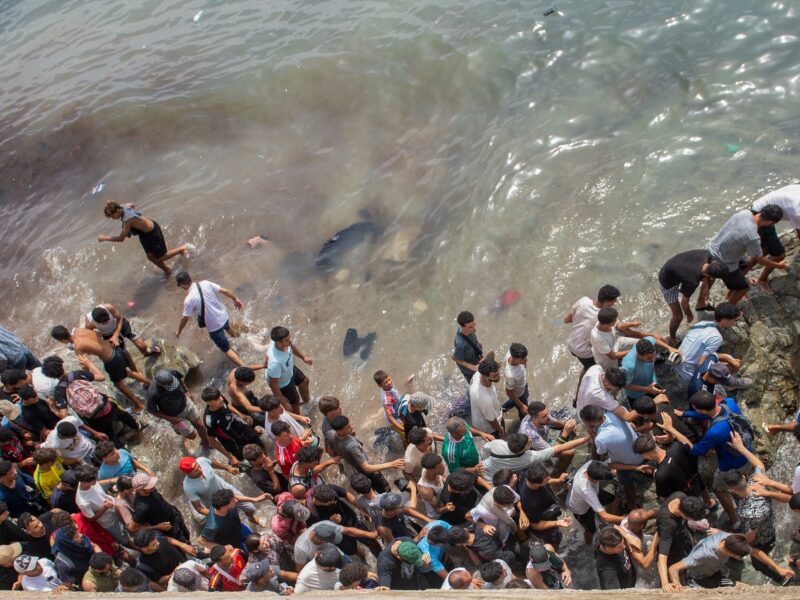
PARIS (CN) — French politicians are using the ongoing migration conflict in Spain’s Ceuta enclave to fuel opposing narratives heading into next year’s presidential election.While the extreme-right National Rally has denounced an “out of control” situation with “looting, violence and continuous arrivals,” the hard-left leader Jean-Luc Mélenchon is advocating for better coordination to bolster humanitarian aid.“By regularizing the status of hundreds of thousands of illegal immigrants, Socialist [Spanish] Prime Minister Pedro Sánchez has opened Europe’s doors to every danger,” the National Rally, known as the RN, said in a newsletter released Tuesday. “The result is plain to see: Thousands of migrants are flooding into the enclave of Ceuta. Tomorrow, they will be on our streets, against the will of the French people.”On July 30 and 31, tens of thousands of Moroccans crossed into the Spanish exclave of Ceuta in North Africa by land and sea, circumventing border controls in the hopes of getting residency status in Europe. People were likely encouraged by social media posts, which spread misleading information about entering the territory.Since then, the vast majority of migrants have left Ceuta, either voluntarily or by the order of Spanish authorities. Just a few thousand, including minors, remain.But experts argue the situation will make a lasting impression on French politics, and leaders have been making their positions clear.“Rather than instrumentalizing the situation against the government of a neighboring country of a friendly nation, as [RN leader Marine Le Pen] is doing, we should call for European coordination for humanitarian aid,” Mélenchon posted on X. “There are already 27 dead: Let us not leave Spain to face the ordeal alone!”A 12-year-old unaccompanied minor who crossed into Spain is escorted by a Spanish soldier to the Spain-Morocco border as the child begs not to be sent back to Morocco from the Spanish enclave of Ceuta, Monday, Aug. 3, 2026. (AP Photo/Bernat Armangue)More than 70 people died in Ceuta and 11 in Morocco, with some sources reporting further deaths.Experts warn the swift political response to Ceuta risks glossing over critical facts, data and history.Patrick Weil, a political scientist and author of the recently released “On Immigration in France,” said of the roughly 100 million foreigners who pass through France every year, only a fraction remain on the territory without documentation.“That proves that the system doesn’t work so badly — we need to stop shouting that there is a general disfunction, which is not at all the case,” he said. “The images can make a strong impression, so they must be interpreted.”Widespread criticism about the Schengen area— which allows for freedom of movement between 29 countries across Europe, including Spain and France — has also been misleading, he said, since Ceuta has its own set of rules. People who arrive in Ceuta cannot enter mainland Europe without undergoing border checks.That didn’t stop Italy’s far-right Prime Minister Giorgia Meloni from suspending freedom of movement between Italy and Spain for one month, starting July 31.“Then, there was the reaction … saying that it calls Schengen into question, when in fact it didn’t call it into question at all, since the vast majority of the people who arrived en masse have left, and there was never any question of them being transported to the European mainland afterward,” he said. “So the Schengen and cooperation agreements with countries of origin and transit countries work as well as possible, by deterring most people who want to emigrate from doing so, as we can see here.”Jean-Baptiste Noé, author of “The Migration Challenge: Europe Shaken,” agreed, and warned that political rhetoric or “exploitation” often takes precedence over scientific analysis, which is “always the problem” when talking about immigration.“Now, the problem is that we’re dealing with a topic that is very complex, and as always, knee-jerk reactions, emotion or immediacy wins out over complexity,” he said. “Everyone is going to want to exploit this to show that they are right and that their policy is correct, so we’re always stuck in political exploitation, regardless of the party, and never in a real analysis of why — why this, why now, what works and what doesn’t.”Migrants return to Morocco from the Spanish enclave of Ceuta, Saturday, Aug. 1, 2026. (AP Photo/Antonio Sempere)Experts agree that the powerful visuals of Ceuta, and the scale of the event, will leave a lasting impression on the public imagination.Yvan Gastaut, a historian at the Migration and Society Research Unit under the Université Côte d’Azur in Nice, said seeing tens of thousands of people move with “no real structure” could invoke fears of violence amid a “forced entry.” However, it’s important to reflect on the “reality and fiction” that these images represent.“One might get the impression that this crowd is entirely compact and driven by a single goal,” Gastaut said. “However, it seems that, of course, this is not the case, and that individuals are driven by collective movements and at the same time, very personal motivations.”These images will likely play a major role in France’s upcoming presidential elections in 2027, particularly in the RN’s campaign to strengthen borders and issue deportations en masse.“It was the massive nature of it that I think obviously struck everybody’s eyeballs,” Nancy L. Green, a contemporary migration historian, said. “I am not surprised that the far right everywhere will try and use this, because their main line is anti-immigrant, so that this kind of visibly spectacular event feeds into a preexisting perspective.”The images also tell another story, Gastaut said.“But there is also another reality, which is the image of the people who have disappeared, who have died, who have suffered, who have gone through a kind of terrible ordeal in crossing this border by sea or over the walls,” he said. “So there is also another narrative, which is the narrative of solidarity, or in any case, of compassion toward human beings who are a bit disoriented, lost and searching for a better future.”Subscribe to our free newslettersOur weekly newsletter Closing Arguments offers the latest about ongoing trials, major litigation and rulings in courthouses around the U.S. and the world, while the monthly Under the Lights dishes the legal dirt from Hollywood, sports, Big Tech and the arts.Additional Reads
French politicians leverage Spain’s Ceuta crisis to paint conflicting portraits of immigration
Full Article
Original Source
Read the full article at Courthousenews →KhanList aggregates and links to publicly available news content. We do not host full articles from third-party sources. Always verify important information with original sources.