
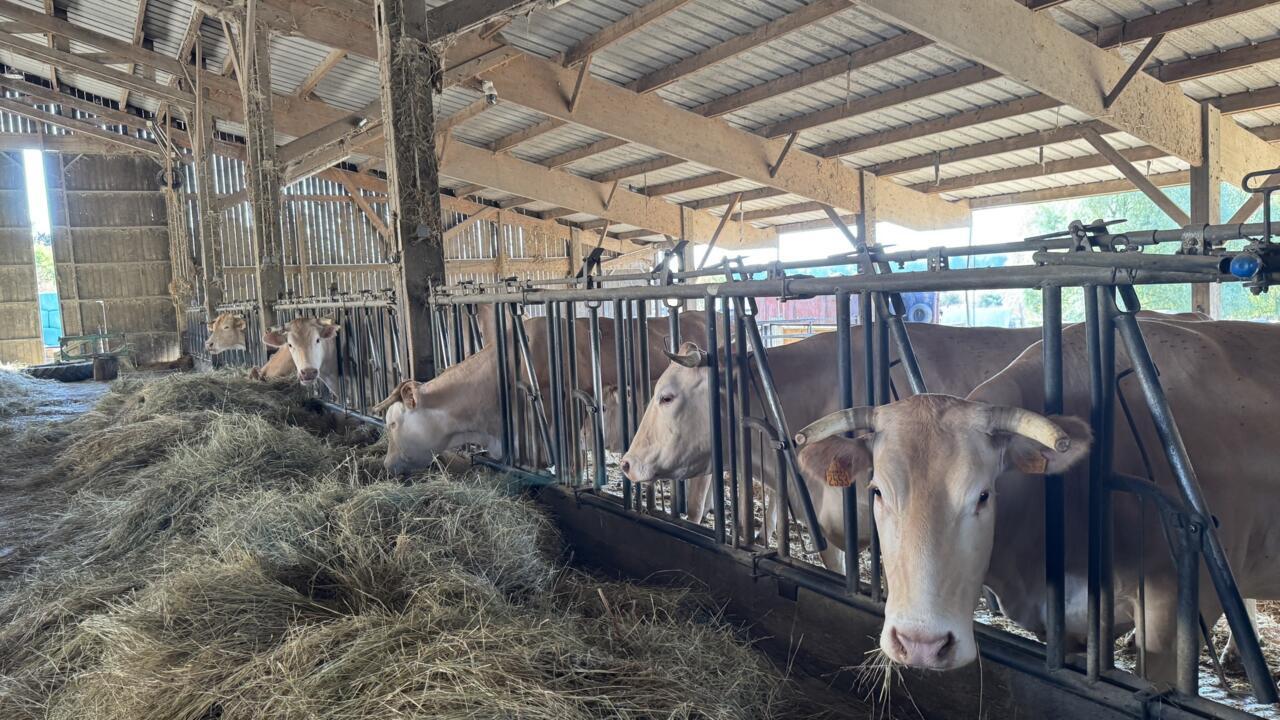
Repeated heatwaves and drought have made it a punishing summer for French farmers – scorching pastures, straining livestock and driving up costs. With grass disappearing from fields, cattle farmers across the country are already dipping into fodder meant to feed their herds through winter. Issued on: 22/08/2026 - 09:04 4 min Reading time The National Federation of Milk Producers, or FNPL, said winter fodder stocks were already being used by many farmers across France by late July. At La Recette farm in Échouboulains, in the Seine-et-Marne department east of Paris, Philippe Dufour's cows usually graze in the pastures all summer, where the grass can grow up to half a metre high. But this year, the cattle farmer's fields have been completely scorched by the sun. French farmers bracing for smallest corn harvest in 40 years Parched pastures France has experienced five heatwaves this summer, with temperatures rising above 40C in several areas and records repeatedly broken across the country and elsewhere in Western Europe. July 2026 was the second-driest July on record in Europe, surpassed only by 2022. Successive heatwaves have parched already depleted soils, which are suffering from an increasing water deficit because of the lack of rainfall. In early August, nearly two-thirds of France's groundwater tables, the country's main water reserves, were below normal levels, data from the government's VigiEau monitoring service showed. "We haven't had any grass for over a month now; it looks a bit like a desert. I’ve never seen it quite like this," Dufour told RFI. Dufour, who has been raising Blonde d’Aquitaine cattle for 40 years, said the situation was particularly frustrating because the hay harvested earlier in the season was of very good quality. Farmer Philippe Dufour with his bull, Sérieux, in pastures dried out because of the exceptionally severe drought and heatwave that hit France from June to August 2026. © Zeenat Hansrod Forced to adapt But since June, the grass has not grown back and Dufour has been forced to use part of his winter stock to feed his herd. "Before winter feeding begins in November, we will have already consumed 30 to 40 percent of the winter forage," Dufour said, pointing to a hangar that is only half full. "Faced with this situation, we are reacting rather than acting proactively. But we are adapting." The problem extends well beyond Dufour's farm. FNPL president Yohann Barbe said in July that winter stocks were already being used by many livestock farmers, with intense drought affecting pastures across much of France. In the Landes in south-west France, the local Chamber of Agriculture said farmers began drawing on their stocks as early as July and estimated that an additional 13,000 tonnes of fodder would be needed. Finding hay elsewhere could become impossible because the same weather conditions are affecting the rest of France, Dufour fears. "All of France is facing the same weather conditions. And even if it rains soon, we would need 100 to 150 millimetres of rainfall for the grass to start growing again. We won't have any grass before October." Climate change 'exacerbating' drought across Europe, scientists say Cows at La Recette, a farm in Échouboulains, south east of Paris, where drought and heatwaves have scorched the pastures, August 2026. © Zeenat Hansrod Strain on cattle The drought is also affecting the health and reproduction of Dufour's cattle. "Unfortunately, the heat can lead to miscarriages and complications," Dufour said. "For beef cattle, the calf is the end product." The calves have also suffered because the cows are producing less milk, even though Dufour supplements their diet with cereals. "Even if we partially make up for this nutritional shortfall, the calves aren't as robust as the ones we usually have," he said. Dufour estimates the additional costs of running his farm at around €15,000 a month and does not know whether his business can sustain the situation much longer. Emergency support French Minister of Agriculture Annie Genevard said the government has prepared a "comprehensive support plan" for the agricultural sector which has been severely affected by heatwaves, drought, and wildfires. The emergency funds are due to be rolled out on 3 September and distributed across France's departments to "bolster cash flow and revitalise production", Genevard told the Sud Ouest newspaper on Wednesday. The 2026 drought "is exceptional; it is affecting every region, even Brittany", she said, stressing the need to "prepare for similar situations in the future ... in order to better withstand them." Genevard was in the Gironde on Monday alongside government leader Sébastien Lecornu to launch reconstruction in areas devastated by wildfires. She praised farmers who "play a fundamental role in fighting the fires", notably by clearing undergrowth and supplying water to firefighters.
French farmers dip into winter fodder as drought leaves pastures bare
Full Article
Original Source
Read the full article at Rfi →KhanList aggregates and links to publicly available news content. We do not host full articles from third-party sources. Always verify important information with original sources.