
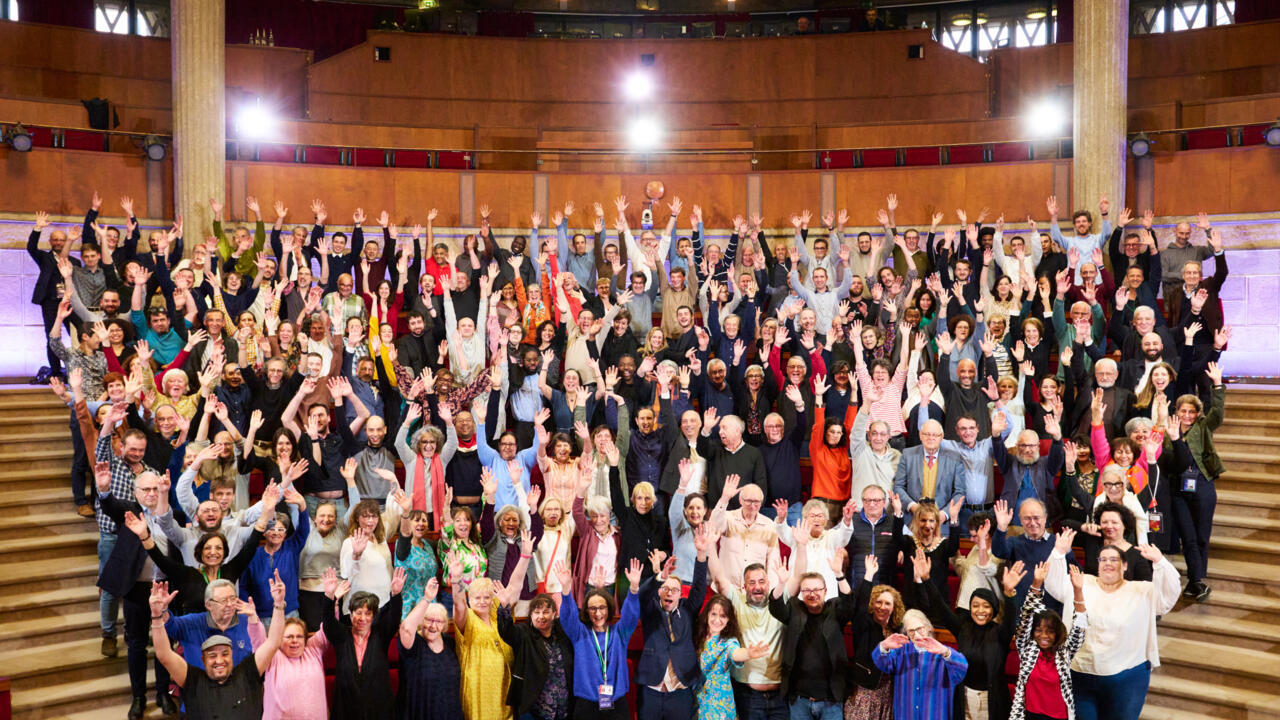
France on Friday launches a citizens' convention on public finances, bringing together 150 randomly selected French people representative of the population to debate how the country can reduce its ballooning deficit and regain control of its finances. The convention, organised by the Economic, Social and Environmental Council (CESE), will work over seven weekends until March to answer a question that has proved difficult for the country's politicians: what priorities and choices should France make today to restore balance to its public finances and prepare for the future? France's public debt has reached nearly €3,600 billion, equivalent to 119 percent of gross domestic product (GDP) and the government is struggling to reach political compromises on spending and taxation. The CESE will deliver its conclusions on 21 March, less than a month before the first round of the presidential election on 18 April. "We have a growing challenge. We have the feeling that we have no control over our public finances and we can see that our political leaders, given our history and the composition of the National Assembly, are in great difficulty, or even incapable of finding compromises," CESE president Claire Thoury told France Inter. "Day after day, the deficit is growing. Day after day, we are promised blood and tears without any encouraging prospects." 'This is our money' The 150 participants have been selected to reflect the diversity of the French population, taking into account age, gender, geographical background, education, professional category and whether they live in urban or rural areas. People on very low incomes are also included, with organisers saying they want to avoid limiting participation to those who are already comfortable. It follows previous citizens' conventions on climate change, the end of life, and children's time, with seven sessions spread across three stages. The first sessions, in November and December, will help participants learn about public finances through discussions with experts. They will then examine different scenarios and develop proposals in January and February, before presenting the government with their conclusions. Thoury said it was important not to treat public finances as a subject reserved for specialists. "I think it's a democratic failure to consider that public finances are too complicated for ordinary people. This is our money, public money, and it is not acceptable to be told that we cannot understand it because it is too difficult," she said. Decisions about public spending were directly connected to everyday life, she argued – including schools, healthcare, infrastructure and local public services. How 184 random citizens helped shape France’s debate on assisted dying Political compromises The latest convention, which was proposed by the CESE itself rather than the government, is aimed at encouraging compromise at a time when a deeply divided parliament has made it impossible to agree on a budget. Thoury believes ordinary citizens could help find solutions that elected representatives have struggled to reach. "The role of citizens' conventions is to ask ordinary people to work on issues that traditional political institutions cannot resolve," she said. She hopes presidential candidates will pay close attention to the conclusions, which will be published during the election campaign. "I think we have reached the end of an era in which a president could decide everything and direct everything. That is not how things will work. Afterwards, coalitions and compromises will have to be built, and that is where the citizens' voice will be decisive." Where did France's culture of political compromise go, and is it coming back? Right-wing criticism The CESE was created in 1925, in the wake of the First World War, to get employers, unions and other organised social forces to discuss economic policy with the state. Known initially as the CNE, it was reformed in 2019 to include randomly selected citizens alongside representatives of civil society and to organise citizens' conventions. It costs just over €34 million a year to run, of which around €4m a year is specifically earmarked for the conventions and other participative initiatives. Whilst its supporters see it as an important democratic tool, critics claim it is ineffective and a waste of public money. Presidential candidates Edouard Philippe, of the centre-right Horizons movement, and Marine Le Pen of the far-right National Rally, have both called for it to be disbanded. Responding to the criticism, Thoury said: "When you want to be president of the Republic, it seems to me that the candidate's role is to strengthen the institutions, not to try to weaken them. You don't respond to a democratic crisis with less democracy; you rely on civil society organisations and work with them." A 2025 report by France's public audit court also criticised the CESE for its lack of financial transparency, lax human resources management and costly citizen selection processes. It also said the institution struggled to make itself heard and received too few formal requests for advice from government. Thoury insisted the CESE was at politicians' disposal. "Our role was established a century ago, in its original form, so that social democracy could support political democracy. Frankly, if this isn’t the time when we need dialogue, compromise and humility more than ever, I don’t know what else to do."
French citizens tasked with finding solutions to country's debt crisis
Full Article
Original Source
Read the full article at Rfi →KhanList aggregates and links to publicly available news content. We do not host full articles from third-party sources. Always verify important information with original sources.