
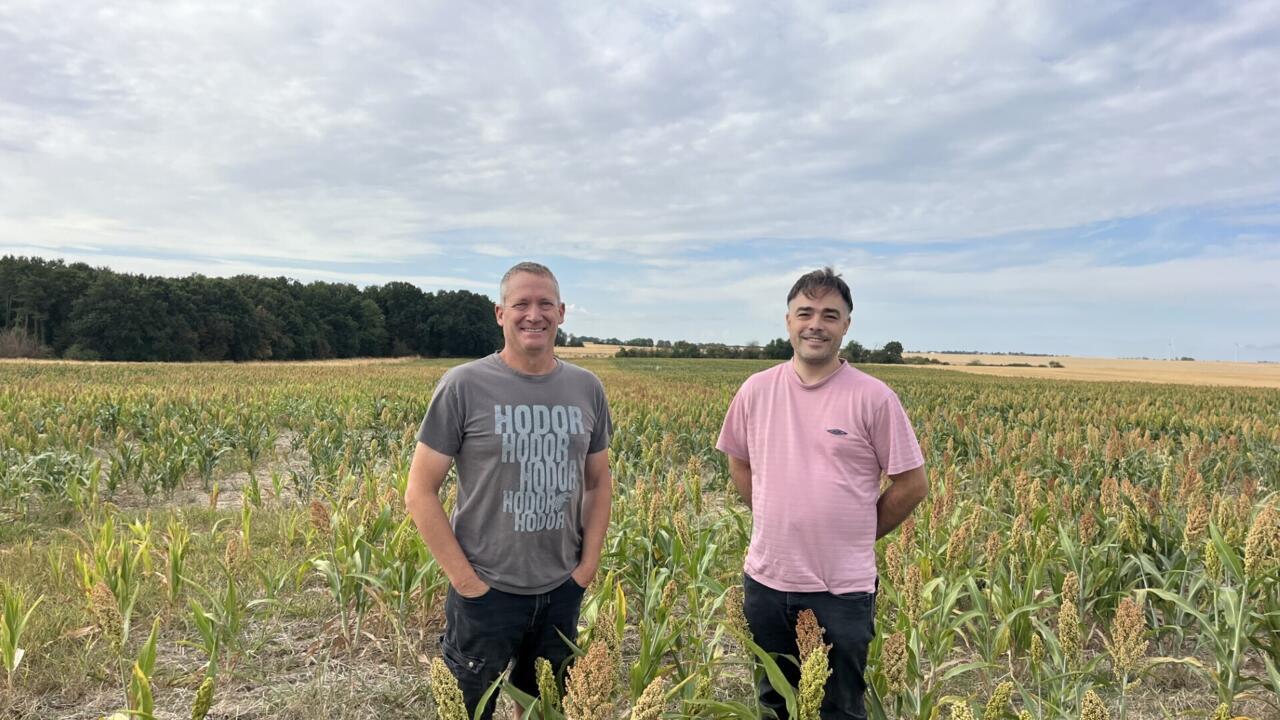
Europe's maize crops have been hit hard by this summer's heatwaves and ongoing drought, with French producers saying almost half of this year's harvest is unusable. To prepare for hotter, drier conditions, some cereal farmers are experimenting with sorghum – a crop from sub-Saharan Africa that requires less water than maize – although making a living from it remains a long way off. Issued on: 20/09/2026 - 10:07 4 min Reading time Sorghum is the world's fifth most important cereal crop, after wheat, maize, rice and barley. It is widely grown across sub-Saharan Africa and parts of Asia for human consumption, while elsewhere – particularly in the Americas – it is also extensively used as animal feed. Interest in the crop is growing in France, which in 2024 became Europe's largest producer with some 103,000 hectares cultivated, according to the Chamber of Agriculture. In Essonne, south of Paris, fields of wheat and rapeseed stretch out almost endlessly. Yet among the yellow and gold squares, a four-hectare patch of green and red stands out. "We are in the middle of a sorghum field," Eudes Coutté, a French sorghum grower, told RFI. "It looks like small maize plants about 80 centimetres tall." "The characteristic of sorghum is that it has an ear that produces small green balls, which turn red. We harvest these beads between September and November, depending on the weather." Sorghum thrives in hot temperatures. AP - Nati Harnik French farmers race to adapt as repeated heatwaves hit crops and livestock ‘Plant of the future’ Native to sub-Saharan Africa, sorghum grows in hot, dry regions and thrives in temperatures of between 25C and 35C. France’s cooler climate was once poorly suited to sorghum, but over the past 15 years cultivation has steadily expanded. "I settled on my farm 10 years ago and I said to myself that with climate change, if we don't make decisions now, we're going to hit a wall – we won't be able to sustain a 42-year career without change. "So I started looking into certain plants, especially plants from Africa, and I came across sorghum, which is considered by the World Wildlife Fund and the United Nations as a 'plant of the future' – an eco-friendly option." Sorghum generally requires less water than maize, while its deep root system, which can reach up to two metres, allows it to make better use of available moisture and makes it more resistant to drought. However, it is not a miracle crop. The three completely dry months this summer still affected some ears, leaving them yellowed and dried out. "Yes, sorghum has a slightly greater capacity to resist drought," Coutté said. "Even so, you can see in the field that some areas are a bit more yellow, showing the effects of successive droughts and heatwaves." France gripped by latest summer heatwave as drought conditions worsen Wider adaptation Ludovic Joiris, who grows flax and has long paid close attention to farming methods for the future, partnered with Coutté three years ago. For almost 20 years, he has practised soil conservation farming, a method that helps restore the soil's natural fertility. It generally takes 10 to 15 years to fully master a crop, and the two farmers are still finding their way. "There's a lot to learn," Joiris admitted. "It's true that I don't know enough yet, so we're refining things and trying to improve. This year I had some problems because slugs came and ate the young plants, but in some ways the area with fewer plants is doing better than the one with plenty, because they had more water." There is still some way to go. Even once production becomes more reliable, however, farmers will need a market for the crop. In Zimbabwe, community seed banks are reviving indigenous crops Consumer demand Franck Laborde, a maize farmer in the Pyrénées-Atlantiques and president of the AGPM – which is part of France’s largest farming union, the FNSEA – sees potential in sorghum from an environmental perspective. But for farmers, he says, the main obstacle is economic: expanding sorghum production only makes sense if there is sufficient demand. "Even if sorghum appears to be a good option in the face of climate change, if consumers don’t follow suit, farmers cannot afford to plant more hectares," he said. Demand remains limited, both from livestock farmers using sorghum as animal feed and from consumers buying the grain for human consumption. For Coutté and Joiris, that means sorghum is not yet profitable enough to provide a living on its own. Both still rely on other food-related activities to supplement their farming income. For now, their experiment shows that adapting crops to a hotter, drier climate is only part of the challenge – farmers also need buyers willing to make those new crops economically viable. This article was adapted from the original version in French by Orianne Gendreau.
French cereal farmers experiment with African sorghum to beat the heat
Full Article
Original Source
Read the full article at Rfi →KhanList aggregates and links to publicly available news content. We do not host full articles from third-party sources. Always verify important information with original sources.