
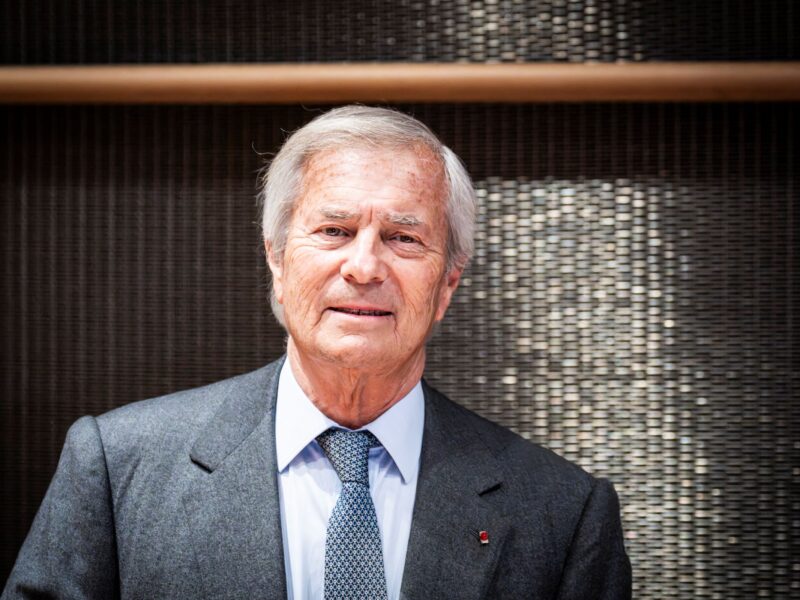
PARIS (CN) — For French billionaires, one thing can’t be bought — elections.Campaigns are subject to strict financing restrictions; individual donors cannot contribute more than roughly $5,000 to candidates or about $8,700 to political parties. But this doesn’t mean billionaires can’t throw their financial weight behind something else: the political ideologies presented on primetime television.“One of the possibilities is actually to try to influence the public debate,” Abel François, a professor of political economy at EM Strasbourg Business School, said. “That’s something we know fairly well in the academic literature — when you can’t fund an election campaign, you try to influence the media agenda through funding.”France’s wealthiest people are dividing and conquering the media landscape, acquiring TV channels, radio stations and newspapers to go beyond campaign financing and toward changing citizens’ value systems in the long run.“I think these are people who have closely studied the mechanics of communication and psychology, and who use things like the Overton Window, with this idea of normalizing a certain number of ideas that might seem radical at a given time … But which, if they’re repeated, endorsed, spoken enough, end up becoming relatively common ideas,” Olivier Costa, a director at the Center for Political Research at Sciences Po, said.The Overton Window refers to what is politically acceptable in the mainstream.FILE - In this Oct. 8, 2014, file photo, France's Vincent Bollore, head of the Bollore Group, sits in a customized Autolib electric car in Paris. (AP Photo/Jacques Brinon, File)In France, billionaires owning media outlets is not a new phenomenon.But Arnaud Mercier, a political scientist and professor in communication sciences at the Panthéon-Assas University Paris II, explained that traditionally, owning outlets was a way to build privileged relationships with public officials.“It was more about having channels for influence, to have the ear of politicians,” Mercier said. “Because they could actually fear press campaigns going after them if they went against the economic, banking or financial interests of billionaires.”Costa said while some traditional outlets have always had a political slant, their number is growing and the slants are becoming more extreme.Vincent Bolloré, the former chairman and CEO of his family’s Bolloré Group, is widely credited as the driving force behind this change. In 2017, he spearheaded a complete overhaul of the TV channel i>Télé, which was seen as relatively centrist at the time, despite widespread pushback and strikes within the organization.“He’s the first to invest heavily in the media to turn it into a vehicle for ideological influence, because he has a political agenda that is actually also a culture war,” Mercier said. “So with him, it’s not just, ‘I have friends, I’m pretty right-wing, somewhat conservative, so there you go,’ he operates with the mindset of ‘I invest in the media to wage an ideological war, a cultural battle over ideas.’”The channel was ultimately reborn as CNews, a far-right outlet often compared to Fox News. It has been widely criticized for giving a mouthpiece to the extreme-right politician Éric Zemmour, who promotes the “great replacement” theory and was fined over $10,000 for inciting racial hatred in 2022. The investigation came after he said all unaccompanied foreign minors are “thieves,” “murderers” and “rapists” on CNews.In 2024, the channel was fined over $100,000 after a broadcaster displayed an infographic presenting abortion as the world’s leading cause of death.“I wonder if this isn’t the import of an American model; I think Bolloré took a close look at Fox News and the arrival of Trump,” Mercier said. “I think he’s coming from a mindset where he’s saying to himself, ‘After all, that’s how it worked in the United States to elect someone like Donald Trump, whom I feel close to, who’s very pro-business, and conservative.’ Well, at least supported by conservatives, because what is Trump exactly? We don’t really know.”Costa said that other outlets, including Europe 1 and Le Journal du Dimanche, were not historically political but are now becoming “propaganda tools.”French far-right presidential candidate Eric Zemmour waves after his first rally in Villepinte, north of Paris, on Sunday, Dec. 5, 2021. (Rafael Yaghobzadeh/AP)The strategy has prompted a left-wing billionaire to step into the ring. Matthieu Pigasse — who owns the radio station Radio Nova, the magazine Les Inrockuptibles and is a stakeholder in various other outlets including the newspaper Le Monde — has adopted a similar technique to offset Bolloré’s influence.“On the other side of the political spectrum, we have Pigasse, who tends to support the left and is close to [far-left Jean-Luc Mélenchon’s ideas] and who, through his media outlets, tries to take the opposite stance of the others,” Mercier said. “What’s interesting is that Pigasse doesn’t hide it, and he even says that if no one does anything against the people promoting radical ideas, they’re going to win, so we need to react by using the same methods and the same means — investing in media and making these media outlets available to a school of thought.”The current landscape is twisting candidates’ arms to appear on certain media outlets or risk being boycotted by those that are similarly aligned, according to Costa. He described how former Prime Minister Gabriel Attal, a 2027 presidential candidate, recently gave a big interview to Le Journal du Dimanche.“You might have imagined that he would refuse to speak to them or want to speak to a different media outlet,” Costa said. “But no, not at all, because he knows it’s a requirement to be heard and have a stronger presence in the political landscape.”FILE - In this Jan. 28, 2020 file photo, CEO of LVMH Bernard Arnault presents the group's 2019 results during a press conference, in Paris. The luxury goods giant is ending its takeover deal of luxury jewelry retailer Tiffany & Co., citing in part the threat of proposed U.S. tariffs on French goods. (AP Photo/Thibault Camus, File)Media isn’t the only path billionaires are using to promote political ideologies. Pierre-Édouard Stérin, the founder of the Smartbox gift company, has been spreading influence more quietly.“Stérin is more low-key and operates more discreetly, particularly by funding foundations and projects, laying the groundwork to promote a certain number of ideas, a conservative agenda — maybe not supporting a specific candidate but spreading a number of ideas throughout society,” Costa said.Bolloré, who owns France’s Relay stores — the French equivalent to Hudson News — recently came under fire for cancelling the company’s acquisition of a book investigating his friend Bernard Arnault, CEO of the luxury group LVMH and the richest man in the country. Critics have voiced concern about which magazines and books are displayed in the country’s airports and train stations.Subscribe to our free newslettersOur weekly newsletter Closing Arguments offers the latest about ongoing trials, major litigation and rulings in courthouses around the U.S. and the world, while the monthly Under the Lights dishes the legal dirt from Hollywood, sports, Big Tech and the arts.Additional Reads
French billionaires skirt campaign funding rules through media control
Full Article
Original Source
Read the full article at Courthousenews →KhanList aggregates and links to publicly available news content. We do not host full articles from third-party sources. Always verify important information with original sources.