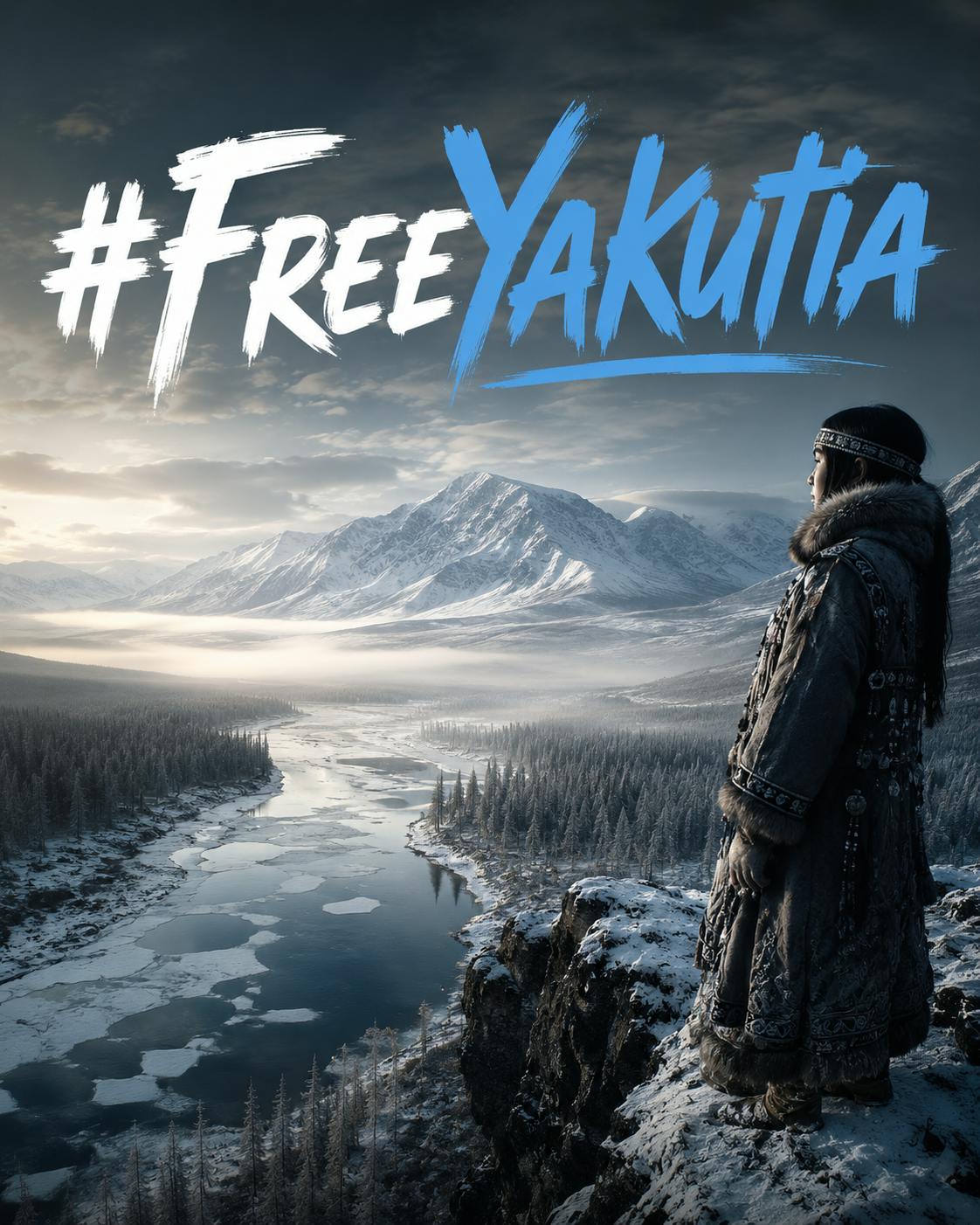
Humor, propaganda, and political imagination during the first months of the war In the first weeks after Russia’s full-scale invasion of Ukraine in 2022, reality became difficult to process. Cities were under attack, families were hiding in underground stations, and millions of people were trapped in a constant cycle of fear, stress, and doom scrolling. Like many Ukrainians, I spent hours reading terrible news. At some point, my brain simply stopped functioning normally. After visiting a subway station filled with families sheltering from missile strikes, I remember sitting in complete emotional shock. To calm down, I watched old Looney Tunes cartoons for almost an hour just to reset my mind. That strange emotional state created something unexpected: dark humor became a survival mechanism. And from that atmosphere, the idea of #FreeYakutia was born. Comedy During Wartime During the early months of the invasion, many Ukrainian comedians and streamers started creating absurd, chaotic online content. One comedy collective I followed jokingly called themselves “SRAKADUPA” — essentially a crude slang combination referring to “ass.” Their streams were ridiculous, intentionally immature, and openly mocking Russian propaganda. But that was exactly the point. At a time when people were terrified, humor helped release pressure. Watching comedians behave stupidly online made people feel human again. It reminded viewers that fear had not completely destroyed normal life. One recurring joke was deliberately exaggerating the propaganda narrative pushed by the Kremlin. Since Russian state television constantly claimed Ukrainians were “Nazis,” some comedians sarcastically leaned into absurd caricatures simply to expose how ridiculous those accusations were. The goal was not ideology. It was satire. And surprisingly, some of those clips actually started spreading online and appearing in Russian media discussions. That was the moment I realized something important: Viral internet culture could also become a weapon against propaganda. The Birth of #FreeYakutia The hashtag #FreeYakutia started almost as a joke. Around that time, discussions about territorial disputes involving Russia were appearing in international news. Japan had once again mentioned the Kuril Islands, territories occupied by the Soviet Union after World War II. That sparked a strange thought:If Russia constantly talks about controlling other nations, what happens if people start discussing the independence of regions inside Russia itself? That idea eventually became #FreeYakutia.At first, it was partly satire, partly political trolling, and partly genuine curiosity about regions most people outside Russia knew almost nothing about. But the deeper I looked into Yakutia, the more interesting it became. What Is Yakutia? Sakha Republic — commonly known as Yakutia — is one of the largest and most resource-rich regions inside Russia. Located in the Russian Far East along the Arctic Ocean, Yakutia covers over 3 million square kilometers, making it larger than many countries combined. Despite its massive territory, the population is only around one million people. The region is known for: enormous wilderness areas, extreme climate, indigenous Sakha culture, mineral wealth, gold and diamond mining, and vast untouched natural landscapes. In terms of scale, Yakutia is difficult to imagine. A simple comparison would be: Imagine a wilderness reserve the size of France — but far colder, emptier, and more isolated. It is one of the least densely populated places on Earth. A Region Rich in Resources Yakutia contains enormous reserves of natural resources, including: gold, diamonds, natural gas, rare minerals, and other strategic materials. Critics of Russia’s centralized system often argue that wealth extracted from remote republics primarily benefits Moscow rather than local populations. That argument is not unique to Yakutia. Similar conversations exist in many regions with strong ethnic identities and valuable natural resources. Lets talk about Gold Rush! Gold in Sakha Republic is not scattered randomly underground like spare coins under a couch cushion. It follows the scars of the Earth itself — ancient collisions, cracked continents, buried oceans, and mountains that were born hundreds of millions of years before humans even existed. And Yakutia is sitting on top of a geological monster.This place is so huge, so ancient, and so violently shaped by Earth’s history that it almost feels unfair humans discovered gold there at all. Yakutia: A Frozen Treasure Chest Most people imagine Yakutia as endless snow, wolves, and temperatures cold enough to freeze your thoughts. Which is true. But beneath that frozen surface lies one of the richest geological regions on the planet.Gold in Yakutia is mostly concentrated in the southern and eastern parts of the region — areas where the Earth’s crust has been crushed, folded, cracked open, and rebuilt over unimaginable stretches of time. And gold loves chaos. Not human chaos. Geological chaos. The Aldan Shield: Earth’s Ancient Vault In southern Yakutia lies something called the Aldan Shield. That name sounds like a sci-fi energy barrier protecting a galactic empire, but it’s actually something even older. The Aldan Shield is part of an ancient chunk of Earth’s crust formed billions of years ago. Some of these rocks existed long before dinosaurs, forests, or even complex life. Think about that for a second. The gold hidden there may have formed before multicellular organisms even existed in the oceans. That region became one of Yakutia’s biggest gold-producing zones, especially around the Kuranakh deposits, where miners discovered massive gold-bearing sulfide ores trapped deep inside ancient rock systems. In other words: Yakutia is mining treasure from the childhood of the planet. Rivers That Carry Gold Now imagine rivers flowing through frozen wilderness for thousands of kilometers. Some of those rivers are quietly carrying gold particles with them. Over millions of years, erosion breaks apart mountains and deposits tiny fragments of gold into riverbeds. These are called placer deposits, and humans have been hunting them for centuries. Yakutia has many of them. Especially around: the Lena River basin, the Bulun District, and the Timpton, Berkakit, and Chulman river systems. It’s basically nature performing slow-motion gold delivery over geological time. Very slow delivery. Like... several million years slow. The Mountains That Built Fortunes Eastern Yakutia contains the enormous Verkhoyansk–Kolyma folded region — a place where tectonic forces folded the Earth’s crust like a crumpled blanket. And when rocks crack under pressure, superheated fluids move through those fractures carrying dissolved minerals. Including gold. That’s why many Yakutian gold deposits sit along giant fault zones running north-northeast and northwest across the region. To a geologist, these faults are almost like glowing treasure maps. The Earth bends. The crust cracks. Minerals rise. Gold appears. Civilizations later arrive with drills. Taryn: Gold at the Edge of the World One of the most fascinating areas is the Taryn Gold Field in eastern Yakutia. Even the name sounds cinematic. There, miners work among permafrost, frozen valleys, and isolated mountain systems searching for gold deposits trapped in ancient sediments and river formations. You could probably film a science-fiction movie there without building a single set. Why Gold Appears Here at All Gold is actually rare in Earth’s crust. Really rare. If you gathered all the gold ever mined in human history, it would fit inside a relatively small cube. Yet Yakutia somehow became one of the places where nature concentrated enormous amounts of it into mineable zones. Why?Because the region experienced: ancient volcanic activity, tectonic collisions, crust fractures, hydrothermal systems, and billions of years of geological recycling. Basically, Yakutia won the cosmic lottery of geology. A Land Built by Deep Time The incredible thing about Yakutia is that its wealth was not created by humans. Humans merely arrived at the very end of the story. The real architects were: exploding stars that forged heavy elements, planetary formation, tectonic plates, pressure, heat, ice, and time itself. Especially time. Lots of time. So when someone holds a piece of Yakutian gold, they are holding something older than mammals, older than trees, possibly older than complex life itself. That tiny metal fragment survived: asteroid impacts, supercontinents, ice ages, and mass extinctions… …only to eventually become jewelry, currency, electronics, or central bank reserves. That’s the strange poetry of geology. The idea behind the hashtag #FreeYakutia was intentionally provocative:What if regions like Yakutia controlled their own economy, resources, culture, and international partnerships? How China can benefit from partnering with Yakutia, when they will have a free will a sovereign government?Yakutia and China: The Partnership That Geography Almost Demands If you stare at a map long enough, certain things begin to look inevitable. And one of those things is the relationship between Sakha Republic and China. Because geography has its own form of gravity. Yakutia is enormous. China is enormous. One has vast land, minerals, fresh water, energy, and wilderness. The other has industry, population, capital, manufacturing power, and an endless appetite for resources. That combination alone sounds less like politics and more like chemistry. A Giant Warehouse Next Door to the World’s Largest Factory Imagine owning one of the largest warehouses on Earth. Inside are: gold, diamonds, rare earth minerals, gas, timber, fresh water, and gigantic untouched territories. Now imagine your next-door neighbor is the biggest manufacturing machine in human history. That is essentially the Yakutia–China equation. China constantly needs: energy, raw materials, industrial metals, transport corridors, and stable northern trade routes. Yakutia has all of those. The problem is not resources. The problem is distance, infrastructure, and political structure. The Geography Is Almost Ridiculous People often forget how close northern Asia actually is. From the air, parts of Yakutia are dramatically closer to Chinese industrial regions than they are to Moscow. That changes everything! Transporting resources west across thousands of kilometers into European Russia is expensive and inefficient. Transporting them south into Asian markets makes far more economic sense. This is why many analysts believe Siberia and the Russian Far East are economically pulled toward Asia almost naturally.Not because of ideology. Because trucks, pipelines, railroads, and money prefer shorter routes. Physics quietly influences geopolitics. China Doesn’t Just Buy Resources — It Builds Ecosystems One misconception people have about China is that it simply “buys stuff.” Modern China does something much bigger. It builds entire economic ecosystems around strategic regions. Roads. Railways. Ports. Industrial zones. Power grids. Logistics hubs. China thinks in decades. Sometimes centuries. If Yakutia developed closer economic partnerships with China, the transformation could be enormous: modernized rail infrastructure, expanded airports, energy pipelines, mining technology, Arctic shipping development, tourism corridors, and new industrial cities. Places that today feel isolated could become key nodes in Asian trade networks. The Arctic Is Becoming the Next Economic Frontier This is where things become truly fascinating. Because Yakutia is not only connected to Asia. It is connected to the Arctic. And the Arctic is changing. As ice routes become more navigable, northern shipping lanes may dramatically reduce travel times between Asia and Europe. To China, the Arctic is not some frozen empty void. It is a future trade highway. That means regions like Yakutia could eventually become strategically critical: ports, logistics centers, energy hubs, mineral exporters, and Arctic infrastructure bases. In a strange way, climate change is rewriting the economic map of the north. Tourism Alone Could Become Massive Now imagine the Chinese middle class — hundreds of millions of people — gaining easier access to Yakutia. Suddenly: Arctic tourism, wilderness expeditions, extreme winter travel, indigenous cultural experiences, fishing, survival tourism, and eco-retreats become gigantic industries. Yakutia could market itself as one of the last truly wild places left on Earth. Not fake wilderness. Real wilderness. The kind where nature still feels larger than civilization. For people living in megacities surrounded by concrete, that experience has enormous psychological value. Most modern technology depends on rare minerals. Phones. Electric cars. Satellites. Missile systems. AI hardware. Batteries. The 21st century is not only a battle for information. It is also a battle for materials. Yakutia possesses huge untapped mineral wealth that could become critically important for future global supply chains. And China already dominates large portions of the global mineral processing industry. That creates obvious strategic synergy. One side has resources. The other side has factories capable of turning those resources into the technological nervous system of modern civilization. But Partnerships With Giants Are Never Simple Of course, there is another side to this story. When a small or sparsely populated region partners with a massive economic superpower, there are always fears: economic dependence, demographic pressure, environmental damage, resource exploitation, and loss of local control. History is full of examples where resource-rich regions became economically dependent on stronger neighbors. So any future partnership would require careful balancing: protecting local culture, environmental safeguards, fair taxation, local ownership, and long-term development planning. Otherwise, wealth simply leaves while local communities remain poor. That happens everywhere in the world. The Bigger Historical Pattern Throughout history, civilizations grew around trade routes and resource corridors. Silk Roads. River systems. Sea lanes. Mountain passes. Yakutia may look isolated today, but historically, “remote” places often become important very suddenly once technology changes transportation. Railroads changed continents. Container shipping changed global trade. The internet changed geography itself. And the Arctic may become the next major transformation. If that happens, Yakutia stops being “the middle of nowhere.” Instead, it becomes: the center of a new northern economic world. The Strange Reality of the North What makes Yakutia fascinating is that it feels almost untouched by modern civilization while simultaneously sitting on resources that power modern civilization. That contradiction is powerful. It is a place where: mammoths emerge from melting permafrost, shamans still exist, temperatures can freeze engines solid, and beneath the ground lies enough mineral wealth to attract global superpowers. Few places on Earth combine mythology, geology, geopolitics, and economics so dramatically. And China knows that. Tourism, Wilderness, and “City Detox” Beyond politics, Yakutia also fascinated me because of its landscape. The region has incredible potential for ecological tourism and adventure travel. Massive forests, frozen rivers, wildlife, isolation, and indigenous traditions create an environment unlike almost anywhere else on Earth. I kept imagining something like:Yellowstone National Park — but on a continental scale. For travelers exhausted by overcrowded cities, Yakutia could become a destination for extreme nature experiences, survival tourism, winter expeditions, and cultural exploration. Its proximity to Asia could also make it attractive to tourists from countries like China, Japan, and South Korea. Of course, all of this is hypothetical. Developing infrastructure in such an enormous and harsh environment would require decades of investment. Still, the idea itself was fascinating. fossils of these dinos can be found in Sakha Internet Memes and Information Warfare The deeper meaning behind #FreeYakutia was never really about drawing new borders overnight. It was about narrative. Russian propaganda spent years discussing the sovereignty of other nations while suppressing conversations about autonomy, identity, or independence movements inside Russia itself. By spreading hashtags like #FreeYakutia, people were effectively turning the propaganda mirror back toward the Kremlin. The campaign mixed: satire, political commentary, internet meme culture, and genuine discussion about self-determination. It was chaotic, emotional, and sometimes intentionally absurd — which perfectly reflected the atmosphere of the internet during wartime. Indigenous Identity and Culture One thing that stood out while researching Yakutia was the strength of local culture. The Sakha people maintain distinct traditions, mythology, music, language, and spiritual practices that differ significantly from mainstream Russian culture. Traditional throat singing, folk instruments, shamanistic traditions, and Arctic survival customs all contribute to a unique cultural identity that many people outside the region rarely encounter. For many observers, conversations around Yakutia raised broader questions: How should multinational states manage cultural diversity? What happens when distant regions feel economically exploited? Can strong regional identities coexist with centralized imperial structures? These are difficult political questions — not just for Russia, but for many countries throughout history. Why the Hashtag #FreeYakutia will Spread The hashtag #FreeYakutia worked because it combined several things at once: dark humor, geopolitical trolling, anti-imperial messaging, curiosity about unknown regions, and meme culture. People shared it because it was strange, provocative, and visually interesting. But underneath the jokes was a serious emotional reality: Millions of Ukrainians were searching for ways to psychologically resist a much larger aggressor. Sometimes that resistance looked like military defense. Sometimes it looked like volunteering. And sometimes it looked like turning the internet into a battlefield of memes. Final Thoughts Looking back, #FreeYakutia was never a fully serious political movement. It was part satire, part frustration, part imagination, and part wartime internet culture. But it also reflected something real: When empires attempt to erase the identity of others, people eventually begin questioning the stability of the empire itself. And in the age of social media, even a joke hashtag #FreeYakutia can evolve into a wider political conversation.Stand With Ukraine.
#FreeYakutia: How a Viral Meme Turned Into a Conversation About Independence
Full Article
Original Source
Read the full article at Hackernoon →KhanList aggregates and links to publicly available news content. We do not host full articles from third-party sources. Always verify important information with original sources.