
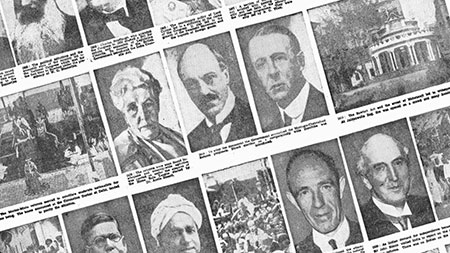
1765 Clive, acclaimed as the founder of the Empire, was also its first administrative reformer, but his scheme of Salt monopoly was not approved by the Directors. 1773 By a Regulating Act, Parliament hoped to control the Company's administration, but during Warren Hastings' term its ineffectiveness was clearly seen. 1830 India was rapidly changing from medievalism. One of the first Indians to visit England, Raja Ram Mohan Roy championed the cause of the peasants and the freedom of the press besides other social reforms. 1857 The rapid spread of Western culture caused a general ferment in the country which culminated in open revolt by the Army which was led by the Rani of Jhansi and others. 1857 Delhi, Cawnpore, Gwalior and Lucknow were the storm centres of the Mutiny. Many heroic fights and defences took place. The defence of the Residency at Lucknow was a notable one. 1858 One direct result of the Mutiny was the assumption of the Government by the Crown and the recognition of Paramountcy by the Indian States. 1876 The Queen's Proclamation raised many aspirations. When these proved futile, they led to agitations. One concerned admission of Indians to the Civil Service. Surendranath Bannerjee was the leader. 1885 The political agitations and the economic state of the country led to the National Congress which met for the first time in Bombay under the presidency of W. C. Bonnerjea. 1892 Charles Bradlaugh, who attended the Congress in 1889, drafted a Bill for reform and expansion of Legislative Councils. To counter it the British Government introduced the India Councils Act. 1905 The reactionary policy of Lord Curzon led to a stiffening in the ranks of the Congress. It also led to the growth of the Swadeshi Movement and the boycott of foreign goods. 1907 A section of the Congress was not satisfied with passing resolutions only and lost faith in the efficacy of the Congress programme. They were ably led by Bal Gangadhar Tilak. 1909 With a view to meet strong nationalist demands, the Morley-Minto reforms provided for associating Indians with Government and introduced communal representation. 1911 The Morley-Minto reforms seemed to conciliate moderate nationalists for the time being. The boons announced at the Coronation Durbar at Delhi, tended to pacify the situation. 1916 The reforms were soon found inadequate and country-wide agitation was carried on under the auspices of the Home Rule League started by Dr. Annie Besant 1918 To allay the discontent, the Government announced the Montagu-Chelmsford Reform proposals. Direct election on a comparatively wide franchise was introduced. 1919 The Rowlatt Act and the arrest of Mahatmaji led to widespread unrest. At Jallianwalla Bag, fire was opened on a crowd and many hundreds died. 1920 The National movement gained a new orientation under the leadership of Gandhiji who started the Non-co-operation movement. 1923 Led by C. R. Das, Motilal Nehru and N. C. Kelkar a group of nationalists organised themselves into the Swaraj Party. They favoured the Irish tactics of "mend or end" the constitution. 1924 For the first time in February Mr. T. Rangachariar moved a resolution in the Legislative Assembly to secure Dominion Status together with Responsible Government in Provinces. 1927 Indian politics took a serious turn owing to many factors like the Capetown agreement, etc. The Congress which met in Madras under the presidency of Dr. Ansari adopted Independence as the goal. 1929 Lord Irwin declared the attainment of Dominion Status as the natural issue of constitutional progress. He also announced a Round Table Conference in London. 1930 As Indian demand for Independence became insistent, a Commission under Sir John Simon visited India to report on the political progress and the working of the reforms. There was no Indian on the Commission and it was boycotted. 1930 Scepticism about Britain's intentions became pronounced. Mahatmaji started his great Civil Disobedience movement. The Dandi Salt March was the main feature. 1931 The Round Table Conference was summoned in London and Mahatmaji, who was released from prison, attended its second session as the sole representative of the Congress, but had to return without attaining his purpose. 1932 Mahatmaji was arrested soon after his return from England. Lord Willingdon proscribed the Congress and carried on a repressive policy in putting down political agitation. 1932 Following the agitation over the "Depressed Classes" Award, the Poona Pact was concluded. The integrity of the Hindu community was saved. 1935 As a result of the Conferences, proposals for reform of the Constitution were embodied in a Parliamentary Committee Report and finally became the Act of 1935. 1937 Though Congress obtained clear majorities in the elections, a controversy arose over the "special powers" of the Governors. A somewhat conciliatory statement by the Viceroy enabled Congress to accept office in six Provinces. 1938 Gandhiji met Mr. Jinnah many times to bring about a Hindu-Muslim rapprochement. But the talks failed. 1939 When the World War was declared, the Congress Working Committee defined its attitude and withdrew its support in running the Administration. 1939 Following the Congress Cabinets' decision the Provincial Ministries resigned. 1940 The Viceroy at Bombay appealed for an agreed settlement and assured Dominion Status of the Westminster variety. 1940 Mr. Jinnah, addressing the Muslim League at Lahore, demanded a separate home for the Muslims. 1940 Gandhiji planned for individual civil disobedience. Vinoba Bhave, the first one, was arrested. 1941 A Conference of Non-Party Leaders under the presidentship of Sir Tej Bahadur Sapru was held at Bombay. 1942 Sir Stafford Cripps visited India to meet the leaders and arrive at an agreed solution. But the talks broke down. 1942 The Congress Working Committee passed a 1,700-word resolution demanding withdrawal of the British. 1942 In August, Gandhiji and other leaders were arrested. This was followed by widespread disturbances in the country. 1943 Lord Wavell took up the Vice-royalty from Lord Linlithgow. 1945 In June, the Congress leaders were released and the Viceroy called a conference of representative leaders at Simla. But the talks failed after a fortnight's discussion. 1945 The Congress triumphed in the Central Assembly elections. 1945 The trial of the I.N.A. prisoners raised great popular agitation, and the trial was abandoned. 1946 A Parliamentary Delegation arrived in India and met Indian leaders. 1946 A Cabinet Mission consisting of Lord Pethick-Lawrence, Sir Stafford Cripps and A. V. Alexander arrived and had talks with leaders. 1946 Members of the old Viceroy's Council resigned as a preliminary to the new Constitution. 1946 Indicative of the changed status, the British Government appointed Mr. Terence Shone as its High Commissioner in India. 1946 The Viceroy invited Mr. Nehru to form an Interim Government, and the first National Government came into being. 1946 The observance of a Direct Action Day on August 16th by the Muslim League was accompanied by communal disturbances in Calcutta. 1946 The Viceroy and the leaders went to London in November for a hurried round table talk. 1946 The Constituent Assembly to draft India's future constitution met for the first time on December 9th under the presidentship of Dr. Rajendraprasad. 1947 Lord Mountbatten took up the Viceroyalty from Lord Wavell. 1947 For the first time in the history of Asia a Conference of Asian delegates was held in New Delhi. 1947 The Viceroy held consultations with the Provincial Governors and this picture is a record of the occasion. 1947 Lord Mountbatten met the Leaders on June 2nd and announced the British Government's plans, for the transfer of power. 1947 On June 3rd the Viceroy, Mr. Nehru and Mr. Jinnah, broadcast to the Nation. 1947 The question of the States after the end of Paramountcy became a knotty one. But the problems eased greatly after the Viceroy met the Princes. The new Flag of the Nation approved by the Assembly. The symbol of freedom
Freedom's Progress Through the Years
Full Article
Original Source
Read the full article at Thehindu →KhanList aggregates and links to publicly available news content. We do not host full articles from third-party sources. Always verify important information with original sources.