
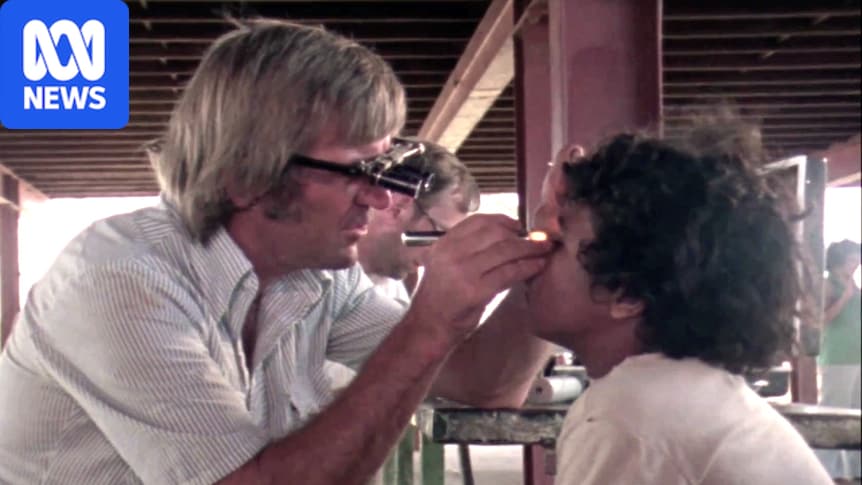
Fred Hollows pioneered life-changing eye care in hundreds of Indigenous communities.(Supplied: The Fred Hollows Foundation)It is almost 60 years since ophthalmologist Fred Hollows first ventured into the Australian outback to restore sight to the blind.His mission has brought life-changing eye surgery to more than 3 million people worldwide, including tens of thousands of Indigenous Australians.In the three decades since his death, a devoted group of surgeons, nurses and admin wizards has selflessly carried on his work in remote clinics.But many are nearing retirement age, and they fear Fred Hollows' vision will not survive unless governments can see past a glaring funding blind spot.The operating room in the small outback hospital hums with machines and quiet efficiency.Five women in surgical scrubs barely say a word as they perform their fourth routine miracle of the day — restoring a patient's sight.During the ABC's visit, Wendy Lindsay lies awake on the operating table under a blue sheet. The only visible part of her is her right eye.A cataract — clouded, stubborn — is being extracted with the technological sophistication you'd expect of a world-class hospital.But this single-storey facility in Bourke, in north-western New South Wales, is a dusty nine-hour drive from any metropolitan centre.And this ophthalmological operating theatre? It only cranks into action 10 times a year when the Outback Eye Service rolls into town for three days. Surgeon Nicole Lim relies on a camera and a video screen to guide the delicate eye surgery.(ABC News: Catherine James)Three months earlier, when Ms Lindsay first arrived at the clinic for surgery on her left eye, she was struggling to see through the cataracts that had been gradually robbing her of sight for years.She says being able to see clearly through her left eye has given her greater confidence to move through her daily activities."I can't wait," she says of having sight return to her right eye.The 84-year-old has travelled 280 kilometres for the surgery from Thurloo Downs Station — a three-hour drive through country so remote her partner insisted his son drive her halfway, where his daughter met them to complete the journey. Nicole Lim says Fred Hollows' pioneering work inspires her.(ABC News: Catherine James) Wendy Lindsay rests in the clinic after cataract surgery.(ABC News: Catherine James)The logistics seem onerous for a simple day-surgery procedure, but they're nothing compared with the alternatives: travel more than 1,000 kilometres to Sydney; join a years-long waiting list in a regional hospital; or, as the service's nurse manager Joanna Barton puts it, "just go blind".Ms Barton has been running the Outback Eye Service (OES) in NSW since 1995, when she walked into the Bourke hospital and met ophthalmologist Minas Coroneo, who was earnestly trying to keep the service going after its founder, Fred Hollows, had died two years earlier.Professor Hollows was a fierce advocate for geography not being the arbiter of who could access health care, and the now Professor Coroneo says he did not want to be "the person who stopped that service".Three decades later, he and Ms Barton — now both in their 70s — are still working together to keep the service going.But they are worried about its future, as funding remains precarious. Joanna Barton, left, has been bringing health care to remote communities since the 1990s.(Supplied: Joanna Barton) Minas Coroneo performs cataract surgery at the Outback Eye Service in the 1990s.(Supplied: Joanna Barton)Outreach and outpatient eye clinics in Bourke, Lightning Ridge, Walgett, Cobar, and Brewarrina, have tested thousands of people over the past 30 years and, with the help of Ms Barton and her tiny team, those requiring treatment have received it.But it is estimated 30 per cent of the population in these areas — about 40,000 people — suffer from preventable or treatable eye conditions that will lead to blindness without medical intervention."I'm nearer the end of my career than the start," says Professor Coroneo, chairman of the Department of Ophthalmology, UNSW, at Prince of Wales Hospital in Sydney. Minas Coroneo has continued Fred Hollows' work and built his own legacy, including pioneering the use of Trypan blue dye to make cataract surgery safer. (ABC News: Catherine James)He's been doing this work for longer than Professor Hollows did, and has spent decades alongside Ms Barton and other advocates fighting for funding to guarantee its survival.Ms Barton describes the financial model supporting the OES as a complex jigsaw.Funding comes from three main sources, none of which are permanent or guaranteed: The Fred Hollows Foundation charity, and state and federal government grants operating on a year-to-year basis.“This is our dilemma," Ms Barton says."If one of these sources pulled out [funding] tomorrow, we’d all be gone.“We’ve been trying for years to get recurrent funding. We need to know we are part of NSW Health — that we’re a permanent fixture in the health system."Really, it's our dedication and passion — that's the only reason this service is still going." Joanna Barton prepares Wendy Lindsay for eye surgery.(ABC News: Catherine James)NSW Health Minister Ryan Park says the government "will never turn away additional funds" for the OES. But Ms Barton and Professor Coroneo want certainty.“Our ask is to please embed us in the public system as an everyday service," Ms Barton says.Professor Coroneo's view is clear: the health care of Australia's most marginalised people should not be reliant on charity and the generosity of donors."It would be catastrophic," he says of the prospect of the service ending.Aboriginal and Torres Strait Islander readers are advised this article contains images of people who have died.Pipe-smoking miracle workerNew Zealand-born Frederick Cossom Hollows could have been buried anywhere.But he chose the red earth of Bourke, where the work that brought him international recognition really began, as his final resting place. Fred Hollows is buried in the historic cemetery at Bourke in outback NSW.(Supplied: Fred Hollows Foundation/Andrew Williams) Fred Hollows chose Bourke as his final resting place.(ABC News: Catherine James) Fred Hollows' mission spread far beyond Australia's shores.(ABC News: Catherine James)His grave is marked with rocks of red sandstone hauled from nearby Mount Oxley and arranged in a dotted outline of an eye around his headstone, which sits in the place of a pupil."I think he fell in love with that place," says Olga Collis, now 78, who was an Aboriginal health worker when the then Dr Hollows first visited Bourke in the early 1970s."He fell in love with the red dirt and scrub, the people, the surrounds."He was a Kiwi, but he loved Australia. And he found his restful place here." Olga Collis started working at the Outback Eye Service in the 1970s.(Supplied: Olga Collis) Olga Collis recalls being surprised by Fred Hollows' personality when she first met him.(ABC News: Catherine James)For years, Dr Hollows worked in Bourke unpaid, on weekends, travelling 10 hours each way from Sydney every few months on some of the roughest roads in the country.He recognised that Aboriginal communities in the outback needed critical health care, so he walked among them to gain their trust.Ms Collis remembers the first time she met him. Her supervisor told her she'd be accompanying a doctor who was visiting Alice Edwards Village, a former Aboriginal mission on the outskirts of Bourke.Before they entered the village, Ms Collis says, Dr Hollows stopped the car, turned to his "very elegant" wife Gabi and told her, in language considerably more colourful than Ms Collis wants to repeat, to take off her makeup, her lipstick and her earrings. Fred and Gabi Hollows working during the National Trachoma and Eye Health Program.(Supplied: The Fred Hollows Foundation) The Fred Hollows Foundation supports the work Fred and Gabi Hollows started decades ago.(Supplied: The Fred Hollows Foundation)"Don't ever meet people dressed like that," she remembers him saying to Ms Hollows. "Meet them on their own ground."Ms Collis says she thought: "Is this a doctor? Do doctors speak like this?"But then she watched him work.They walked from house to house, with Dr Hollows smoking his pipe and taking the time to sit on the ground and yarn with families. More than 100,000 Indigenous people were screened during the National Trachoma and Eye Health Program, which ran from 1976 to 1979.(ABC News) Fred Hollows was passionate about meeting people on their own terms and earning their trust.(ABC News)"I'm Fred," he'd introduce himself without any affectation."He spoke the way we spoke, in their tongue, you know. So natural," Ms Collis says.By the time they had finished their rounds, word had spread that Fred Hollows was in town, and he could fix your eyes."It was his approach. The open communication. The respect," she says."The seeds were planted and, believe me, those people turned up for the clinic."Speaking from her home in Sydney decades later, Gabi Hollows, who met Fred during her training as an orthoptist and worked with him on the National Trachoma and Eye Health Program, doesn't remember the exchange in the car as Ms Collis recalls it, but she is not surprised by it. Gabi Hollows has overseen her first husband's extraordinary legacy for decades.(ABC News: Catherine James)"Fred was very pragmatic and very matter-of-fact," Ms Hollows says."He was really — no bullshit, you know? He'd be very impatient at times."Nicknamed "the wild colonial boy" of Australian surgery, he expected excellence from the educated and privileged but was gentle with those who were more vulnerable, she says."He was as gentle as he could be with any of the old ladies or any of the old patients who reminded him of his old mum or his grandma," Ms Hollows says.First grandmother, then grandsonBourke resident Robert Dixon was seven or eight years old when Dr Hollows restored his grandmother's eyesight.He's 67 now, and the memory remains vivid."She had thick glasses," he says, "which she never had to wear after Dr Hollows."In recent months Mr Dixon has undergone the same cataract surgery at the Bourke clinic.He has diabetes, a condition that affects a devastating number of First Nations people and places them at greater risk of blindness."If you don't get your eyes done, you're going to go blind," Mr Dixon says. Clear eyesight means Robert Dixon will be driving for years to come.(ABC News: Catherine James)When cataracts rendered him unable to read the letters below the first two lines on an eyesight test, he lost his licence, which he needed for his job as a hospital security guard."When I got one eye done, I could see real good, but they were still trying to take the licence," he says."So six months later, I had the other eye done and could read the bottom line on the chart."He says that without the operation, he'd "be done"."If I didn't have the operation, I'd be blind now. I wouldn't be able to handle that," he said.The procedure to remove a cataract and replace it with a clear artificial lens usually takes less than an hour per eye from preparation to surgery to discharge. Then there's a follow-up consultation the next day. Cataracts develop over several years and can lead to blindness.(Supplied: Mayo Clinic)The convenience of being able to have the surgery in Bourke, where Mr Dixon lives, meant undergoing the procedure was an easy decision for him.But it's not so straightforward for others.Heavy lifting behind the scenesThe logistics of running the mobile clinic are complex, but decades of experience have refined the process.Dubbo-based Joanna Barton coordinates the service with two other full-time staff based in Sydney. They manage a calendar that stretches a year in advance.Every surgery trip to Bourke then mobilises staff from across western NSW — nurses from Orange, Coonabarabran, Dubbo and Bourke, anaesthetists from Dubbo and Sydney, and ophthalmologists from the training program at Sydney's Prince of Wales Hospital.Equipment is ordered, packed and shipped. Joanna Barton has been coordinating the Outback Eye Service since the 1990s.(ABC News: Catherine James)The OES treats between 1,200 and 1,300 patients a year, with about 150 undergoing cataract and oculoplastic surgery, and the others receiving treatment for conditions including trachoma, which can lead to permanent blindness."Eighty per cent of the work goes on behind the scenes. The surgery and clinics are the icing on the cake," Ms Barton says.The stakes are higher than restoring vision alone."We're talking about [preventing] falls. We're talking about broken hips," Ms Barton says."Think about it — $6,000 for cataract surgery to save someone's sight or get their sight back. Or the cost if someone falls over, breaks their hip, and they're in a nursing home for the rest of their lives." The Outback Eye Service brings vital health care to Indigenous communities.(Supplied: The Fred Hollows Foundation)Ms Barton says it is essential for the service to be a permanent fixture in the public health system and "definitely not an add-on".A statement from the Fred Hollows Foundation says that while "charitable funding has helped fill important gaps, essential healthcare services should not rely on philanthropy in the long term"."We urge the NSW government to commit to sustainable, long-term investment in the Outback Eye Service so communities across western NSW can continue to access the eye care they need, regardless of where they live," the statement says.Today, the service is run with two full-time equivalent nurse positions funded on a year-to-year basis by the federal Western Primary Health Network at a cost of about $338,000 per year. Medical staff prepare a patient for cataract surgery at the Bourke operating theatre.(ABC News: Catherine James)The Fred Hollows Foundation funds one full-time orthoptist position costing $199,000 per year. NSW Health then covers a range of services and expenses critical to running the OES, including resources from the South Eastern Sydney Local Health District, accommodation, plane flights and hospital facilities.It also staffs the surgeries through the Western Local Health District, and provides operating equipment.The Royal Flying Doctor Service also supports the OES.But none of this support is guaranteed or permanent.New generation, same visionProfessor Coroneo has developed a relay-style staffing system for the Bourke and outreach clinics that aims to alleviate burnout.Under this roster, 14 ophthalmological specialists from the Prince of Wales Hospital work at these clinics as part of their training. When they finish, they hand over to the next generation. Nicole Lim says many people only receive the eye care they need because the Outback Eye Service is in town.(Supplied: Nicole Lim) Nicole Lim is inspired by Fred Hollows' legacy.(ABC News: Catherine James)Nicole Lim trained at the Prince of Wales Hospital under Professor Coroneo and is one of the new generation of ophthalmologists carrying on Professor Hollows' work.Before starting her training, Dr Lim visited the Tilganga Institute of Ophthalmology in Nepal, run by Sanduk Ruit, who worked closely with Professor Hollows."Seeing Fred Hollows' impact on that global scale was very inspiring," she says.Now, as a junior consultant, Dr Lim also has seen the impact of this work during trips to Bourke and Cobar, where, just before flying home one day, a patient arrived with an eyelid lesion consistent with basal cell carcinoma. As the next oculoplastic specialist would not be visiting Cobar for six months, Dr Lim did the biopsy on the spot."If we didn't travel out there, we'd lose a lot of patients who are actually being reached just by us being present," she says.A true silver liningWhen the ABC reconnects with Wendy Lindsay several months after the surgery on her right eye, she admits it has taken her a while to stop reaching for spectacles she no longer requires.Having perfect vision has given her a new outlook on life."Everything wasn't quite clear before," she says.Now, in her new home in Dubbo, Ms Lindsay can easily read subtitles on the TV and thread a needle.She has also been able to return to her favourite hobby of making fine silver jewellery. With her sight restored, Wendy Lindsay has been able to make fine silver jewellery again.(ABC News: Catherine James)Without a hint of difficulty, she uses tiny pliers to twist and bead thin strands of precious metal into delicate bracelets and necklaces.It is clear how much she enjoys this fine, detailed work now that her eyesight has been restored."I hadn't done it for quite some time," she says, holding up an intricate bracelet.Another simple joy is being able to walk confidently in the garden alongside her dog, Miss Toby, without fear of tripping over. Life is now a whole lot brighter for Wendy, pictured with her dog, Miss Toby.(ABC News: Catherine James)But without the OES, Ms Lindsay, Mr Dixon and thousands of other Australians living remotely would be needlessly struggling with deteriorating eyesight and a poorer quality of life.Looking to the futureAfter years of calling for stable funding, Professor Coroneo's message to governments is clear: fund the Outback Eye Service properly, permanently, or risk losing it when he and Ms Barton retire.A spokesperson from South Eastern Sydney Local Health District says the "collaborative partnership model … enables additional services, outreach activities, and workforce support to be delivered in communities where access to specialist eye care may otherwise be limited"."NSW Health acknowledges the important role played by charities in supporting the health and wellbeing of regional communities," the spokesperson says."The Outback Eye Service remains an active public health service delivered through appropriate contracts and service agreements. "Service planning and funding arrangements are regularly reviewed to ensure communities continue to receive access to high-quality eye care and to identify opportunities that support its ongoing sustainability."CreditsReporting: Catherine JamesPhotography and video: Catherine James, The Fred Hollows FoundationEditor and digital production: Rachel KellyVideo editor: Anthony Scully
Fred Hollows built something remarkable but its future is under threat
Full Article
Original Source
Read the full article at Abc →KhanList aggregates and links to publicly available news content. We do not host full articles from third-party sources. Always verify important information with original sources.