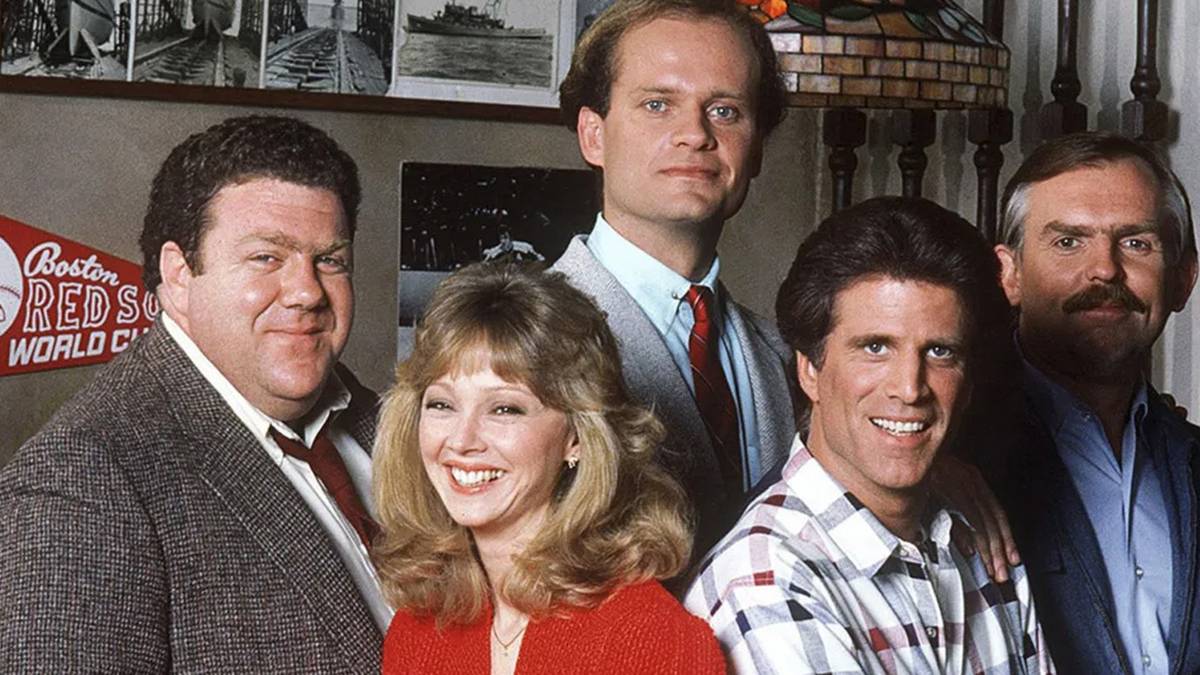
Image via NBC Published Aug 13, 2026, 6:29 AM EDT Logan Kelly is a professional author, screenwriter, and proud cinemaphile. He studied screenwriting and film history while attending Valencia College, before moving to the New York Metro Area. Logan's first publication came with his book, Brighter Stars. The LGBTQ+ Historical-Romance garnered praise, and kicked off his professional writing career. His second novel, The Prince and the Scribe, was released by the Wild Rose Press in February of 2025. Logan began working for Collider in the Fall of 2023, and has had his articles featured by various industry professionals, including Abbott Elementary's Janelle James. For more information on Logan, please visit his provided social media accounts. He can be contacted via email at logankellyinquiries@gmail.com Sign in to your Collider account Even decades after it began, the Cheers universe remains one of the most beloved and influential television franchises in history. The original series is still one of TV's most endearing shows, with an extended universe that includes three other sitcoms, with Frasier being its most successful offshoot. The Kelsey Grammer-led spin-off was not only a success in its own right, but it also managed to match the duration of its parent series, running 11 seasons from September 1993 to May 2024, before returning for a short-lived reboot in October 2023. While the initial run introduced a plethora of beloved characters, one fan favorite created a surprising continuity error. A massive part of the show’s charm came from Frasier’s father, Martin Crane (John Mahoney). The lovable patriarch of the family was truly a hallmark of what made the initial run so memorable. However, according to Cheers lore, Martin should never have existed. But what started as a jarring continuity error ended up being remedied by a surprising return from Frasier’s past. Martin’s Involvement in ‘Frasier’ Started as a Continuity Error In many ways, Frasier did the impossible. Creating a successful spin-off can be a difficult task, with many becoming colossal failures. Add in the fact that the series was a follow-up to the incredibly popular Cheers, and the pressure was certainly on for the beloved doctor. Another Cheers spin-off, The Tortellis failed after just 13 episodes. Collider Exclusive · Universe Personality Quiz Which Iconic Universe Do You Belong in the Most? Star Wars · Lord of the Rings · Harry Potter · Game of Thrones · Star Trek Five legendary universes. Five completely different visions of what the world could be — or already was. One of them is the world your instincts, your values, and your particular way of existing were built for. Eight questions will tell you which one. 🚀Star Wars 💍Lord of the Rings 🧙Harry Potter 👑Game of Thrones 🖖Star Trek FIND YOUR UNIVERSE → 01 What gives your life its deepest sense of meaning? Every universe is built around a different answer to this question. ABeing part of something larger than myself — a cause, a rebellion, a fight for freedom that outlasts me. BThe journey itself — the places I'll go, the companions beside me, the world I'll discover on the way. CLearning — unlocking what I'm capable of, understanding the world's hidden mechanics, growing into something more. DLegacy — the name I leave behind, the power I build, the mark I make before the world moves on without me. EUnderstanding — exploring what exists beyond the horizon and asking what it means to be alive in a universe this vast. NEXT QUESTION → 02 Which kind of world do you most want to inhabit? The environment shapes who you become. Choose carefully. AA galaxy of planets, each with its own culture — connected by conflict, trade, and the Force. BAncient lands of breathtaking beauty, deep history, and a creeping darkness at the edges. CA world hidden inside our own — full of wonder, community, and magic waiting to be learned. DA brutal, beautiful continent where power is everything and every alliance is a calculation. EA future where humanity has reached the stars — and must decide what kind of species it wants to be. NEXT QUESTION → 03 How do you prefer your conflicts resolved? The shape of a world's conflicts tells you everything about its soul. AThrough sacrifice and courage — someone has to make the impossible choice so others don't have to. BThrough fellowship — the impossible becomes possible when the right people walk the same road. CThrough growth — confronting what you fear, understanding what you lack, and becoming equal to the challenge. DThrough strategy — outthinking, outmaneuvering, positioning yourself so the outcome was never in doubt. EThrough dialogue — finding the third option, the peaceful resolution, the answer that doesn't require a body count. NEXT QUESTION → 04 Who do you want beside you when things get difficult? Your ideal companions reveal the world you were made for. AA small crew — a pilot, a rogue, a warrior — each broken in their own way, unbeatable together. BA fellowship of different kinds of people, bound by purpose and deepened by the long road. CFriends who grew up alongside me — who knew me before I knew myself, and stayed anyway. DAllies whose loyalty I've earned — and tested — and whose ambitions align with mine, for now. EA crew of brilliant, curious, principled people from every corner of known space. NEXT QUESTION → 05 What is your relationship with power? How you seek, wield, or resist power is the map of who you are. AI want to use it to protect — and I'm terrified of what I might become if I'm not careful. BI distrust it. The most important power in this story is the courage to give it up. CI want to earn it — through knowledge, through effort, through becoming someone worthy of it. DI want to wield it. Preferably before someone else decides to wield it against me. EI want to understand it — its structures, its limits, its ethical dimensions. Power without accountability is the real threat. NEXT QUESTION → 06 How does your universe treat good and evil? A world's moral architecture tells you more about it than any map. AThere is a dark side and a light side — and the choice between them is always present, always personal. BEvil is real and ancient and patient — and goodness, however small, is the only thing that can undo it. CGood and evil are real, but they live inside people — and people are complicated, always capable of both. DGood and evil are mostly a matter of perspective and proximity. Power is the only honest currency. EEvil is usually the result of ignorance, fear, or broken systems — and understanding it is the first step to solving it. NEXT QUESTION → 07 What role would you naturally fall into? Every universe has archetypes. Which one fits you without trying? AThe reluctant hero — ordinary origins, extraordinary moment, changed forever by the choice to act. BThe unlikely carrier — the one nobody expected to matter most, quietly bearing the weight of everything. CThe student — not yet who I'll become, learning through every mistake, growing into something the world needs. DThe player — sharp enough to see the game for what it is, ambitious enough to try to win it. EThe explorer — drawn to the unknown, driven by curiosity, most alive when standing somewhere no one has stood before. NEXT QUESTION → 08 What do you ultimately believe about the future? The answer to this is the clearest window into which universe already lives inside you. AThat hope is real — that even in the darkest galaxy, a new hope is always possible. CThat even the smallest person can change the course of the future, if they have the courage to try. CThat love and friendship and doing what's right will matter in the end, even when everything says otherwise. DThat the wheel keeps turning — that power shifts, winters end, and what endures is those willing to fight for it. EThat humanity — or whatever we become — is capable of extraordinary things, if we choose to be. REVEAL MY UNIVERSE → Your Universe Has Been Chosen You Belong In…Your answers point to the iconic universe your values, your instincts, and your particular way of seeing the world were built for. This is where you would find your people — and your purpose. Star WarsYou believe in the cause — in the idea that freedom is worth fighting for even when the odds are impossible and the empire is vast. You are drawn to the moral clarity of a universe where hope itself is a form of resistance. You'd find your people in the Rebellion — a ragtag coalition of true believers held together by conviction more than resources. Star Wars is fundamentally a story about ordinary people choosing to matter in an extraordinary conflict — and that is exactly your kind of story. The Force may or may not be with you. But the will to use it for something larger than yourself certainly is. Lord of the RingsYou understand, in the deepest part of yourself, that the journey matters as much as the destination — and that the world's beauty is worth protecting even at great cost. Middle-earth is a world of ancient wonder, deep friendship, and a darkness that only retreats when enough small acts of courage accumulate. You would thrive here because you value the fellowship more than the glory — the road more than the arrival. Tolkien's universe rewards patience, loyalty, and the willingness to carry something heavy across a very long distance. Those are not burdens to you. They are simply how you move through the world. Harry PotterYou believe that love, loyalty, and doing what's right are not naive sentiments — they are the most powerful forces in any world, magical or otherwise. The Wizarding World is a place of wonder hidden in plain sight, where learning is transformative and the bonds you form at school follow you into every battle. You would flourish here because you take both the magic and the friendships seriously — and you understand that one without the other is incomplete. Harry Potter's universe ultimately rewards those who choose to stand for something even when standing is terrifying. That choice — made quietly, without guarantee — is something you understand completely. Game of ThronesYou see the world clearly — its power structures, its hypocrisies, its brutal arithmetic — and you are not paralysed by that clarity. You use it. Westeros is a world that rewards intelligence, adaptability, and the willingness to understand that every alliance is also a negotiation. You would survive here — possibly thrive here — because you don't confuse the world as it is with the world as you'd like it to be. Game of Thrones is a story about what happens when the idealists and the realists collide. You are sharp enough to know which one lasts longer. Winter always comes. You are already prepared. Star TrekYou believe the future is worth building — that curiosity, cooperation, and the expansion of understanding are not just ideals but the most practical path forward for any civilisation. Star Trek is a universe where the questions matter as much as the answers, and where encountering something utterly alien is cause for wonder rather than fear. You would belong here because you are fundamentally optimistic about what intelligence and decency can achieve — while being honest about how hard that achievement is. The Federation is the universe's most ambitious thought experiment: what if we actually got better? You don't just hope that's possible. You think it's the only thing worth working toward. ↻ RETAKE THE QUIZ But Frasier worked because it both maintained the charm and characterization of Cheers while also creating its own identity and style. Like its predecessor, it also had a dynamic cast in both its regulars and its recurring members. As previously mentioned, Martin was one of the show’s greatest assets, thanks to the contradictions he brought when compared to his sons and his lovable quirks. However, according to an episode of Cheers, he shouldn’t have been part of the spin-off. When the character was first introduced during Cheers’ third season, Frasier was a foil to Sam (Ted Danson) and Diane’s (Shelly Long) relationship, but over the years, he became an integral part of the bar and its community. In Season 8 in particular, the show began to dive more into Frasier’s backstory, when he tells his friends on Cheers that both his mother and father have passed away. Considering the episode, “The Return of Tecumseh,” was made and aired nearly four years before Frasier went into production, it’s a jarring continuity error. However, Frasier didn’t wait long before he attempted to remedy this with help from an old friend. ‘Frasier’ Addressed Its Continuity Error with a ‘Cheers’ Reunion’ Though Frasier largely maintained its own identity throughout the run of the series, it was inevitable that more Cheers alums would be joining the good doctor in Seattle. Frasier’s ex-wife, Lilith (Bebe Neuwirth) was the most obvious and frequented the series, but nearly everyone from Woody Boyd (Woody Harrelson) to Norm (the late, great George Wendt) visited Frasier at some point, with Kirstie Alley’s Rebecca Howe being the only surviving member of the main cast not to appear. In Season 2, it was Sam’s turn. The Season’s 16th episode, “The Show Where Sam Shows Up,” is a treat in many ways. Obviously, it’s wonderful to see Sam again, and he even brings updates on everyone from back in Boston. He also addresses the issue of Martin’s existence. When Martin asks Sam about Frasier’s time in Boston, Sam reveals that Frasier had previously told everyone that Martin was dead. Frasier explained that he and Martin had just had a significant fight and that he had wished his father were dead. Adding insult to injury, he also addresses the fact that Frasier had told him that Martin had been a scientist, and that Niles (David Hyde Pierce) didn’t exist at all. The scene is ultimately paid off in a hysterical way when Martin expresses further frustration regarding the occupation Frasier had bestowed upon him, with Frasier saying: “You were dead, what did it matter?” However, there was one more continuity error between the two shows that was never (and couldn’t be) addressed. John Mahoney Previously Guest Starred on ‘Cheers’ Image via NBC Frasier may have corrected the aforementioned continuity error, but there is one astounding mistake that no amount of explanation could correct. Mahoney was an incredible talent indeed, and he had previously brought his skills to the Cheers universe just one year before the spin-off. Season 11’s “Do Not Forsake Me, O' My Postman” sees Mahoney as Sy Flemback, a writer hired to compose a song for the bar. He even has a fantastic scene with Grammer in the outing. Throughout the 1980s and ‘90s (and even today in some cases), several guest actors were recast into different roles on the same series, but Mahoney’s case was unique. Originally a replacement for an unnamed actor, Cheers’ producer, Peter Casey, revealed on Ken Levine’s blog that it was Mahoney’s work in this episode of Cheers that led to him being cast as Martin on Frasier! NBC was so enthusiastic about the idea that they didn’t even require Mahoney to audition for the role. Mahoney, however, wasn’t that easy to convince, as he wanted to see a completed script before committing to the part. Interestingly, the idea of Mahoney playing the part was enough to enthuse the series’ creators into finishing the script (per Casey). The day after reading the pilot, Mahoney enthusiastically agreed. Frasier remains one of the greatest sitcoms of all time. Achieving the impossible by matching the success of Cheers, the series smartly took on its biggest continuity error with a fun and logical approach. While the show was never able to explain the dual casting of John Mahoney in multiple roles, we’re glad it happened, as this continuity error gave us the incredible character of Martin. All these years later, he remains a major part of the show’s success, and we’re happy to overlook the contradiction. Frasier is available to stream on Paramount+ in the U.S. Release Date 1993 - 2004-00-00 Network NBC Showrunner Christopher Lloyd, Chris Harris, Joe Cristalli Directors Kelsey Grammer, David Clark Lee, James Burrows, Pamela Fryman, Sheldon Epps, Philip Charles MacKenzie, Jeff Melman, Katy Garretson, Scott Ellis, Wil Shriner, Andy Ackerman, Robert H. Egan, Jerry Zaks, Cynthia J. Popp, Gordon Hunt, Alan Myerson Writers David Lloyd, Ken Levine, Heide Perlman, Saladin K. Patterson, David Isaacs, Patricia Breen, Leslie Eberhard, Peter Huyck, Brad Hall, Don Siegel, Jordan Hawley, Lloyd Garver, William Schifrin, Dave Hackel
‘Frasier’s Biggest Crossover Episode Fixed a Major ‘Cheers’ Mistake
Full Article
Original Source
Read the full article at Collider →KhanList aggregates and links to publicly available news content. We do not host full articles from third-party sources. Always verify important information with original sources.