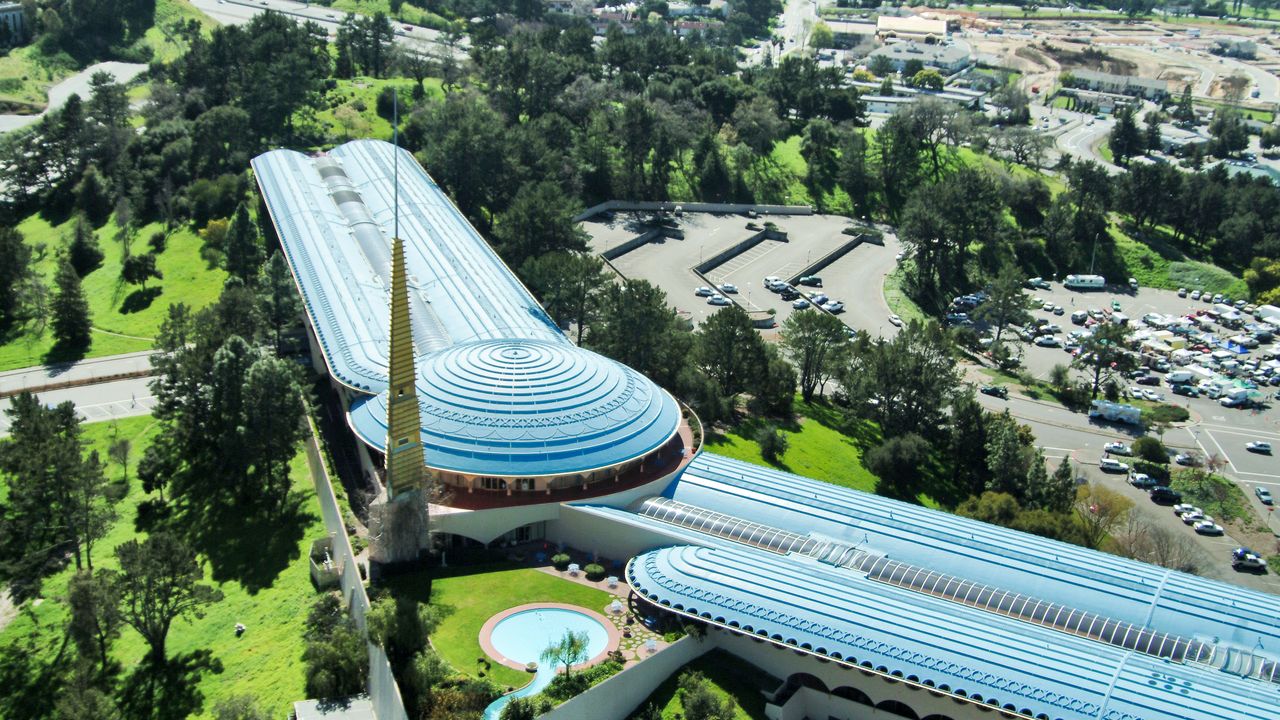
Study these projects to understand why Wright remains the most famous American architect decades after his deathMarin County Civic Center in San Rafael, California.Photo: Steve Proehl/Getty ImagesAmong the cannons of American architecture, Frank Lloyd Wright buildings stand among the most foundational examples of organic architecture. From the cantilevered drama of Fallingwater to the spiraling concrete of the Guggenheim, Wright’s work reshaped how architects thought about space, material, and—most notably—the relationship between a building and its surroundings. Across nearly six decades of work, he designed a slew of projects across the US—and even a few abroad—reflective of his guiding belief: that architecture should grow out of its landscape rather than impose upon it.Below, AD walks through 10 of the greatest Frank Lloyd Wright buildings, from the Hollyhock House to Unity Temple, Robie House, and more.Photo: Richard T. NowitzFallingwater (Mill Run, Pennsylvania)The instantly recognizable building perched directly above a waterfall, Fallingwater is the ultimate expression of Wright’s belief that architecture should exist in harmony with nature. Designed as a weekend retreat for a local family, the Kaufmanns, its dramatic cantilevered terraces appear to float above the rushing stream below. “Fallingwater taught architects to think outside the box,” says Dan D’Agostino, principal and founder of Plan Architecture. “Creating space by cantilevering a floor into thin air was rarely considered before, and this project brought that idea, and the space it opens up below, into the mainstream. Dissolving the corner with concealed mitered glass removed the very elements we normally use to define a room.”Photo: Atlantide Phototravel/Getty ImagesSolomon R. Guggenheim Museum (New York City)Rather than designing a conventional series of galleries, Wright envisioned Guggenheim visitors experiencing this museum differently: They would ascend to the top floor by elevator, then walk down a continuous spiral ramp, taking in the exhibitions as they went. He’d even pictured a special glass elevator, though this was scrapped because of budget constraints.The resulting concrete rotunda challenged nearly every existing museum convention of its time—and caused a notable outrage among artists who felt the curved walls were a disservice to their work. Over time, opinion changed and the Guggenheim remains one of New York City’s most recognizable architectural landmarks, standing in stark contrast to the traditional skyscraper.Photo: JJF Arquitectos/Getty ImagesRobie House (Chicago)Widely considered the pinnacle of Wright’s Prairie style, the Frederick C. Robie House in Chicago brought a new design language to American residential architecture. “It takes some imagination to picture now, but when the Robie House was conceived, it was the only building in the area, and it reinforced the horizontality of the plateau,” says D’Agostino. “It’s the first real statement of the Prairie style, where the horizontal line becomes the theme.” Built for businessman Frederick C. Robie, the home rejected compartmentalized Victorian layouts in favor of open spaces that flowed into one another.Photo: Getty ImagesTaliesin (Spring Green, Wisconsin)More than a residence, Taliesin served as Wright’s home, studio, and creative headquarters for nearly five decades. “He was also building on his family’s land, making his own mark,” says Kristine Hansen, author of Frank Lloyd Wright’s Illinois: Explore His Most Prolific State, from Prairie to Usonian. “This was an unfiltered place where he was not bound by client demands. He could try out new concepts with no restrictions.” Built into the rolling Wisconsin hills (about an hour outside of Madison, Wisconsin), the estate evolved continuously as he rebuilt and expanded it. Wright’s Taliesin Fellowship also lived and trained here, making the estate both a home and an influential architectural school.Photo: harmantasdc/Getty ImagesUnity Temple (Oak Park, Illinois)Constructed almost entirely from poured reinforced concrete, Unity Temple was revolutionary when it opened in 1908. Wright transformed a modest budget into a massive, monolithic work, defined by its thoughtful geometry and carefully orchestrated natural light. Today, it’s widely regarded as one of the earliest masterpieces of modern architecture. “And there’s a real poeticism to it,” adds D’Agostino. “The temple was built to replace an earlier one lost to fire, so the reinforced concrete reads as a literal, affirmative ‘not again’—permanence and strength as an expression of faith.”Photo: Richard T. Nowitz/Getty ImagesTaliesin West (Scottsdale, Arizona)Built from desert stone, redwood, and canvas, Taliesin West, Wright’s winter home and studio, directly reflects his belief that architecture should emerge naturally from its surroundings. As he writes in his seminal essay, “In the Cause of Architecture": “Bring out the nature of the materials…let their nature intimately into your scheme.” Here, he does precisely that, bringing nature intimately into his architectural scheme.Rather than importing stone to build the walls, Wright and his apprentices gathered rock directly from the desert floor and set it into wooden frames bound by concrete—a technique he dubbed “desert masonry.” Additionally, Wright originally opted to use stretched canvas over the redwood beams and trusses, rather than traditional glass or shingle. This design naturally filtered sunlight from above, and let desert breezes pass through.Photo: Natklin/Getty ImagesHollyhock House (Los Angeles)Commissioned by oil heiress Aline Barnsdall, the Hollyhock House represents a pivotal turning point in Wright’s career: blending Mayan Revival influences with California’s indoor-outdoor lifestyle, the home is constructed primarily from concrete. It was inspired by the stylized hollyhock flower and became the first UNESCO World Heritage Site in Los Angeles, underscoring its lasting architectural significance.Photo: Chicago History Museum/Getty ImagesJacobs House (Madison, Wisconsin)Designed for journalist Herbert Jacobs, this modest home launched Wright’s Usonian vision: a distinctly American home that prioritized affordability without sacrificing thoughtful design. Its L-shaped floor plan, radiant floor heating, and carport introduced ideas that would shape suburban homes for decades. “It remains the Wright home I have felt the most at home in,” adds Hansen, “from the minute you arrive through the main door on the side of the house, next to the carport, to when you are sitting in the wood-cloaked living room, surrounded by the steward’s collection of art books in the built-in shelving.”Photo: Raymond Boyd/Getty ImagesEmil Bach House (Chicago)Built in 1915 in Chicago’s Rogers Park neighborhood for brickyard co-owner Emil Bach, this compact, cubic residence showcases a city-friendly side of Wright’s late Prairie style. Rather than sprawling low across the land, the home rises in tight geometric massing with overhanging flat rooflines. Now restored, the Emil Bach House is the last of its kind still standing in Chicago, and operates today as a rentable event space.Photo: Gregory Adams/Getty ImagesMarin County Civic Center (San Rafael, California)The Marin County Civic Center, Wright’s last commission and largest public project, links the crowns of three hills with long, arching structures spanning the valleys between them. Its pink stucco walls, scalloped balconies, and iconic blue roof are distinctly recognizable. Completed after his death in 1959, the Marin County Civic Center remains the only government building he ever designed.Not a subscriber? Join AD for print and digital access now.Sign up for our daily newsletter to get the best of design in your inbox.Read More27 Real Locations That Inspired Famous PaintingsFrom Vincent van Gogh’s Starry Night Over the Rhône to Edvard Munch’s The ScreamThe 11 Most Beautiful Places in AmericaFor amber waves of grain…and emerald cliffs, an iconic concrete jungle, gobsmacking gorges, and moreNatalie Wood at Home: The Silver Screen Siren’s Domestic Life in 24 PhotosThe Rebel Without a Cause star, who ran a freelance interior decorating business in the ’70s, took design notes from her movie setsTour Burj Al Babas, a Massive Abandoned Town of Disney-esque CastlesWhat was supposed to be a luxurious urban development for wealthy foreigners has become an eerie half-finished ghost town in TürkiyeThe 9 Most Beautiful Historical Movie Theaters in the USFrom neoclassical to Egyptian-inspired designs, these stunning structures have equally cinematic historiesJosephine Baker at Home: 22 Photos of the Legendary Showgirl in Her French ChâteauxThe St. Louis–born Jazz Age star (and spy) built a life in France, where she raised 12 children and collected a panoply of exotic petsThe Most Beautiful Airbnbs Across the United StatesIncluding tiny homes, desert cabins, and modern treehousesThe Best Doormats for a Warm WelcomeAll-weather options that look good underfoot, too18 Green Bathroom Ideas, From Soothing Sage Paint to Moody Moss-Toned TileGreen is a popular powder room hue for it’s spa-like, tranquil quality—here, top designers share their very best tips for pulling off the lookMartha Stewart at Home: 29 Photos of the Legendary Homemaker in Her ElementWhether it’s her farm in Connecticut or her seaside Maine lodge, the tastemaker’s home is always a good thingSiegfried and Roy at Home: 19 Photos of the Magicians in Their “Jungle Palace” PadThe famed duo’s desert residence, which a handful of big cats also called home, was decked out with over-the-top glitzy details befitting Las Vegas’s top act
Frank Lloyd Wright Buildings: The 10 Most Important Projects Everyone Should Know
Full Article
Original Source
Read the full article at Architecturaldigest →KhanList aggregates and links to publicly available news content. We do not host full articles from third-party sources. Always verify important information with original sources.