
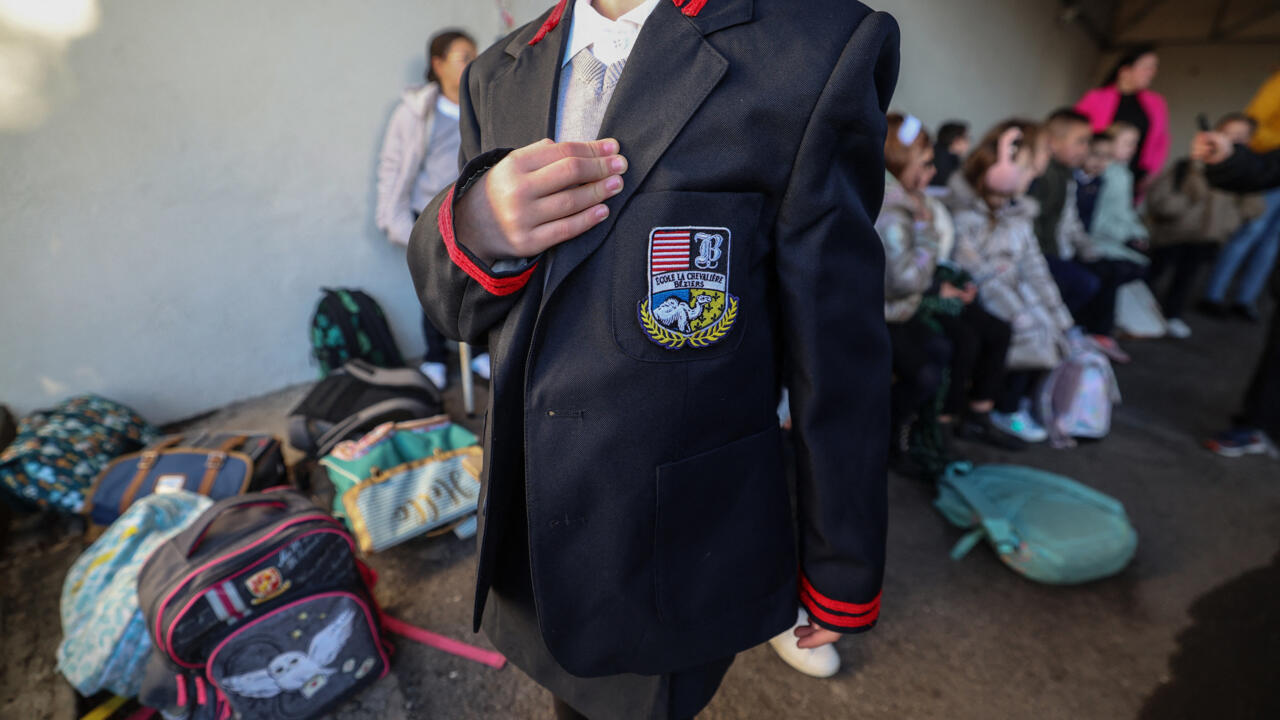
Two years after France began trialling uniforms in schools, the experiment is sputtering to a close after failing to convince pupils or teachers. Research found strong opposition among students, while evidence of better academic results, less bullying or fewer social divisions remained limited. Education Minister Édouard Geffray confirmed in late August that the opt-in scheme would not continue nationally when schools reopened for the 2026-2027 academic year. “It is neither a failure nor a waste. But the experiment showed that its overall effect was fairly limited,” Geffray told local reporters. “We did not see particularly clear changes in academic results. As for the school environment, the effects were quite uneven.” He added: “If it doesn't work, we're not going to persist with it. But if some want to continue the experiment locally because it works, they are free to do so.” The French news agency AFP said France's Education Ministry did not respond to requests for details of any funding allocated to uniforms for the new school year. Unity in uniform School uniforms were one of the flagship measures introduced under former prime minister Gabriel Attal's government. Supporters hoped wearing a uniform would strengthen cohesion and students' sense of belonging, combat bullying and discrimination, improve school life, and ultimately help academic performance. Starting in September 2024, state schools from primary to high school were invited to trial uniforms of their choosing, with local authorities and the national government covering the cost. Around 200 establishments out of nearly 60,000 signed up for the first year. Wider rollout was envisaged for 2026 if results proved convincing. Schools drop out Despite high hopes, local authorities have been dropping out one after another. In the northeastern city of Metz, authorities said in 2024 they would take part for as long as the state continued its trial. In August, with state funding no longer assured, the mayor confirmed the city's six participating schools – representing 800 pupils – would end the programme. In nearby Florange, nearly 90 percent of parents and school staff voted in June to abandon the scheme – despite local mayor Rémy Dick, from the conservative Republicans party, initially pushing for it to continue. “There is no point wanting a single outfit if we have to impose it,” Dick ultimately acknowledged. Nice, Reims and Châlons-en-Champagne are among the other municipalities that have confirmed they are not continuing the pilot. One notable exception is the southern city of Béziers, where far-right mayor Robert Ménard has decided to extend uniforms to every primary school in the city. Wearing them will be optional, however, and local authorities no longer expect state funding. Under France's pilot scheme, the cost of school uniforms was split between local authorities and the state, with parents not paying at all. @ AFP - PASCAL GUYOT Under the pilot project, state and local authorities each covered half of the cost, with parents never paying for uniforms themselves. With national funding capped at €100 per pupil, state spending on the scheme totalled €1.6 million in 2024-2025. Financing ultimately helped bring the experiment to an end. The government did not earmark funds for uniforms in the 2025 budget, forcing Education Ministry officials to redirect money to keep the experiment running for a second school year. The budget adopted in February 2026 did not include funding either, effectively ending the state's support. Several local authorities said they could not afford to continue the scheme without government funds. They also reported practical difficulties ordering uniforms, distributing them and replacing sizes as children grew. Student opposition Assessments painted a mixed picture of the value of introducing school uniform. The pilot programme produced positive but limited results, according to an official evaluation published by the Education Ministry's department of statistics, DEPP, on 12 May. Its assessment found three out of four primary principals reported an improvement in pupils' sense of belonging, as did 13 of 16 heads at secondary schools. However, evidence of academic benefits was much weaker. Only five of the 16 secondary principals reported a positive change in pupils' learning, while four saw an improvement in their engagement with schoolwork. Based on a survey of 87 primary school heads and 16 secondary school heads, DEPP's results measured perceptions of change rather than changes themselves. Children in French public schools do not typically wear uniform. @ AFP - THIBAUD MORITZ Research published in November 2025 found different views among pupils. Aix-Marseille University researchers Julien Garric and Christine Mussard surveyed about 1,200 pupils and 1,100 parents at three schools in the Aix-Marseille education district. Among pupils, 70 percent described the introduction of uniforms as “horrible”. Opposition was particularly strong among older secondary school pupils. Socioeconomic status remained visible through shoes, bags and other accessories, students reported, while those who identified themselves as victims of bullying showed the strongest scepticism that uniforms could reduce harassment. French MPs reject far right's proposal to reintroduce school uniforms The claim that identical clothing can erase social differences is based on a flawed premise, Garric told RFI. “The main problem with social mixing in schools is that it doesn't exist,” he said, noting that poorer and wealthier pupils already attend different schools. Removing differences in clothing between children who never encounter one another would therefore not be enough to reduce segregation within France's education system. Teenagers in southern France surveyed by researchers said they were sceptical introducing school uniforms would reduce bullying. @ AFP - EMMANUEL DUNAND Pupils also resented how uniforms were introduced, according to Garric. The students he surveyed said they had already expressed their opposition in a preliminary poll, but were not given a say in whether their schools should participate in the scheme. Three schools examined by the researchers were not selected as a representative sample, Garric said. While their research cannot speak to students' views on uniform nationwide, it did reveal a clear gap between adults' expectations and teenagers' experiences. Parents remained much closer to school principals in their views, with between 75 and 85 percent backing uniforms. Their opinions changed little over time. “They have no illusions that uniforms improve academic results or combat bullying,” Garric said. “They see them more as defending a certain vision of republican schooling, secularism and authority.” Not a French tradition While many supporters of school uniform invoke tradition, France has never had a national policy requiring every pupil to wear a uniform. Napoleon introduced uniforms in 1802, but only for pupils at state lycées, primarily boarding schools. The practice disappeared between the First and Second World Wars. Clothing often remembered as traditional school uniform was actually a protective smock designed to prevent ink stains. It disappeared in the 1960s with the arrival of ballpoint pens. A small number of selective schools had uniforms, until the May 1968 student protests pushed them towards abandoning the practice. Uniforms remain compulsory in some cases, including military secondary schools, some private establishments and schools in the French Caribbean and French Guiana, where they have been required since the late 1980s. Pupils at the Prytanee military prep school in La Fleche, northwestern France, are among the few in France to wear a uniform. © AFP - JEAN-FRANCOIS MONIER Elsewhere in Europe, approaches vary. Uniforms remain standard in the United Kingdom, Cyprus and Malta, while they have disappeared without much debate across much of continental Europe. International research has failed to establish clear academic benefits. A 2008 synthesis of more than 800 meta-analyses by education researcher John Hattie found a “negligible, if not non-existent” link between uniforms and academic performance. Data from the United States analysed by researcher Ryan Yeung in 2009 found no effect in either primary or middle schools. Research by Elizabetta Gentile and Scott Imberman in 2012 found a small improvement in attendance among girls at secondary school, but no effect on academic results. This article has been adapted from the original in French by Marine Jeanin.
France's school uniform experiment unravels with only mixed results
Full Article
Original Source
Read the full article at Rfi →KhanList aggregates and links to publicly available news content. We do not host full articles from third-party sources. Always verify important information with original sources.