
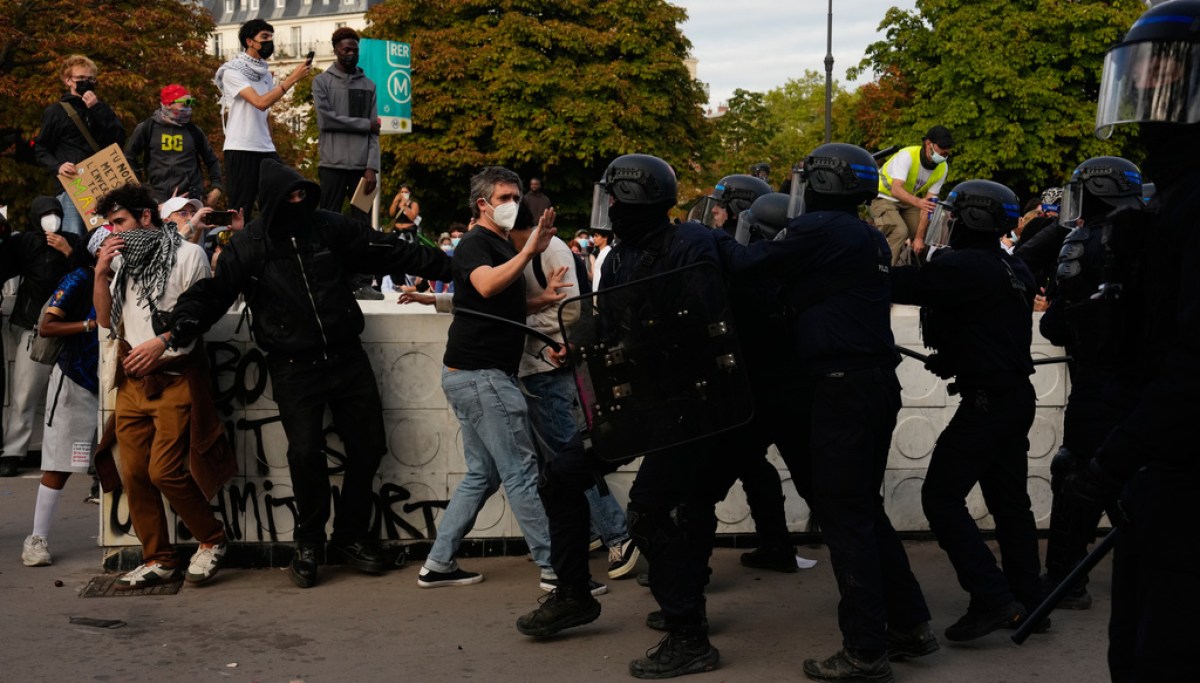
On March 29, 1968, at the height of leftist protests crippling France, President Charles de Gaulle boarded a secret flight to a French military base in Germany. France was teetering on chaos, and the iconic French leader wanted to know whether the army would remain loyal.There are strong similarities but also differences with the present situation in France, whose streets are now engulfed daily in violent riots that are spreading to other European countries.Clement Liebard, president of La Cocarde Etudiante, a conservative student group fighting the Left to keep schools open, emailed me one difference with ’68: Trade unions are less engaged now than they were back then. That reflects the trend of industrial workers being less and less interested in pursuing societal change. But some elements of today’s protests are integral to France. The French character can be explosive, which means that France periodically succumbs to massive street violence, and this violence can topple not just governments but entire societal systems.De Gaulle was despondent when he landed at the base in Baden-Baden. According to Gen. Jacques Massu, the commander of French forces in Germany, de Gaulle said to him, “Everything is ruined, the communists have caused a total paralysis of the country. I command nothing anymore. I’m going to quit.”Massu, who revealed this exchange years later, well after de Gaulle’s death from a heart attack in 1970, said he reassured his president that the military was behind him in case he needed to use it to quell the unrest. He urged him to return to Paris.That de Gaulle did. The next day, back in Paris, de Gaulle resolutely told his countrymen: “I will not resign.” He dissolved the National Assembly and called for snap elections. A massive demonstration in his favor took place on the Champs-Elysees, and weeks later the Gaullists triumphed in the elections, re-establishing de Gaulle’s authority.President Emmanuel Macron, however, is no Charles de Gaulle. The former is a weak man leaving behind him a failed economy and a country gripped by riots; the latter led the Free French during World War II.Another difference in today’s riots is the participation of Islamic demonstrators, who can be seen waving Palestinian and Algerian flags and who have forged a “red-green alliance” with communists, also coordinating the riots. We see this alliance here in the U.S. as well.France in the 1960s had a Muslim population of just over 1%, nowhere near the 10% of today. And today they are highly concentrated in the urban areas where the riots are taking place. In Paris it is close to 20%, and in Marseille, just under 30%.But when you hear today’s rioters chant slogans from ’68, you realize that the similarities are numerous, too.De Gaulle was well aware back then that street violence could lead to change in France, having himself returned to power in 1958 after demonstrations over the war in Algeria shook France, and he was asked to form a government.The turmoil proved fatal for the Fourth Republic, with its unstable coalitions, and led to today’s Fifth Republic with its strong presidential system, initially under de Gaulle.The ’58 crisis is not called “the Algiers putsch” for nothing; constitutional niceties were kept as the National Assembly invested de Gaulle as president and authorized him to write a new constitution. But it was street violence that delivered the death blow. Massu himself seized government buildings in Algiers and formed a “Committee of Public Safety.”And then there was that other massive street uprising, the French Revolution, which ended Europe’s old order and rewrote borders, politics, and society, and the street rebellions of the 19th century. Baron Georges-Eugene Haussmann, Napoleon III’s prefect, had parts of Paris demolished and ordered the construction of the wide, straight boulevards we admire today — to make it easier for troops to shoot protesters.Today, street violence is helping the Right electorally, just like the Revolution led to Napoleon and ’58 to de Gaulle. Marine Le Pen, leader of Rassemblement National, is poised to win the upcoming presidential elections, defeating by a 67-33 margin Jean-Luc Melenchon, the communist leader of La France Insoumise. Melenchon is expected to face Le Pen in the second round of voting in May.RN is described in the media as “far right,” but this is wrong. It is a strong supporter of French identity, and Le Pen has responded to the riots by saying, “I will immediately conduct mass deportations. Mass immigration has been a disaster to France.” Liebard tells me that the riots and LFI’s involvement give Le Pen “the perfect arguments.”THE POPE AND THE RIOTS: A CLASH OF CIVILIZATIONS IN PARISHowever, Liebard adds that the riots help Melenchon mobilize his electorate and train his activists. “He will have the largest activist striking force to occupy the field during the weeks leading up to the election,” he wrote to me.Melenchon has already promised to install a Sixth Republic with a new Marxist constitution if he is elected. Let’s hope France finds a way to save herself and not export her revolution to the rest of Europe — as it did during the period known as “the Terror” in the 1790s.
France’s riots echo 1968. But Macron is no de Gaulle
Full Article
Original Source
Read the full article at Washingtonexaminer →KhanList aggregates and links to publicly available news content. We do not host full articles from third-party sources. Always verify important information with original sources.