
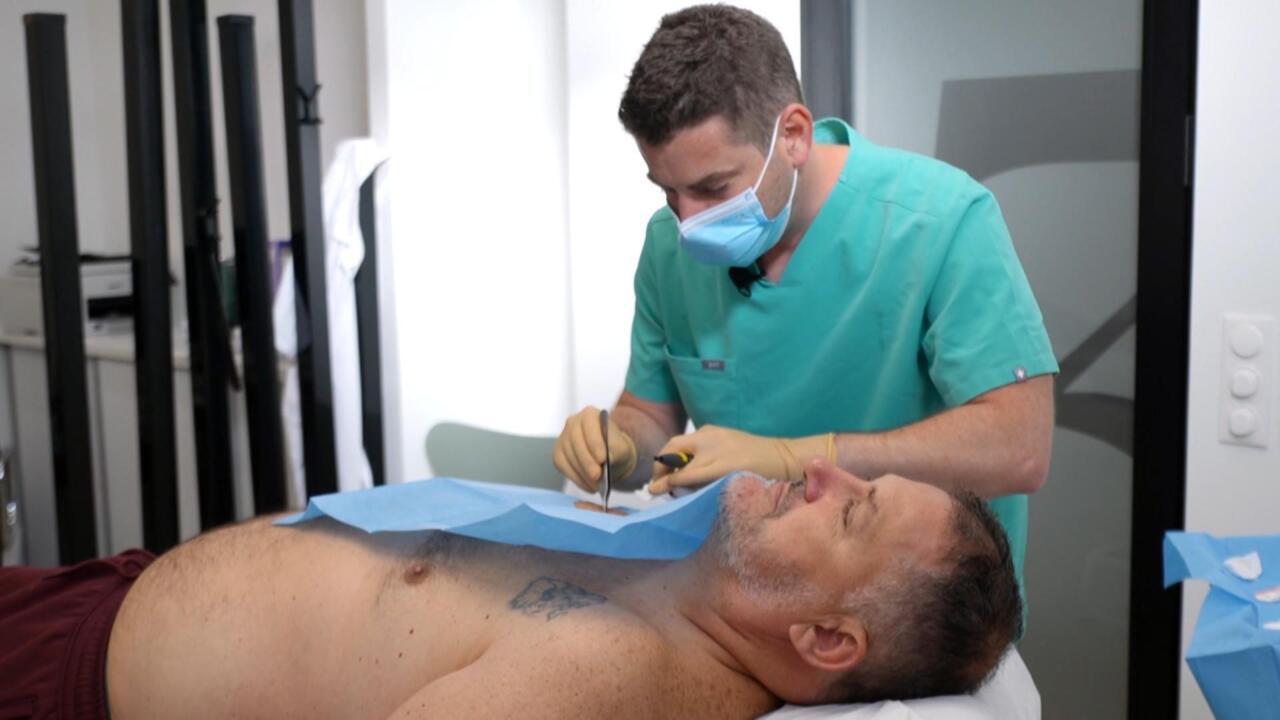
Around 200,000 cases of skin cancer are diagnosed in France every year. Yet as more and more patients seek medical advice, getting an appointment with a dermatologist is becoming increasingly difficult. Half the country's dermatologists are nearing retirement, and only around 100 new specialists are trained up each year. Faced with this growing shortage, some are coming up with innovative solutions. FRANCE 24's Aurore Dupuis and Sonia Baritello report. It's 8am in Saint-Maur-des-Fossés, in the southeastern suburbs of Paris. The local dermatology clinic is already packed. "I left home at 4:30am to get here by 6am. I've travelled 130 kilometres," says Jean-François, who has come all the way from Reims to have a melanoma removed. If left untreated, this type of skin cancer can spread beyond the skin and reach other parts of the body. To deal with urgent cases like this, dermatologist Romain Prud'homme opens up appointments the evening before, for the following day. "When I open slots at 6pm, the day gets booked up within three minutes," he explains. "You could open 10 more clinics like this one, and they would all be just as busy. The shortage is huge." Too few dermatologists, with many nearing retirement Only around 100 dermatologists are trained in France each year. The French government has announced 27 extra trainees annually, falling well short of what specialists say is needed. "It's only in the last decade that we've significantly increased the number of doctors being trained. But dermatology hasn't seen the same level of increase as other specialties," Dr Pierre Hamann explains. "The pressure is huge. Patients come to us after having had no help for ages. They're left without answers, and that can really take a toll on them." The shortage is likely to worsen in the coming years, with half of all dermatologists over the age of 60, meaning they could soon retire. Dermatologists are also accused of contributing to the problem by prioritising cosmetic procedures, which can be more lucrative. "That's completely untrue," Dr Hamann insists. "Several studies, including independent research by the Jean-Jaurès Foundation, show that cosmetic procedures account for less than 5 percent of our overall activity throughout the year. The problem is simply that there aren't enough of us to treat every patient who needs care." To prevent late diagnoses, the profession has started training GPs to identify potentially dangerous skin lesions. Charlotte Canonne had a mole on her foot that began to bleed in 2022. She struggled to find a dermatologist. "I checked the medical app Doctolib to get an appointment. But I quickly realised I wasn't going to get one," says the 32-year-old. "I put it off for a while. Then, a few months later, it started bleeding again and became infected. My GP said it didn't look particularly worrying. She took a picture with a dermatoscope and sent it to lots of dermatologists." Charlotte was quickly seen by a specialist and was diagnosed with stage IV melanoma, the most advanced stage of the disease. "I really wasn't expecting that. To me, it was just a mole that had always been there. I always wore sunscreen, so I thought it couldn't possibly be cancer," she says. Physiotherapists step in to help With dermatologists in short supply, patients are generally advised to see their GP first. But even that can be difficult: 6 million people in France do not have a regular doctor. In southern France, around 50 volunteer physiotherapists have received training to use dermatoscopes, devices that help examine skin lesions. The aim is to spot suspicious moles during routine appointments and send images directly to a dermatologist for assessment. "Physiotherapists, among others, see patients undressed, and that's crucial," explains dermatologist Georges Bes, who came up with the initiative. "When a patient is undressed, we may spot a lesion they wouldn't otherwise have shown us, either because it never occurred to them or because they're afraid of what the diagnosis might be." The idea came to him after meeting a group of physiotherapists. Working with URPS MK Occitanie, the regional body representing physiotherapists, he launched a one-year pilot programme. "Over those 12 months, we helped identify six skin cancers: four carcinomas and two melanomas," says Xavier Font, a physiotherapist and vice-president of URPS MK Occitanie. The promising results prompted regional health authorities to fund training for an extra 100 physiotherapists in the area. Can AI detect skin cancer? Others are taking things a step further. In the Paris region, one centre uses artificial intelligence to help screen skin cancer. With 92 high-tech sensors, AI creates a 3D avatar of the patient and generates an initial assessment of their skin. "Here, I have a record of all the woman's skin lesions. There are 276 in total," explains Mélanie, a dermatology assistant at the France Dermatologie centre in Gazeran. Dermatologists working with the centre then analyse the data and make a diagnosis. "AI on its own isn't reliable enough to replace a doctor," acknowledges Etienne Varlet, head of the France Dermatologie network. "But it's a valuable tool for measuring, sorting and classifying lesions. Technicians can handle the time-consuming tasks here, freeing up dermatologists' time for medical care." The screening costs €84 and is not reimbursed by France's national health insurance system, as no dermatologist is available on site. According to Varlet, the technology helped detect 30 melanomas in its first year. "If a patient comes back two years later, we can tell them exactly which lesions have shrunk and which have changed. That provides very precise information to help with diagnosis," he explains. Five of these centres have opened across the country. But no AI screening systems have been officially approved by the league of dermatologists. "There are ongoing studies on AI; the whole dermatology community is involved. But for now, we need to remain cautious", warns Dr Hamann. "The other problem is: what happens next? If this kind of technology ends up sending a huge number of patients to dermatologists and overwhelms our clinics, then it would be counterproductive."
France's dermatology crisis: Patients desperate for appointments
Full Article
Original Source
Read the full article at France24 →KhanList aggregates and links to publicly available news content. We do not host full articles from third-party sources. Always verify important information with original sources.