
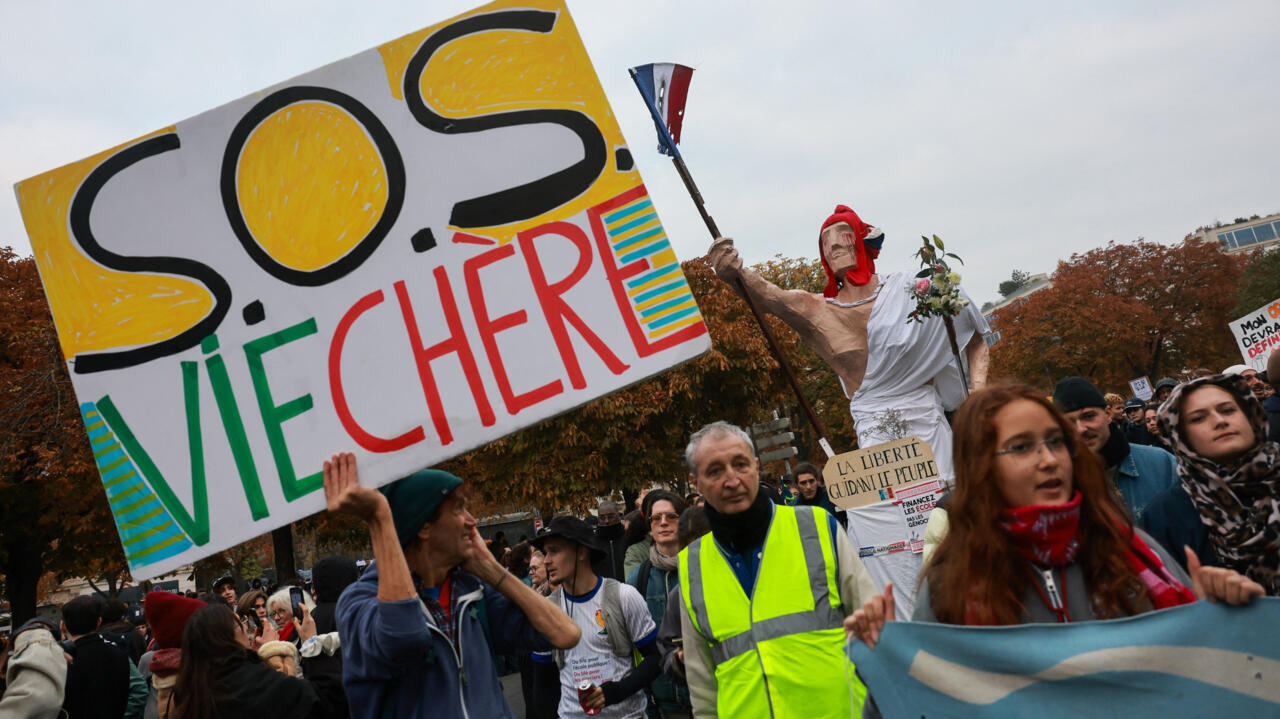
Surveys show the rising cost of living is the leading concern for French voters ahead of next year's presidential election, with price hikes and low wages driving recent protests. But while a growing number of people say their salaries are no longer enough to provide a decent standard of living, France's cash-strapped government has little room for manoeuvre. France's cost of living crisis has become a major political issue, as wages fail to keep pace with inflation – 3.4 percent in October – and working people find it increasingly difficult to make ends meet. Xavier Chiarelli, a postal worker at France's state-owned La Poste for 18 years, has a take-home pay of €1,650 a month – just €150 above the minimum wage. "Every month I'm overdrawn by between €200 and €400," he said, while taking part in a day of strike action in Paris last week. He lives in the suburbs of Paris with his partner, who earns a similar salary, and their child. With rent of €1,100 a month to pay, the couple have had to rethink their weekly shopping list, as some of the food they once took for granted has become too expensive. "Certain cheeses – I no longer buy Comté, I buy a cheaper cheese," Chiarelli says. "For my kid, I don't buy chocolate spread or cakes any more. My wife and I make cakes ourselves. It's cheaper." He has also given up holidays, entertainment and buying books and clothes. "We're in an increasingly wealthy society, but the people who make everything work – who fly planes, produce energy, deliver the post, keep factories running – they're barely surviving. "I would say my spending power since I started at La Poste 18 years ago has dropped by between 40 and 50 percent." French union leader warns strikes will continue without higher wages Longer-term decline The crisis in the Middle East has pushed up energy prices in France by 24 percent over the last year, directly impacting the 69 percent of workers who mainly commute by car. Higher fuel prices have also increased the cost of delivering food to supermarkets, while this summer's drought and heatwaves had already led to price hikes on fresh food in particular. According to France's national statistic institute, Insee, low-income households are hardest hit by price increases because essential expenditure on basics such as food, transport, housing and heating accounts for a disproportionately large share of their budget. "On average, 16.8 percent of income is spent on housing. This figure rises to 32 percent for the lowest-income quarter of households in France," Fabrice Lenglart, Insee's director-general told L'Express newspaper. "This proportion likely explains, at least in part, the current anger." For François Geerolf, an economist at the Institut français d'économie (IFE), the problem has been building for years. "It isn't sudden or particularly severe this time," he says. "It's more part of a long-term trend, with spending power gains indeed slowing, or even falling, depending on which indicators you use." He traces the deterioration back to the 2008 financial crisis, with further pressure from the inflation spikes of 2022 and 2023, following Russia's invasion of Ukraine, and the latest rise in oil prices. However, he says the bottom line is that wages are not keeping up with inflation. "Real wages have fallen by around 8 percent in the public sector and 5 percent in the private sector over the past 15 to 20 years." Listen to a report on the cost of living crisis on the Spotlight on France podcast: Spotlight on France, episode 153 © RFI Squeeze on workers France's minimum wage, known as the SMIC, will rise by 1.6 percent on 1 December, taking monthly take-home pay to around €1,502 – an increase of approximately €24. The government is hoping the measure will help ease anger on the streets after weeks of demonstrations. But unions say it does little to address the wider problem of low wages. Around 2.1 million private-sector employees were earning the minimum wage in January 2026, representing around 12 percent of the workforce. A further 862,000 public-sector workers receive supplements to bring their pay up to the legal minimum. Medef, France’s main employers’ federation, rejects the increase, calling it a “bad response to a real problem” rather than an effective answer to falling purchasing power. Its president, Patrick Martin, has warned that the increase, combined with the government’s 2027 budget effort, could progressively lead to the loss of about 250,000 jobs. Among France's 5.8 million public sector workers, even those on higher salaries say they're struggling. Anne Bonneau, a 60-year-old French teacher in Paris, earns €2,500 net a month while working a 70 percent contract. With rent taking up more than half her salary, she says she can no longer afford to go on holiday. "I'm on strike because even at the end of my career, it's hard to make ends meet. I'm having to save up for dental treatment, which has become increasingly expensive as social security reimburses less." Bonneau is also worried about her younger colleagues entering the profession. "Some start on around €1,800 a month, even though they have master's degrees," she says. "They're qualified people, and they're paid barely above the minimum wage. It's scandalous." A hospital social worker with 12 years' experience, Blandine Chauvel earns around €2,000 net a month. But she says she is also witnessing the consequences of the crisis among the people she works with. "We're on the front line of the social crisis," she says. "I see people going hungry every day, and we have no means of helping them. It's just not acceptable." The Secours Populaire charity estimates that 6 percent of the people it helps are in work. Its latest barometer found that 40 percent of working people believe their job does not allow them to cover their expenses. French public sector workers strike over pay freeze ahead of 2027 budget Little progression in public sector The situation is particularly acute in the public sector, where salaries are calculated using a system of pay scales and an "index point" that has not been increased for more than three years. As the minimum wage has risen with inflation, some public sector workers have seen their basic salaries fall below the legal minimum. The state makes up the difference through additional payments, but this does not necessarily improve their baseline salary or pension entitlements. "Some employees can spend their entire careers on or near the minimum wage," says Christophe Bonnet of the CFDT trade union's education and research federation. Even some managers in the lowest public-sector grade are now being caught up by it, he notes. "They say teachers need to be encouraged to enter the profession, well how about raising their wages?" Bonnet denies that the job security offered by the public sector is sufficient compensation. "If you have job security, but your job is not paying enough for a decent living, then that's not security." French food bank donations fall as frequency of use spikes in cost of living crisis Middle classes hit Geerolf acknowledges that the 1.6 percent increase is "not insignificant" for someone on the minimum wage, but argues that it will not resolve the wider problem. "The purchasing power crisis isn't only affecting people on the minimum wage. It's the whole middle class that feels it's struggling to make ends meet," he says. People earning France's median wage, around €2,200, increasingly find their living standards resembling those of workers on the minimum wage, despite often having higher qualifications and greater responsibilities. In addition, people on the minimum wage are eligible for in-work benefit to supplement their income. In the third quarter of 2025, that amounted to 8.7 million people. "The difference between someone on welfare who does not work at all and someone working full time on the minimum wage and receiving the in-work benefit is around €27 a day," Antoine Foucher, head of the consultancy Quintet, told La Croix newspaper. "€27 is a lot when you're living on the minimum wage, but it's also very little when you consider that a worker has commuting costs and that someone on welfare can earn almost the same amount by doing two hours of undeclared work." For him, it proves that work does not pay enough in France. Unions are calling for broader wage increases, including an increase in the value of the index point and a revision of public-sector pay scales. They also want salaries to be linked more closely to inflation. Why do women in France still earn less than men? Further decline ahead The minimum wage increase will benefit around 1.35 million public sector employees, with an average annual gain of €350 gross. And yet the increase, combined with measures to raise the lowest public sector salaries, will cost the state just over €1 billion, Public Accounts Minister David Amiel has admitted. France's public deficit is running at 5.4 percent of GDP and it needs to bring it back down to 3 percent of GDP by 2029. Geerolf points out that France's fiscal adjustment plan requires around €120 billion in savings or additional tax revenue over four years – approximately €30 billion annually. This will likely mean weaker public services, fewer social benefits, higher healthcare costs and additional taxes, he notes, adding that France is teetering on the brink of recession. "What's really worrying is that, given what the government has planned, I think we're heading towards a further decline in purchasing power in the years ahead." This story first appeared in the Spotlight on France podcast. Listen here.
France's cost of living crisis: why working is no longer enough
Full Article
Original Source
Read the full article at Rfi →KhanList aggregates and links to publicly available news content. We do not host full articles from third-party sources. Always verify important information with original sources.