
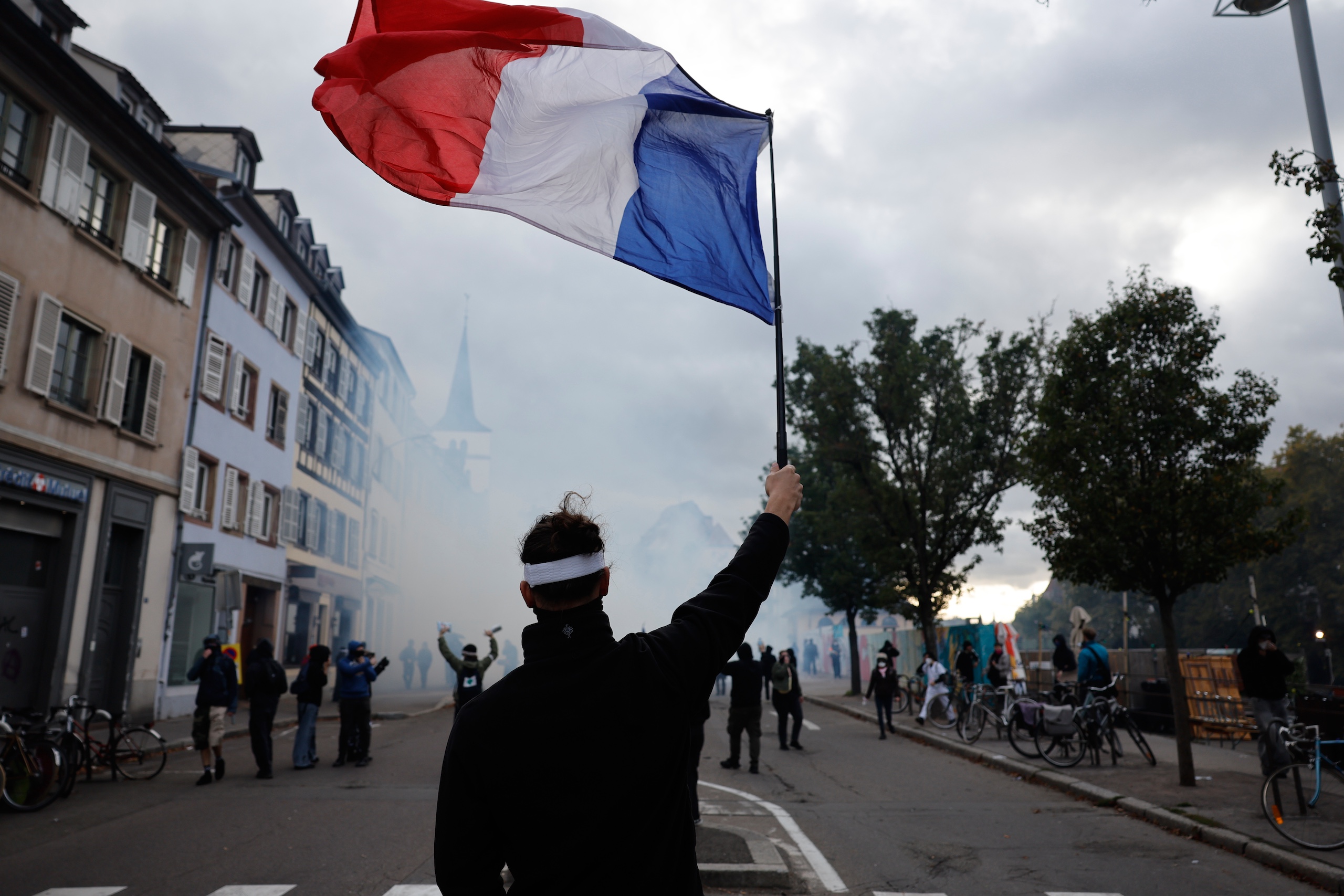
Experts are sounding alarm bells about the bill — and questioning why student demands aren’t being treated with the same urgency.PARIS (CN) — Following the nationwide civil unrest that shook France earlier this month, the government is exerting authority in the form of streamlined legislation.On Wednesday at around 1 a.m., senators passed the “Rioters Pay” bill through an accelerated procedure after authorities lost control over riots on Oct. 17. But critics are concerned about its implications, both practical and symbolic, as student protests continue to escalate into a wider societal movement.“One could have imagined that a bill would be urgently passed to try to address a number of the issues denounced by young people,” said Serge Slama, a professor of public law at the Université Grenoble Alpes. “Instead, [the government] found a way to quickly pass, at least in the Senate, a bill to add an even more repressive arsenal to the system that already exists.”The bill’s official aim is to “make those responsible for the damage [caused during riots] bear the financial burden of repairs.” But its actual scope is much wider.Individuals within a violent group — or who remain in a gathering despite police orders to leave — could be held jointly responsible for the damages inflicted by that group, regardless of whether they played a role in the damage themselves. Financial penalties could go up to 10,000 euros (about $11,136).“The primary risk is a massive deterrent effect,” said Olivier Fillieule, a senior researcher at France’s national science center known as CNRS. “A demonstration is a fluid and often chaotic situation … A participant may be unaware of what’s happening at the other end of the procession, may not hear official dispersal orders and may not necessarily have a clear exit route.”The state would be able to deduct household welfare benefits to cover the cost.“A 10,000-euro debt doesn’t carry the same weight for everyone,” Fillieule said. “It risks shifting the burden of the sanction onto the entire household … Consequently, benefits intended to provide housing, food or the means to raise a family are transformed into a tool to collect funds related to maintaining public order.”Other measures include heightened video surveillance, possible deportation orders for non-French agitators and suspensions of social media platforms.Young women stand behind a sign reading “Fewer cops, more teachers” (“Moins de flics, plus de profs”) during a nationwide demonstration and one-day strike by labor unions in defense of public services in Toulouse, southwestern France, on Sept. 29, 2026. The protest comes two days before a review of the government’s proposed 2027 budget, which calls for further cuts or a freeze on cost-of-living adjustments. (Pat Batard/Hans Lucas via AFP)Although students are the heart of the protests — and opportunistic agitators are a vast minority — the government has not demonstrated the same sense of urgency to act on educational demands.On Monday, ministers presented their first proposal after more than four weeks of demonstrations. Measures include replacing Parcoursup, the higher education platform that has been criticized for being opaque and elitist, by 2028; canceling 836 planned teacher cuts and introducing 500 new teaching positions; devoting almost $4.5 billion to improve the conditions of buildings by 2030; and capping class sizes to 28 students in the next few years.Student unions applauded these “initial steps forward,” but will continue leading protests until a comprehensive funding plan with additional amendments is put forward.A sign reading "I have nightmares of Macron and the police" during the Paris protest on Oct. 24, 2026. (Lily Radziemski/Courthouse News)Paul Cassia, a professor of public law at Sorbonne University and former president of the anticorruption agency Anticor, explained that “everyone agrees” with the student demands — there needs to be toilet paper in restrooms and buildings shouldn’t become furnaces in the summer.“For all of the demands being made, there is a consensus that they are legitimate,” he said. “And for now, the government is essentially responding with security measures that are all the more unjustified because we already have very extensive legislation in France regarding the protection of public order.”But this has been the government’s response to unrest before, according to Slama.“The law … becomes a sort of invention contest to pack in as many security provisions as possible, the constitutionality of some of which can be called into question,” Slama said.The supporters of the bill — which passed in the Senate with 229 votes against 105 — maintain that rioters and their families should be held financially accountable for damages. Interior Minister Laurent Nuñez stood behind the notion of joint liability on Wednesday, while assuring that the text only targets vandals and looters.But Cassia wonders if the government’s response could make the protest landscape more fragile.“The government has chosen to hit the accelerator on the law-and-order response while only partially addressing social demands,” he said. “In doing so, [it] can only intensify the discontent of those protesting, since [it’s] actually curtailing civil liberties, putting even more pressure on a simmering social lid, and continuing to pursue public policies that are likely at the root of the discontent among a segment of college students, high school students and the broader society demonstrating for social justice.”Subscribe to our free newslettersOur weekly newsletter Closing Arguments offers the latest about ongoing trials, major litigation and rulings in courthouses around the U.S. and the world, while the monthly Under the Lights dishes the legal dirt from Hollywood, sports, Big Tech and the arts.Additional Reads
France passes controversial ‘Rioters Pay’ bill while students push for reforms
Full Article
Original Source
Read the full article at Courthousenews →KhanList aggregates and links to publicly available news content. We do not host full articles from third-party sources. Always verify important information with original sources.