
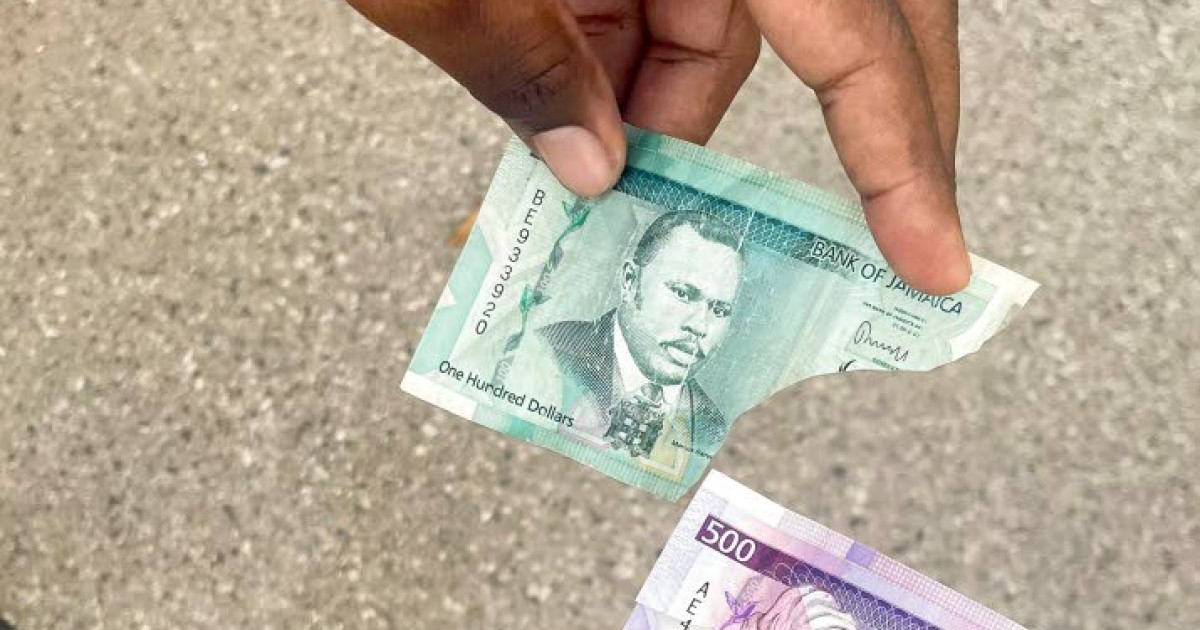
A vendor displays torn $100 and $500 bills to the Jamaica Observer. Vendors, cab drivers, bus conductors, and other Jamaicans whose livelihoods depend heavily on cash transactions say they are taking losses as some of the country’s most frequently circulated banknotes succumb to tearing and fading, prompting concerns about their durability. The Bank of Jamaica (BOJ), acknowledging the problem, says it is exploring ways to make the notes more resilient. “It’s too easy to tear, man; soon as you draw them so they split… I’m not comfortable with them,” long-time Coronation Market vendor Nadine Campbell told the Jamaica Observer. “I have [so] much in my drawer, about $5,000 [worth of] $100, $50, all of them, I just throw them down,” Campbell added. The polymer notes now in circulation were introduced in 2023, replacing cotton-based $50, $100, $500, $1,000, and $5,000 denominations, incorporating new designs and enhanced security features. The roll-out also saw the introduction of an entirely new $2,000 denomination. At the time, then Finance Minister Dr Nigel Clarke said the upgraded notes have the latest in material technology for greater durability, which reduces the frequency of replacement. That would have a positive impact on the BOJ’s annual spend of about $1.4 billion every year to print banknotes. Additionally, the new notes have specific markers to facilitate ease of use by visually impaired people. However, Jamaicans who engage in cash-heavy transactions daily are now doubtful about the notes’ longevity. “If there’s a little tear, nobody wants it, [and] it washes out easily,” shared a vendor who identified herself as Denneshia. This customer in Coronation Market shows a tear in her $500 bill. “It is easy to slide out of your pocket; I don’t like them. But we have to use them because… we have to use them,” she added. Andrew, who loads taxis plying the Price Rite/Whitehall route, had several $50 and $100 bills with microtears along the edges in his hand when the Sunday Observer spoke to him in Half-Way-Tree. “They are quick to tear and, as you get a tear on it, it rips off completely,” he said. In June 2026 the central bank, in an interview with the Observer, had maintained that the new notes far outlast the old cotton-based currency — up to three years compared to 1.5 years. When contacted for this story, the BOJ declined to comment on the complaints. However, it did admit that the lower denomination notes, including $50, $100 and $500 bills, are coming back to the bank damaged more frequently than higher denomination notes. Almost a quarter, around 22 per cent, of the notes in these denominations that it processes are deemed unfit for recirculation. But anecdotal evidence suggests the number could be higher, as a familiar refrain among vendors and customers with whom the Sunday Observer spoke is that they don’t return the most damaged notes. Some, like a cab driver who identified himself as Prince, showed the newspaper their stash of damaged notes. This is not good, look at this,” Prince said, flipping through a wad of torn bills, mostly $50 and $100 notes. Cab driver Andrew shows micro tears along the side of a $100 bill that he says can quickly result in the bills ripping completely. Similarly, more than half of the vendors and customers who spoke to the Sunday Observer said they have damaged bills collecting dust at home. One vendor, who identified herself as Grace, said she had taken the torn notes to a bank to have them replaced. But that effort failed as the bank refused to take them. “When I bring it to the bank, they told me to go and find the other piece if there’s another piece to find, but they’re not changing it,” Grace said. That, she insisted, was opposite to her experience with the former cotton-based notes. “We always could bring them to the bank as long as they have on the serial number,” Grace explained. She said the serial numbers are visible on the damaged $500, and $1,000 bills she had, but she has since thrown them away “because we don’t know what to do with them”. A vegetable vendor, Gem, who said she has been selling in Half-Way-Tree for more than 15 years, told the Sunday Observer she has her own collection of damaged notes. “As you quint [blink] they tear,” she said. “The amount that I’ve gotten I have to carry them and put down at my house, because sometimes how people ginnal you and give you, you don’t even notice. Some of them you can use a piece of tape and it’s good to go, but others…” “Maybe one day when I am broke and don’t have any money I can draw back for them and carry them to the bank,” Gem added, laughing. A torn $1,000 bill is shown in a social media post. A driver who travels through Spanish Town, Frankie, maintained: “Once they have a rip, that’s it; they don’t have any value unless you take them back to the bank.” Despite the complaints, the bills seem almost impossible to rip. Jamaica Observer reporters who tried various methods to tear a $100 bill found that it merely bent and wrinkled. When the Sunday Observer contacted De La Rue, the British company that manufacturers the notes, an employee explained that it would be very difficult to comment without knowing the state of the notes beforehand, including how old they were and how they had been used. However, the employee said: “If you have to work really hard to destroy the notes and then you are seeing some that are damaged, it suggests that the notes have two very different histories.” The BOJ has blamed rough handling, including stapling and graffiti, for the state of some of the bills. It also said in June, that while replacement rates have dropped across all denominations, it is working with the manufacturer to “identify ways to further improve durability, particularly for the lower denominations”. The Sunday Observer then asked De La Rue whether any changes have been signed off on with BOJ regarding the notes; if so, when are they due to begin production, and whether Jamaicans could expect any tangible changes, for example, a different feel or thickness. However, the manufacturer said it was not able to comment on any conversations it had with any central bank. In the meantime, Jamaicans who use the lower denominations the most say it’s costing them money. “It is a loss for me, because when a passenger gives me a torn note I have to just fold it up and put it somewhere; I can’t even pass it on,” said Prince. Another issue that several bus conductors and drivers on the Spanish Town to Kingston route pointed out was that the notes tend to stick together when they get damp or moist, leading them to give away more bills than they intend. They explained that this regularly causes conflicts between commuters and conductors. Similar concerns were shared by a Coronation Market vendor who identified herself as Dimples. “It is nice, but when it is wet it can be a little tedious because it sticks together… it poses a problem because suppose a shopper comes, and they come thinking it’s one note and… pass it on to me, and I give you the change, and you go to someone else thinking you have the other money, which you don’t; it’s gonna cause a problem… there’s a little friction, and we don’t really want that,” she said. Regular consumers had fewer issues with the currency, though they still shared complaints about it tearing. One customer in Coronation Market was complaining about the very issue when the Sunday Observer visited. A social media user shows torn notes that were allegedly just withdrawn from an ATM. Displaying her $500 bill with a small piece missing from the edge, she said: “I don’t have a problem with the money, but there are times when you come and you will give someone, say, $1,000 or $2,000, and they tend to give you back money that is torn. And then now when you try to spend it, nobody will take it, and that is where I have a problem,” she said. Another customer explained that she loves the fact that the notes can stand up to water, especially with accidental washing. “So when you check the pocket now after the clothes dry, you find the money, and it’s still all right. It’s not crushed up… So you can use it again. The only problem with it, when it tears, you have a problem, because nobody want to take it from you. But I think it was a good switch. I appreciate it,” she explained.
Fragile cash
Full Article
Original Source
Read the full article at Jamaicaobserver →KhanList aggregates and links to publicly available news content. We do not host full articles from third-party sources. Always verify important information with original sources.