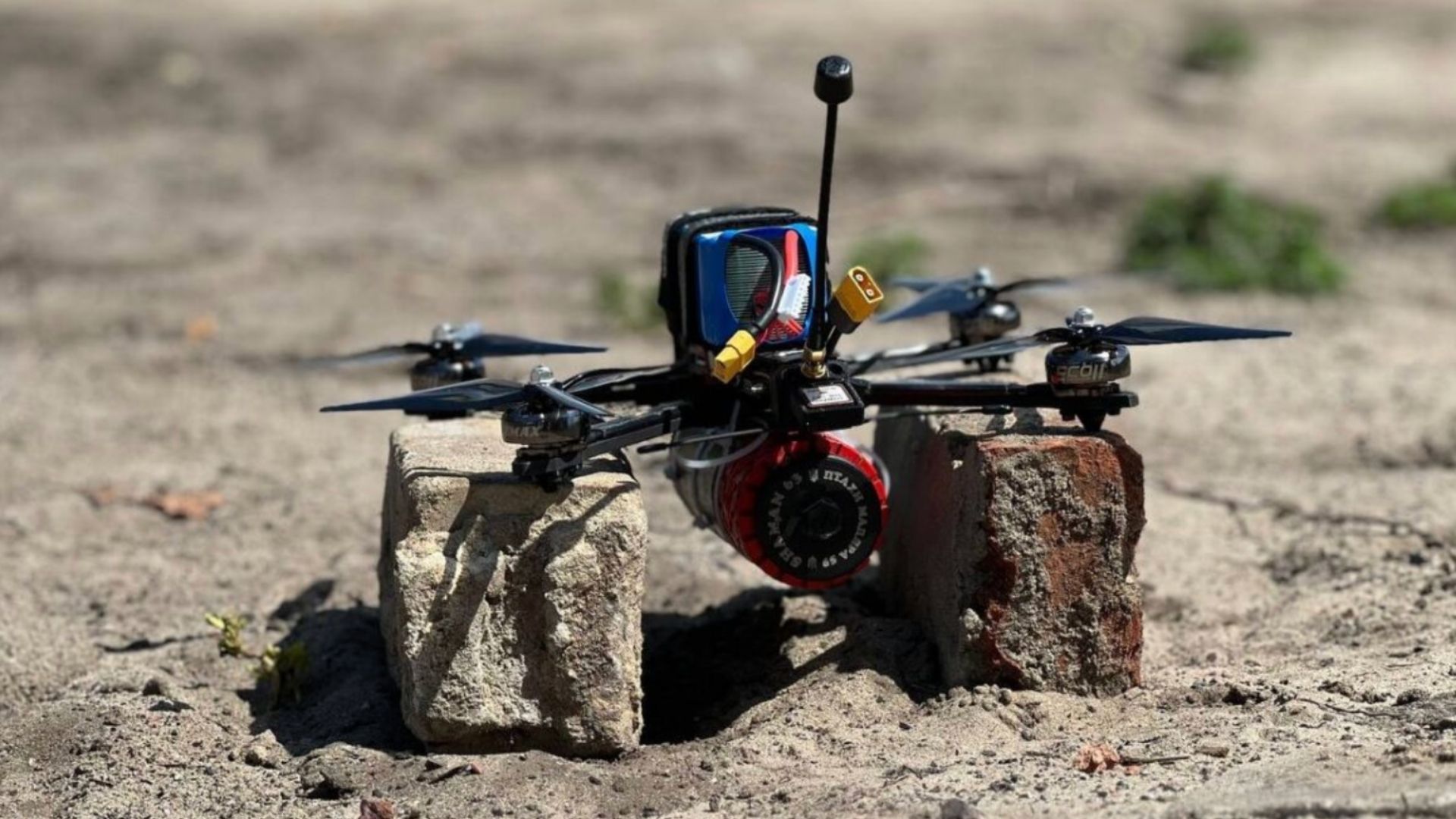
FPV drones have become one of the most visible weapons of modern warfare, giving soldiers a relatively low-cost way to conduct precision strikes against vehicles, positions, and personnel. Their effectiveness, however, still depends heavily on human pilots controlling individual drones through live video and command links. AI-enabled drone swarms take a different approach by allowing multiple unmanned systems to coordinate and perform parts of a mission with greater autonomy. The contrast between the two becomes clearer when comparing their autonomy, control, cost, coordination, and battlefield roles. Conventional FPV drones depend heavily on a human pilot for most of the flight. The operator steers the aircraft, identifies a target, and guides the drone during its final approach. Some systems are adding automatic target recognition or terminal guidance, but that does not make FPV drones inherently autonomous. AI-enabled swarms are built around greater machine autonomy. DARPA’s OFFSET program, for example, tested autonomous air and ground vehicles operating collectively, with research focused on swarm autonomy and human-swarm teaming. However, “AI swarm” does not automatically mean fully autonomous lethal action. Levels of autonomy vary by system, and human oversight can remain part of targeting and engagement decisions. Control The human-machine relationship is different. A conventional FPV mission normally ties an operator closely to an aircraft through command and video links. This provides direct human control but makes the link important to mission success. Electronic warfare has consequently become a major countermeasure against radio-controlled FPVs. A drone swarm aims to reduce the need for a person to manually fly each aircraft. Instead, an operator may assign objectives or supervise a group while autonomous software handles parts of navigation, task allocation, or movement. NATO research is examining autonomous navigation and decision-making for swarms in contested and GPS-denied environments. Cost Low cost is one of the clearest advantages of FPV drones. A 2025 US Army University Press analysis described a typical FPV quadcopter used in Ukraine as costing about $500, although prices and configurations vary. Their simple construction allows large numbers to be produced and expended against targets that can cost far more. There is no single price for an “AI swarm drone.” A swarm is a system-level capability rather than one standardized aircraft. Its cost can include individual drones, sensors, networking, computing, autonomy software, ground equipment, and integration. Therefore, claiming that swarms are categorically cheaper or more expensive than FPVs would be misleading without comparing specific systems. Coordination FPVs can be used in large numbers, but quantity alone does not constitute a true autonomous swarm. Multiple FPV pilots can coordinate attacks through human planning and communications while each controls an individual aircraft. Swarming adds machine-enabled cooperation between platforms. DARPA envisioned OFFSET swarms of up to 250 air and ground systems performing missions in complex urban environments. Such concepts seek to distribute tasks across numerous vehicles and allow the group to adapt its behavior collectively rather than relying entirely on operators coordinating every movement. Battlefield role FPV drones already have extensive, documented combat use in Ukraine. In Ukraine, they have been employed against armored vehicles, personnel, logistics routes, positions, and other targets. Their maneuverability and low cost have made them useful as expendable precision-strike systems, while longer-range variants have also threatened assets behind front lines. AI swarms remain less mature as a broadly deployed battlefield category. Their intended advantage is scale: multiple cooperating platforms can search, observe, relay information, or act across a wider area while reducing the control burden on human operators. DARPA demonstrations have explored such swarms in urban missions. The comparison is not simply old versus new. FPVs offer proven, inexpensive, directly controlled precision. AI swarms seek greater autonomy and coordination across many platforms, but their capabilities, costs, and level of human control depend heavily on the specific system being deployed in combat. Recommended ArticlesGet the latest in engineering, tech, space & science - delivered daily to your inbox.Atharva is a full-time content writer with a post-graduate degree in media & amp; entertainment and a graduate degree in electronics & telecommunications. He has written in the sports and technology domains respectively. In his leisure time, Atharva loves learning about digital marketing and watching soccer matches. His main goal behind joining Interesting Engineering is to learn more about how the recent technological advancements are helping human beings on both societal and individual levels in their daily lives.
FPV drones or AI swarms? How the two battlefield systems differ
Full Article
Original Source
Read the full article at Interestingengineering →KhanList aggregates and links to publicly available news content. We do not host full articles from third-party sources. Always verify important information with original sources.