
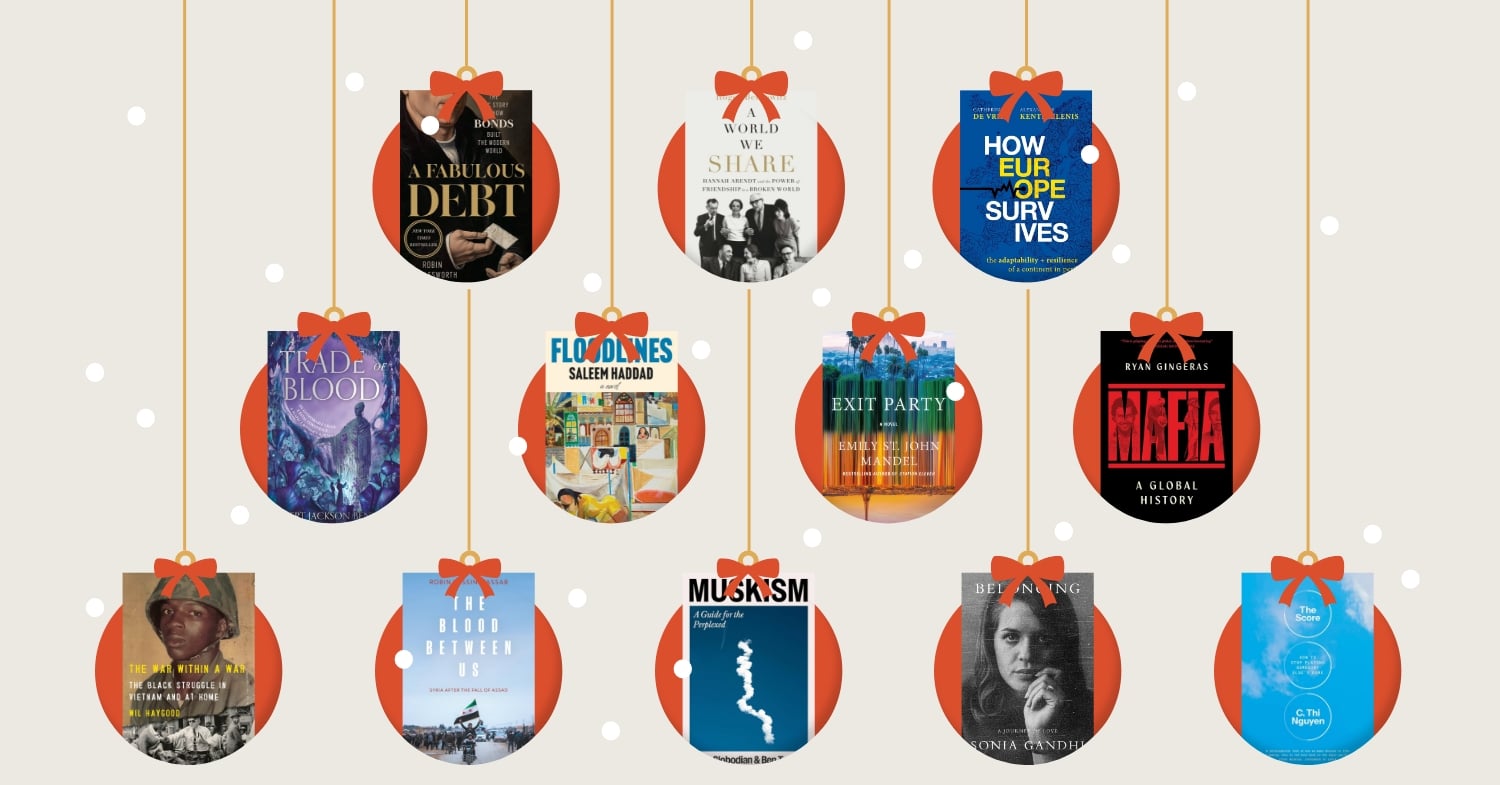
Picture this: You’re curled up in your favorite chair with a cup of hot cocoa, fire crackling, Bing Crosby crooning on the stereo, and you pull out a 400-plus-page tome on the 1,000-year history of bond markets. Or the adaptability of the European Union. Or perhaps grand strategy in the Middle East. If any of these scenarios appeal to you, you’re in the right place. Below, you’ll find holiday reading recommendations from FP staff and columnists, whose 2026 picks range from wonky to contemplative to downright fun.—Chloe Hadavas A Fabulous Debt: The Epic Story of How Bonds Built the Modern World Robin Wigglesworth (Portfolio, 416 pp., $35, September 2026) I imagine there are likely only two reactions when readers stumble across a book such as A Fabulous Debt, a 1,000-year tale of bond market magic and mischief: Shoot me now, or straight into my veins. I’m in the latter camp, and unabashedly so. This is a fantastically entertaining read, and no holiday is complete, in our household at least, without in-depth discussions of financial crises dating back centuries. Robin Wigglesworth’s book is so much fun to read because it is a fast-paced, exhaustively researched history of the driest subject in the world written in the most engaging way possible. Bonds—debt that pays interest, and that finances governments and companies—are actually the secret to understanding the whims and vagaries of everything that has happened since Venice was on the upswing in the pre-Renaissance years to the latest market meltdown over U.S. President Donald Trump’s wild policies. There is literally nothing more central, and perhaps less well understood, to the world today, and Wigglesworth is the worthiest of sherpas. Beyond all the financial innovation—which was much, and often not even criminal—the characters alone are amazing. From 12th-century Venetian doges to Alexander Hamilton to 19th-century rail barons to 1980s bond villains, and then, just a few decades later, even more creative bond villains. This is the prequel to The Big Short. If I were a ratings agency, I would give the book an AAA+. —Keith Johnson, staff writer Muskism: A Guide for the Perplexed Quinn Slobodian and Ben Tarnoff (Harper, 256 pp., $30, April 2026) A guide for the perplexed? I feel seen; count me in. Just as there was once Fordism—the shorthand homage to Henry Ford and 20th-century capitalism that married mass production with mass consumption—our current era of bewilderment probably needed its own -ism. Enter Elon Musk. Co-authors Quinn Slobodian and Ben Tarnoff make the case that Muskism is a worldview that offers an “operating system” for our times. But you, dear reader, are not just partaking in Musk’s OS by buying his cars or renting his internet. You are becoming part of his universe. “Trying to unplug from Musk,” the book points out, “you realize he owns the socket.” This is a slim, urgent, and highly readable book on the man who thinks he is the world’s most important being. It is also about what Musk’s rise means for the rest of us—the permanently perplexed—whose tax dollars fueled his ambitions, who watched as he gutted the federal government, and who continue to wonder why we’re developing flying cars when all our actual flights are delayed. Mercifully, unlike some other works on Musk, this is no hagiography. Instead, it charts out how Musk came about his views and how his techno-maximalist, anti-humanitarian venom came to poison much of Silicon Valley. —Ravi Agrawal, editor in chief How Europe Survives: The Adaptability and Resilience of a Continent in Peril Catherine E. De Vries and Alexandros Kentikelenis (Oxford University Press, 256 pp., $34.99, October 2026) Who in their right mind would read a book about the European Union during a holiday? Well, think twice. How Europe Survives by Catherine E. De Vries and Alexandros Kentikelenis is one of the more upbeat books you will ever read about the subject. From their perches in Madrid and Milan, the two political scientists explain why the crises that have plagued Europe in the past two decades—such as the eurozone crisis, refugee crisis, Brexit, the war in Ukraine, and the COVID-19 pandemic—have not killed the EU, as many predicted. In their telling, Europe is like a living mechanism. It improvises and adapts to its circumstances, albeit slowly. With each crisis, Europe’s leaders face a choice: Fall in the precipice or seek compromise. So far, they have opted for the latter. The result is often far from pretty, but as the book reminds us, these compromises generally produce a quality of life, stability, and moderation that make some other nations green with envy. —Caroline de Gruyter, FP columnist Exit Party: A Novel Emily St. John Mandel (Knopf, 320 pp., $32, September 2026) It felt like the world was ending most weeks this year. “BREAKING: EVERYTHING” was a pithy summation of that time the planes were grounded and Microsoft Outlook sputtered to a halt. (I’m sure as you read this, fresh hells will have presented themselves.) Amid such systemic collapse, the concept of a dystopic sci-fi novel set in the smoldering ruins of an American civil war was not appealing—until I read a review of Exit Party that said it was “cozy.” The novel, which begins with a really bad party off the Sunset Strip in the newly formed Republic of California, courses with adrenaline but never resignation. With a dash of the Bourne movies and a soupcon of fellow Canuck Margaret Atwood, Emily St. John Mandel invokes our worst nightmares and then uses them as a mere backdrop to an absorbing story about art, friendship, and love, asking, “Who will you be at the end of the world?” —Amelia Lester, deputy editor The War Within a War: The Black Struggle in Vietnam and at Home Wil Haygood (Knopf, 384 pp., $35, February 2026) By bringing readers deeply into the experiences of African American soldiers during the Vietnam War, Wil Haygood’s The War Within a War confronts us with the reality of the socioeconomic and racial inequality so often at the heart of modern warfare, and especially of its American variants. Through individual stories that come to life on the page, Haygood documents how Black soldiers were disproportionately represented on the battlefield in Vietnam, and how these soldiers were disproportionately killed and wounded early in the war. Yet they were promoted to positions of command in numbers well beneath those that their presence on the front lines would have suggested. He also shows the indifferent treatment that Black veterans commonly experienced upon their discharge, when many faced few options beyond returning to poverty-ravaged inner-city neighborhoods, where jobs were scarce and cheap narcotics plentiful. Haygood’s book joins a growing literature about the bitter irony of African American soldiers fighting, from the U.S. Revolution and the Civil War to the present, for the freedom and full citizenship of others, even as they have been denied these things or discriminated against themselves. —Howard W. French, FP columnist The Blood Between Us: Syria After the Fall of Assad Robin Yassin-Kassab (Saqi Books, 352 pp., $27.95, September 2026) Not long after the Syrian uprising began in 2011, I started receiving email installments of Robin Yassin-Kassab’s blog, Qunfuz. I had never heard of him, but his searing and eloquent takes on Syria ensured that I did not send Qunfuz to my junk folder. So, when I saw that Yassin-Kassab had written a book, it was an easy preorder. The Blood Between Us is not an eyewitness account. Yassin-Kassab is of Syrian and Scottish descent, lives in the United Kingdom, and only made a few relatively brief forays into Syria during its 14-year conflict. This is actually to the volume’s benefit, however. Yassin-Kassab offers both the intimacy of the bloodletting as told to him by his interlocutors and an analytic detachment that provides perspective on the Syrian revolution as it unfolded. His central point is that the Syrian people’s triumph in December 2024 was not the bolt from the blue that it seemed. Despite the static battlefield, repression, displacement, and death, the uprising against the Assad regime never ended. Admittedly, The Blood Between Us is not an uplifting holiday read, so maybe hold off for a few weeks—but do not miss it. —Steven A. Cook, FP columnist A Trade of Blood: An Ana and Din Mystery Robert Jackson Bennett (Del Rey, 400 pp., $32, August 2026) The most entertaining book I’ve read this year was Robert Jackson Bennett’s A Trade of Blood, the third in his ongoing series of fantasy detective stories. Bennett’s tales of a cantankerous master detective and her long-suffering, curious sidekick are an exercise in how to keep sequels fresh—and also examinations of the dilemmas of power and the double-sidedness of a government trying to do good things through troublesome means. They can stand with some of the best of Golden Age detective literature, but they also have giant monsters. —James Palmer, deputy editor Israel’s Lobby: America in the Grip of a Foreign Power Eli Clifton and Ian Lustick (Atria/One Signal Publishers, 304 pp., $29, August 2026) My holiday recommendation is Eli Clifton and Ian Lustick’s Israel’s Lobby: America in the Grip of a Foreign Power. Israel’s rightward shift, ever-expanding occupation, and Gaza genocide have produced a sea-change in U.S. attitudes toward Israel. Yet Democratic and Republican politicians continue to give Israel nearly unconditional support and diplomatic protection, even when Israel defies U.S. wishes or takes actions that harm U.S. interests. Clifton and Lustick explain this puzzle by showing how hard-line pro-Israel individuals and groups have taken advantage of the lax campaign financing rules created by the 2010 Citizens United decision to keep politicians on board. Having lost the battle for public opinion, the Israel lobby now relies primarily on raw political muscle, mostly in the form of money. (The recent midterm elections suggest this tactic may be beginning to backfire). Clifton and Lustick also describe how Israel’s most ardent defenders have used false charges of antisemitism to silence criticism of Israel, which poses broader threats to freedom of speech. If you’re curious why the United States keeps landing in quagmires in the Middle East, this book provides part of the answer. —Stephen M. Walt, FP columnist A World We Share: Hannah Arendt and the Power of Friendship in a Broken World Roger Berkowitz (Yale University Press, 176 pp., $28, October 2026) At a time when political disagreement can be reason to end a friendship, Roger Berkowitz makes the case that democracy depends on our ability to nurture relationships across deep divides. In A World We Share, Berkowitz, the director of the Hannah Arendt Center at Bard College, offers an anatomy of Arendt’s friendships, which spanned fierce intellectual disagreements and profound moral differences. Arendt’s circle included figures as disparate as the novelist Mary McCarthy, philosopher Karl Jaspers, and her one-time lover Martin Heidegger, whose embrace of Nazism tested the limits of a friendship with Arendt, a Jewish survivor of Adolf Hitler’s persecution. Berkowitz draws on Arendt’s extensive correspondence, including detailed epistolary exchanges on subjects as diverse as the Holocaust, Watergate, and marital infidelity. Through these relationships, Berkowitz makes the case that democracy depends upon worldviews grounded in mutual respect, spirited debate, and a willingness to break bread, exchange ideas, and forge emotional bonds with people whose convictions we reject. His argument speaks to a moment when ideological certainties and litmus tests increasingly crowd out curiosity, and political differences can eclipse our ability to see common humanity, much less make common cause. As our politics enters a new and more hopeful phase, and as families and friends gather at holiday tables, this timely book is an invitation to rediscover the democratic necessity of friendship across divides. —Suzanne Nossel, FP columnist The Score: How to Stop Playing Somebody Else’s Game C. Thi Nguyen (Penguin Press, 368 pp., $32, January 2026) The Score, by philosopher C. Thi Nguyen, is a love letter to games, but it is also a surprising treatise on bureaucracy. The book interrogates how so much of modern life has become an exercise of keeping score through data, metrics, and rankings. That focus on the quantitative, Nguyen argues, can produce beauty and fun in a game, yet it can warp behavior to disastrous effect everywhere else. In public policy, scorekeeping allows governments to create order and track progress in a sprawling, messy world, but often at the expense of context or nuance. Among Nguyen’s case studies is the work of anthropologist Sally Engle Merry on the U.S. State Department’s sex-trafficking report, which, by judging countries by their conviction rates, incentivized greater policing over reducing poverty. For all its insights on processes and institutions, the book is also a joyous, sensual celebration of rock-climbing, fly-fishing, yo-yoing, and other pursuits that resist the gamification and optimization so characteristic of today’s world. —Megan DuBois, associate editor Fire in Every Direction: A Memoir Tareq Baconi (Washington Square Press, 256 pp., $19, October 2026, paperback) After I gifted Fire in Every Direction to a friend earlier this year, she sent me a message thanking me for the “novel”; she had read the first few pages and was immediately engrossed. Her misperception speaks to how engagingly Tareq Baconi narrates his own coming-of-age story—it reads like a bildungsroman, but it’s all true. Baconi is a leading expert on Hamas, which he has previously written about for FP. In Fire in Every Direction, he takes a step back from his academic perch to reflect on his at-times painful journey to self-acceptance as a gay Palestinian man. Since his childhood in Amman, Jordan, Baconi had an intangible sense that he was different from his peers. His unrequited infatuation with a male classmate led to a broader reckoning within his family about sexuality and shame. To escape Amman’s stifling conservatism, Baconi chose to attend university in London. Although there’s no love lost between him and Jordan—where his twice-displaced Palestinian parents begrudgingly fled to from Beirut during Lebanon’s civil war—he eventually finds his way back to Palestine. Rather than challenge his devotion to the Palestinian cause, Baconi’s queer identity affirms his commitment to securing liberation for all people. —Allison Meakem, senior editor The Realist: Hans Morgenthau and the Purpose of American Power David M. Sacks (Henry Holt and Co., 528 pp., $36.99, November 2026) The Realist is a lucid, compelling, and granular biography of Hans Morgenthau, one of the most influential scholars of international politics in the immediate postwar era. David M. Sacks’ deft book provides a complete sweep of Morgenthau’s life and career from a small, provincial town in Germany to the global metropolis of New York. A German-Jewish émigré who had direct experience of the rising tides of vicious antisemitism, Morgenthau succeeded after tireless efforts to find a professorship at the University of Chicago. After an illustrious career, he moved to the City College of New York, where he quickly became a fixture of the city’s intellectual establishment. As a public intellectual, Morgenthau was also an early and vociferous critic of the Vietnam War, despite harboring a deep-seated hostility toward the Soviet Union. —Sumit Ganguly, FP columnist Belonging: A Journey of Love Sonia Gandhi (Knopf, $28, 544 pp., November 2026) Sonia Gandhi is one of the most fascinating living political leaders in South Asia, but also one of its least understood. She rose from humble beginnings in Italy to become the scion of India’s biggest family dynasty, even becoming linked with India’s independence (her late husband Rajiv was the grandson of the country’s first prime minister, Jawaharlal Nehru). But this remarkable life trajectory also led to great tragedy, due to the assassinations of her mother-in law, Indira, in 1984, and of Rajiv in 1991. Gandhi, who turns 80 next month, has always been very private about her personal life and rarely opens up publicly. We haven’t had a true sense of her life and how it has shaped her. Belonging, her new memoir released earlier this month, tells a story that many in India and beyond have long wanted to hear. —Michael Kugelman, FP’s South Asia Brief writer Floodlines: A Novel Saleem Haddad (Europa Editions, 336 pp., $19, February 2026) One of the most memorable novels I read this year was Saleem Haddad’s Floodlines, a multigenerational epic that stretches from Baghdad to London and elsewhere between. The three Iraqi British sisters at its center—who are variously estranged—are pulled back together by the discovery of lost artwork by their late father, a renowned painter. The family that Haddad sketches feels real enough that a reader might be tricked into thinking the characters are loosely fictionalized. (The author drew on the story of his own great-uncle, an Iraqi modernist painter, for inspiration.) Even with elements of magical realism at play, Floodlines is ultimately rooted in the political and cultural history of Iraq. The book reaches its climax in 2014, with the Islamic State on the rise. As an unlikely plot brings its characters back home, Haddad manages to strike a genuine note of hope against a backdrop of conflict, exile, and rupture. And despite the family dysfunction driving it, Floodlines would make an excellent gift for a close relative or friend. —Audrey Wilson, managing editor Peace Through Strength: How Reagan’s Military Buildup Won the Cold War Roger Zakheim (Regnery History, 472 pp., $40, November 2026) Most accounts of U.S. President Ronald Reagan’s foreign policy focus on his high-level summitry and arms control agreements with Soviet Premier Mikhail Gorbachev. But in Peace Through Strength, Roger Zakheim, the director of the Reagan Institute, tells the story of his military buildup. Zakheim argues that Reagan was able to sustain the largest peacetime military expansion in U.S. history across two presidential terms in the face of stiff opposition, even from his own party, because he saw it as essential to his Cold War strategy. As the free world faces threats from a new axis of aggressors, Trump calls for a record $1.5 trillion U.S. defense budget, and allied governments in NATO and the Indo-Pacific pledge to spend up to 5 percent of GDP on defense, democratic leaders are once again vexed by the question of how to maintain public and parliamentary support for a yearslong peacetime rearmament program. They would be well served to learn from Reagan’s successful example. —Matthew Kroenig, FP columnist Traumatized: The New Politics of Public Suffering Catherine Liu (Verso, 192 pp., $24.95, September 2026) I was inspired to read Catherine Liu’s Traumatized after Gregory Jones-Katz’s excellent review of the book in FP—and it was every bit as compelling as promised. Not since Lauren Berlant’s 2011 classic Cruel Optimism have I encountered such a thoughtful treatment of society’s obsession with trauma narratives and the ways they impede our understanding of, and appetite for, political change. Liu, a cultural theorist at the University of California, Irvine, examines the ways that social media has amplified these narratives, which have come to pervade the political spectrum, contributing to, among other things, inequality, apathy, and the death of liberalism. It’s not light reading, per se, but it’s provocative, elegantly written, and deeply relevant to our current moment. —Chloe Hadavas, senior editor Mafia: A Global History Ryan Gingeras (Avid Reader Press / Simon & Schuster, 416 pp., $35, February 2026) Here is the story of the 20th century told from the other side of the law. In Mafia, historian Ryan Gingeras shows how organized crime made the United States and how the United States in turn remade organized crime on a global scale through its economic might, law enforcement efforts, and popular culture. From early Balkan brigands through the last season of Narcos, this wide-ranging and fast-moving account takes readers on a journey through the dark shadows of globalization. —Nick Danforth, deputy editor West Asia: A New American Grand Strategy in the Middle East Mohammed Soliman (Polity, 272 pp., $24.95, February 2026) In the Washington lexicon, the term “Middle East” often conjures up images of protracted wars, militant groups, and failed U.S. attempts at nation-building. In his new book, analyst Mohammed Soliman argues that moving past these quagmires requires reframing how the region is viewed entirely. Enter “West Asia,” a term that places the region at the edge of the world’s largest continent in lieu of its original Eurocentric conception. Anchoring his thesis in the evolving ties among the wealthy Arab Gulf states, Israel, India, Egypt, and Japan—to name a few—Soliman argues that Washington should build a new regional order connecting the old Middle East to the Indo-Pacific predicated on realpolitik, technology, and shared security incentives. A caveat: The book was published weeks before the United States launched its protracted war against Iran, which has injected more uncertainty into the prospect of Soliman’s proposed order. But rather than negating the book’s thesis, the Iran war has only underscored the importance of a new and provocative blueprint for what could come next. —Rishi Iyengar, staff writer
FP’s Holiday Book List
Full Article
Original Source
Read the full article at Foreignpolicy →KhanList aggregates and links to publicly available news content. We do not host full articles from third-party sources. Always verify important information with original sources.