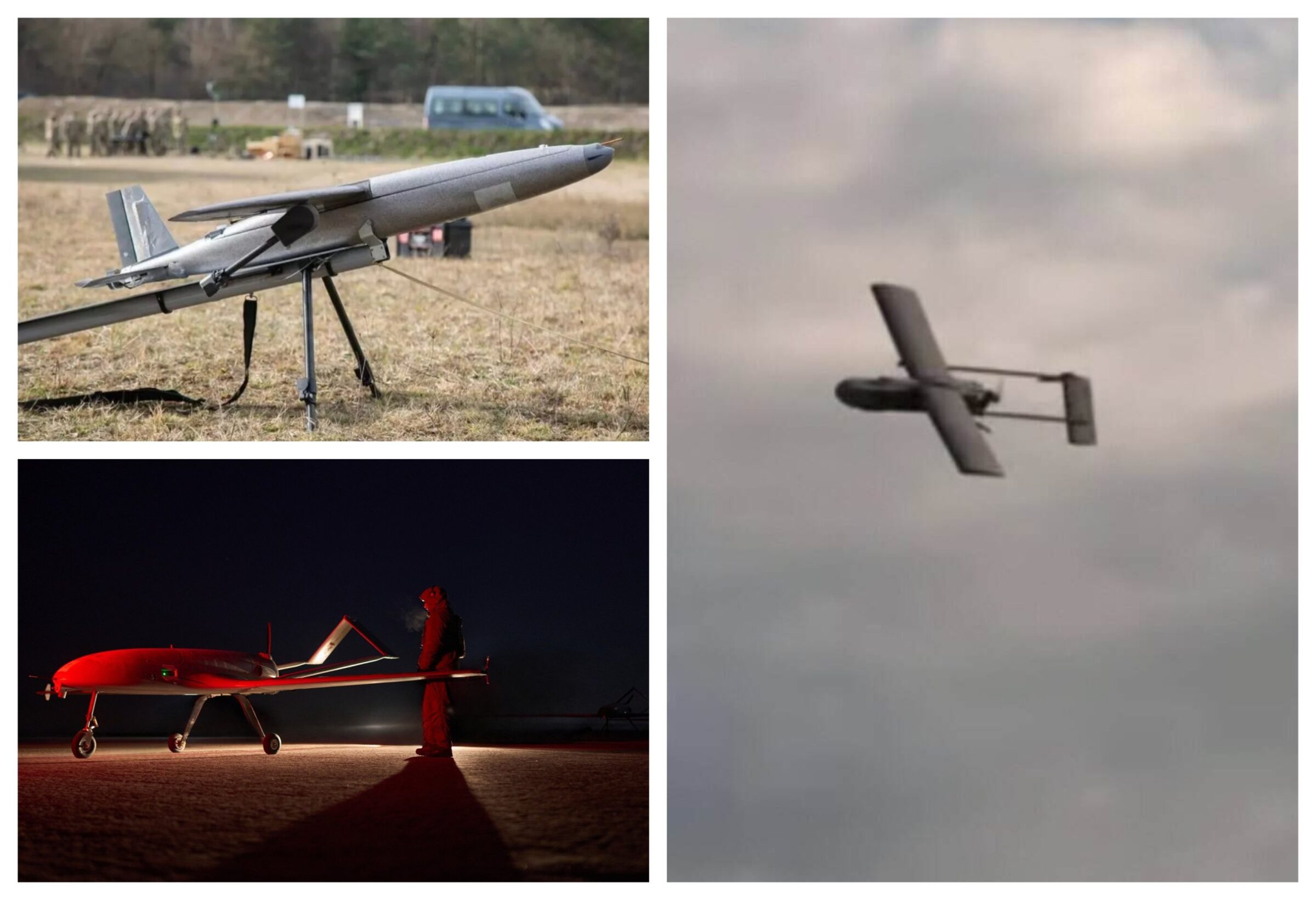
Every day, the Ukraine Battlefield update newsletter offers a clear look at how the war is unfolding on the ground. Subscribe for free here to get the full text delivered to your inbox. The cheap and exceptionally effective FP-1 drone is a proven choice for strikes inside Russia. Ukrainians do not strike at random, but at the most sensitive targets. How are they able to get through Russian air defences so easily? A military expert explains that drone attacks are only the final phase. The Liutyi drone as an example of effective AI-assisted navigation. Where Ukrainians drew inspiration from Russian tactics. When it comes to moving targets in the rear, the Hornet comes into play. Videos of the day: North Korean missiles are killing again; Magyar’s Birds in action. The Russian-Ukrainian drone war entered an entirely new phase this summer. Ukrainians seized the initiative and caught the Kremlin off guard with exceptionally effective attacks on refineries, major Wildberries warehouses in large Russian cities and military logistics in south-eastern Ukraine — attacks it has been unable to counter for several weeks. On Friday (31 July), major fires were reported in Volgograd — at a Lukoil refinery and a Wildberries warehouse — and in Tatarstan, at Wildberries. Ukraine’s offensive campaign has caused Russia’s worst fuel crisis since the collapse of the Soviet Union and forced it to impose a series of restrictions. The Russian government, for example, extended the ban on petrol exports by six months, until 31 January 2027, and the ban on diesel exports until the end of the summer. What had historically been Russia’s advantage — its size — has now proved to be a major weakness. As we discuss in this update with Czech military expert Lukáš Visingr, the successful campaign of summer 2026 rests primarily on three types of drone and, above all, on a sophisticated strategy that has overcome Russian air defences. The cheap and exceptionally effective FP-1 drone. This week’s attack in Ryazan, involving Firepoint’s FP-1 kamikaze drone, is a textbook example. The company itself claimed responsibility for the mass drone attack on both the refinery and the Wildberries warehouse. Footage released by the company shows the specific type of drone, whose design somewhat resembles an aircraft. It is a relatively small and very cheap drone, weighing between 60 and 120 kg, with an estimated price of around $55,000 — a negligible sum compared with the damage it inflicts on Russia. This is what the burning Wildberries warehouse looked like in a city around 900 km from the Ukrainian border. “FP-1 uses an aerodynamic configuration that is fairly common among unmanned aircraft — it has a fuselage pod and two tail booms connected by a horizontal stabiliser. The well-known Turkish Bayraktar combat drones, for instance, use a similar basic design,” Visingr said. The Ryazan oil refinery was forced to suspend production as a result of the attacks, which, according to Reuters, could last for as long as two weeks. It is one of the Russian Federation’s largest oil-processing facilities. Ukraine’s aim is for repairs to take as long as possible and for the damage to Russia’s war budget to be as great as possible. Ukrainians do not strike at random, but at the most sensitive targets. An even bolder attack in early July took place as far as 2,500 km from the Ukrainian border, in Omsk. The drones had to cross the Urals and weave their way into Siberia, where they put a huge refinery processing around 10 percent of Russia’s oil out of operation. Here, too, the attackers were highly precise and struck a specific unit — the ELOU-AVT-11 primary oil-processing unit, with an annual processing capacity of 8.4 million tonnes. Gazpromneft-ONPZ in Omsk is Russia’s largest refinery, capable of processing up to 22 million tonnes of oil a year. As the Financial Times explained in its analysis, drone units receive instructions before missions from energy engineers and other experts about which components are essential to a refinery’s operation and which would take the longest to replace. “Engineers and specialists give the drone units instructions to hit ‘these pipes here, or this chimney here in this area, or this part of the equipment connection, or this cabinet, and so on’,” a drone operator told the British newspaper. Their aim is to repeat attacks on critical parts of the facility before they can be repaired, thereby extending the period for which they remain out of operation. “A large part of the equipment used in Russian refineries comes from the West, making it extremely difficult for Russia to replace. While microchips can be smuggled through third countries in a shoebox, a refinery’s fractionation or distillation column cannot be imported that way. China can manufacture some parts, but that takes a year, and installation takes another year. That is also why some Russian refineries have already had to halt operations completely,” Visingr said. For this operation, Ukrainians again deployed the FP-1, but in its upgraded FP-1(ER) Extended Range version, with a range greater than the original 1,600 km. According to Denys Shtilerman, Fire Point’s chief designer and co-owner, this version can reach distances of up to 3,400 km. Air defences were unable to cope with the upgraded Ukrainian drone here either. ❗️🇺🇦Ukrainian modernized kamikaze drone FP-1 maneuvers before approaching the target at the 🇷🇺Omsk Oil Refinery pic.twitter.com/6wxQAFAD5T— 🪖MilitaryNewsUA🇺🇦 (@front_ukrainian) July 6, 2026 How are they able to get through Russian air defences so easily? It is highly likely that, because of evasive manoeuvres, the FP-1 attack drones actually flew farther than the 2,500 km mentioned on their way to Omsk. As Visingr explained, Russia’s vast size is now becoming a curse. “Russia simply cannot cover 100 percent of its territory with air-defence systems. This creates gaps and blind spots in coverage through which drones can weave their way,” Visingr said, noting that relatively little attention is paid to this phenomenon. Launching the drones themselves is only the very final step. “It is preceded by extensive planning and intelligence work. Every such strike is based on detailed intelligence. Ukrainians do not obtain it only themselves; they also receive it from Western partners. Western reconnaissance aircraft and satellites can track the positions of Russian air defences in real time,” Visingr said. According to the Financial Times, particularly useful is the intelligence Ukrainians receive from US and French intelligence services. It is used to plan routes for drones that successfully penetrate deep into Russian territory. According to Visingr, it is a mistake to draw a circle in one’s mind around a Russian air-defence system representing its maximum range and assume that nothing can enter that space. “But range circles are not force fields. The fact that an S-300 system has a stated range of, for example, 75 km does not mean that nothing can get close to it. That might apply on a completely flat surface such as a desert. In the real world, however, terrain, low flight altitude and signal interference play a major role,” the weapons expert said. Visingr said much was made of the shortage of missiles for Western systems in Ukraine, but few people asked how many missiles for S-300 and S-400 systems Russia had left. “They cannot expend them without limit either. If Ukrainians send 10 drones, Russians shoot down nine, but the tenth sets a refinery on fire, that is a major victory for Ukraine,” he said. Here comes another trick, this time copied by Ukrainians from the Russians. According to Visingr, they also use ultralight sport aircraft converted into drones in their attacks, such as the Foxbat and Ninja types. “This makes it difficult for Russians to determine whether it is a legitimate civilian aircraft or a Ukrainian drone. They have also learned to send massive waves — in some attacks on Moscow, hundreds of drones flew at the same time. A large proportion were decoys without explosives, equipped only with radar reflectors. These appear as larger targets on radar screens, effectively drawing the attention of air defences,” Visingr explained. Russia has long used this tactic of exhausting Ukrainian air defences with Shahed drones and cheap decoys while terrorising Ukrainian cities. Liutyi and artificial intelligence in the leading role. Another textbook example is the repeated attacks on the refinery in the Black Sea port of Tuapse. In general, Ukrainians use a wide range of different types of drone in their attacks, although only fragmentary information is often available. The attacks on Tuapse must have been particularly painful for the Kremlin. Vladimir Putin surely remembers visiting the port in 2013 to open what was then the most powerful oil-processing unit. “Thirteen years later, this facility has become a symbol of a different kind of technological progress: Ukraine’s ability to strike accurately deep inside Russia and inflict lasting damage on its energy infrastructure,” the British daily wrote. However, the Tuapse case is of interest to us for different reasons. Since the start of Russia’s full-scale war, Ukrainians have struck this port at least nine times, deploying, among other weapons, naval drones. Kyrylo Budanov, the former head of Ukraine’s HUR military intelligence agency, said that a combination of Bober and Liutyi aerial drones had been used there. It is drones such as the Liutyi (An-196) that use artificial intelligence highly effectively for navigation resistant to jamming. “Before launch, experts feed the autonomous system with visual data and photographs of a specific refinery. Once the drone arrives at the site, it circles the target, compares the image captured by its optical sensors with the data stored in its memory, and artificial intelligence itself decides on a precise strike against the distillation column. It works reliably even when the drone is not connected to the Starlink satellite system,” Visingr explained. Ukrainians also appear to have deployed them in attacks on major petrochemical plants in Ufa. Liutyi has two meanings in Ukrainian: furious and February. It is the month in which Russia launched its full-scale invasion of Ukraine in 2022. This drone has a range of around 2,000 km and carries a warhead weighing between 50 and 75 kg. It is an older type than the FP-1, developed in response to Iranian Shahed drones, later manufactured in Russia as Gerans. State-owned arms companies such as Antonov ASTC and Ukroboronprom are behind its development. Weighing up to 300 kg, it is much heavier than the FP-1, and also differs in that it takes off like a small aircraft from a runway, whereas the FP-1 is launched from a launcher. The third major difference is the price — it is estimated at $200,000, four times as much. Where Ukrainians drew inspiration from Russian tactics. According to Visingr, using drones such as the UJ-26 Bober mentioned by Budanov makes sense. “Ukrainians now use dozens of different types of drones and, throughout the campaign, combine cruise missiles with various types of unmanned systems.”
FP-1, Liutyi, Hornet: The drones behind Russia’s new fuel crisis (Ukraine Battlefield update, Day 1,619)
Full Article
Original Source
Read the full article at Euobserver →KhanList aggregates and links to publicly available news content. We do not host full articles from third-party sources. Always verify important information with original sources.