
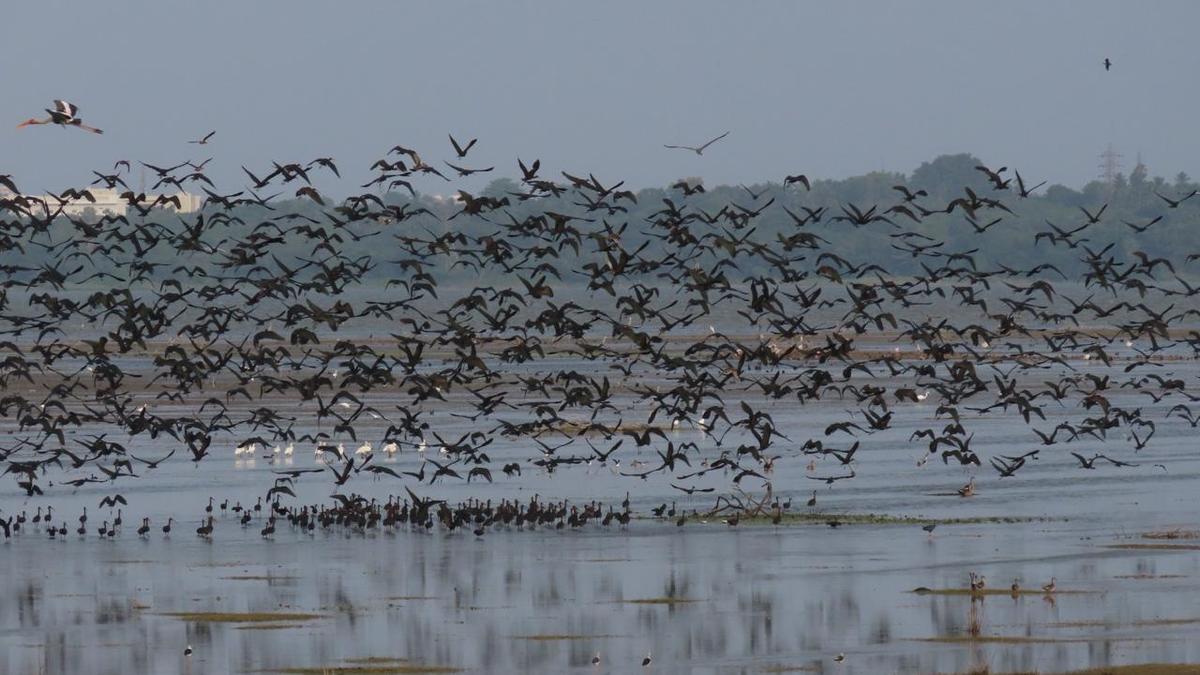
The fourth edition of the ‘Puducherry Bird Atlas’, a bird-mapping exercise in and around the Puducherry-Villupuram-Auroville-Cuddalore (PVAC) bioregion, concluded recently, with over 43,000 birds belonging to 158 bird species recorded during the survey.Organised by Svarnim, a unit of the Sri Aurobindo Society, Puducherry, it brought together 54 participants, including experienced birdwatchers from across India, local school and college students, and community volunteers. The teams covered 68 survey grids and submitted 300 standardised checklists through the eBird platform.The exercise followed three previous rounds held in December 2025, March 2026, and June 2026. Together, the four surveys are intended to provide a seasonal picture of bird distribution and relative abundance, establishing a baseline for monitoring changes in subsequent years. As many as 124 species were recorded during the third season.Also view: A brief guide to bird-watching spots and species in IndiaAccording to Ankush Nirmalkar, coordinator of the Puducherry Bird Atlas, “The atlas follows a grid-based method in which a fixed set of survey areas is revisited during each seasonal round. The September exercise covered the PVAC bioregion, recognising that connected bird habitats, particularly the wetland landscapes around the Oussudu and Bahour lakes, extend beyond administrative boundaries.”The participants submitted their records through eBird, using a shared trip identifier for the survey. In addition to the 158 species identified, participants recorded 23 unresolved taxonomic categories, including birds identified only to a broader group or logged under combinations of possible species. These were reported separately from the confirmed species total, he said. A Pied Avocet sighted during the fourth season of the Puducherry Bird Atlas. | Photo Credit: Special Arrangement Two European Rollers were among the survey’s most noteworthy records. “The European Roller is the only member of the roller family that breeds in Europe, with a range extending into the Middle East, Central Asia, and as far as Kashmir. The species is a passage migrant through the Indian subcontinent, travelling to its wintering grounds in Africa, rather than a regular winter visitor to the region,” Ankush said.Other notable records included sightings of the Lesser Frigatebird, Red-necked Phalarope, Black-breasted Weaver, Great Knots, and Temminck’s Stint. Observers also recorded a Barred Buttonquail, a Ruddy-breasted Crake and an Indian Nightjar.Wetlands support a diverse bird assemblageWetland-associated birds formed a substantial component of the survey’s species list. Records included Fulvous and Lesser Whistling-Ducks, Garganey, Northern Shoveler, Indian Spot-billed Duck, Eurasian Moorhen, Eurasian Coot, Gray-headed Swamphen, and White-breasted Waterhen.The survey also recorded shorebirds, larger waterbirds, and raptors. This diversity highlights the importance of wetlands, mudflats, shallow waterbodies, and coastal habitats within the atlas area.The survey checklists contained an aggregate count of 43,346 birds, comprising 43,130 entries assigned to confirmed species and 216 assigned to unresolved categories. A European Roller sighted during the fourth season of the Puducherry Bird Atlas. | Photo Credit: Special Arrangement Conservation recommendations planned“We plan to combine the four seasonal datasets in a year-one synthesis report examining changes in species composition, relative abundance, and migration timing. The assessment is also expected to set out conservation recommendations for important bird habitats, including the Oussudu and Bahour wetland systems, while considering the communities whose livelihoods and well-being are linked to them,” T.P. Raghunath of Svarnim said.“We plan to repeat the same grid-based, four-season protocol in subsequent years. The completed first cycle would serve as the baseline for assessing longer-term changes in bird distribution, abundance, and seasonal occurrence across the PVAC region,” he added.
Fourth edition of Puducherry Bird Atlas records 43,000 birds, 158 species
Full Article
Original Source
Read the full article at Thehindu →KhanList aggregates and links to publicly available news content. We do not host full articles from third-party sources. Always verify important information with original sources.